

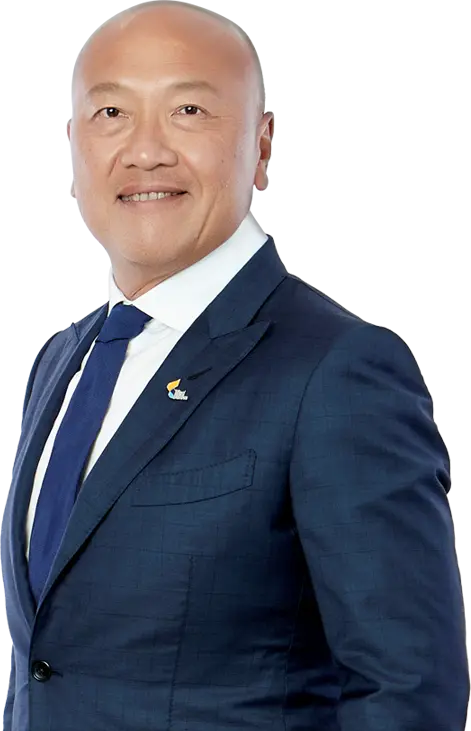
Thiraphong leads drive for sustainable seafood
Thai Union Group Plc has established itself as a global leader in corporate sustainability, turning complex global seafood supply chains into a model for environmental, social and governance (ESG) excellence.
Leading this industry transformation is president and chief executive Thiraphong Chansiri, who has been dedicated to responsible production for a decade.
Thai Union’s sustainability journey reflects the company’s evolving corporate mindset. In the past, business priorities typically focused on manufacturing quality products, operating efficiently, satisfying customer demand and pursuing growth.
There was a time when the ocean was viewed as limitless, too vast to run out of fish, too large to fill with plastic and immune to industrial impact.
However, as Thai Union expanded globally, Mr Thiraphong realised a fundamental truth: growth, revenue, brand and global reach are meaningless if ocean ecosystems become unhealthy, marine resources are depleted or supply chain workers are not treated safely and fairly.
A turning point for Thai Union occurred 10 years ago when environmental activists protested outside its headquarters. Identifying Thai Union as one of the world's largest seafood companies, demonstrators emphasised that the organisation could not detach itself from environmental and human rights challenges connected to the global seafood industry.
This moment forced the company to rethink worker protection across its supply chain and protect the health of the fisheries on which its business depends.
Navigating this transformation required adaptability, particularly in the absence of a blueprint for restructuring a global seafood enterprise. Thai Union experimented with various strategies, learning from successes and setbacks while partnering with fisheries, governments, scientists, customers, non-government organisations and competitors.
Instead of using its scale simply to source more fish, the company began leveraging its market position to improve how fish are caught and managed globally.
A pillar of this effort is the SeaChange 2030 strategy, launched in 2023 as an ESG operational framework. SeaChange 2030 establishes 11 interconnected commitments covering climate action, greenhouse gas emissions, responsible sourcing, waste management, resource efficiency, ecosystem protection and fair labour practices across the value chain.
These targets create shared accountability across global operations, ensuring sustainability is consistently integrated into decision-making, risk management and performance monitoring.
Among its key environmental targets, Thai Union is committed to cutting Scope 1 and Scope 2 greenhouse gas emissions by 42% by 2030 from a 2021 baseline, while also aiming to achieve net-zero emissions across its entire value chain by 2050.
Furthermore, under its Responsible Wild-Caught Seafood commitment, 99.9% of the company's total tuna procurement is now sourced through verified sustainability pathways.
Mr Thiraphong views sustainability as essential to preserving natural resources for future generations. While coordinating external supply chain logistics brings technological challenges, Thai Union remains dedicated to fostering better traceability, stronger standards and deeper partnerships.
Through visionary leadership and action, Thai Union is proving that industrial change is possible, helping ensure future generations inherit healthy oceans, thriving aquaculture communities and a sustainable seafood industry.
His legacy is defined not only by market size, revenue or global reach, but by what he chose to accomplish: helping move sustainable seafood into the mainstream.
Mr Thiraphong was recognised as the Bangkok Post’s CEO of the Year 2026 for Sustainability and Business Impact.
Back to top