

Moving up the value chain
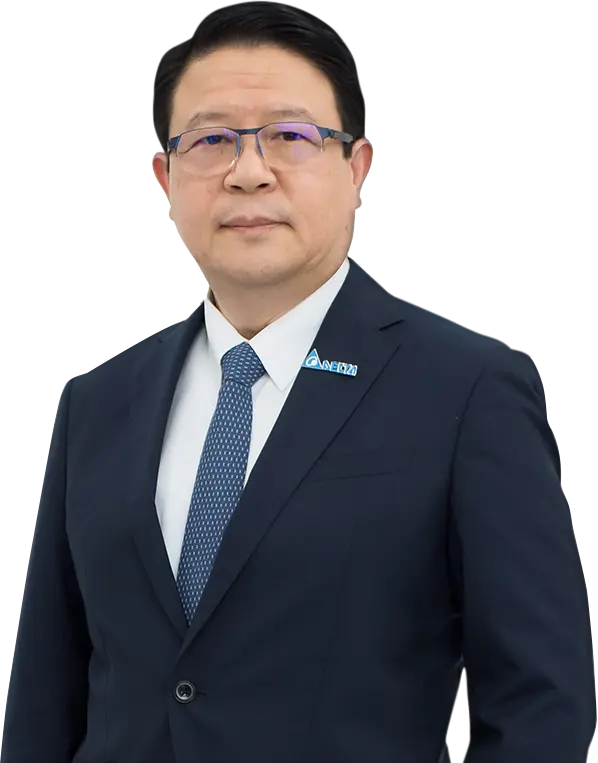
Chief executive Victor Cheng has been steering Delta Electronics (Thailand) beyond its traditional role as a manufacturing base to become a regional hub for advanced technology, R&D and artificial intelligence (AI) infrastructure.
The transformation reflects a shift in priorities for the Thai operation, which is seeking to move up the value chain by developing greater engineering capabilities, expanding high-end manufacturing and building solutions tailored to Southeast Asian markets.
For Mr Cheng, the goal is not simply to produce more products in Thailand, but to enable the local operation to contribute more directly to product design, technology development and the group's long-term growth.
“Delta Thailand should not remain merely a manufacturing centre; it must become the driving force behind the next phase of the group's growth,” he said in an interview published on the company's website.
SMART MANUFACTURING
Manufacturers across Southeast Asia are facing demographic challenges, including declining populations and ageing workforces. Mr Cheng predicts Thailand will encounter the same labour constraints already experienced in Taiwan, South Korea, Japan and China.
As the availability of production-line workers tightens, machines and automated systems will need to take over more repetitive tasks.
Delta Thailand is moving towards a higher degree of factory automation, using digital technologies, machine learning and AI-enabled systems to improve production efficiency and address labour shortages.
The company's manufacturing footprint is expanding as well. Delta's Bangpoo and Wellgrow operations are part of a development plan under which the total number of plants is expected to reach 12 by the end of 2026, with the facilities being upgraded into data-centric smart manufacturing campuses.
The changes are intended to do more than increase capacity. They are designed to enable the Thai operation to handle increasingly complex, precise and technologically demanding production, while improving coordination across the group's business units.
Mr Cheng sees automation as a necessary response to structural changes in the labour market and a foundation for developing more sophisticated manufacturing capabilities.
AI BOOM
The global expansion of AI has provided another opportunity to accelerate the transformation.
The growing demand for AI computing is increasing the need for high-efficiency power supplies, advanced cooling systems and other equipment required to support data centres and information and communications technology infrastructure.
Delta Thailand is expanding its role in these areas, including the manufacture of liquid-cooling solutions for AI data centres and ICT-related equipment.
This move places the company closer to the technology requirements of next-generation computing infrastructure, where power efficiency and thermal management are increasingly important as computing workloads become more demanding.
He believes Thailand's ability to capture the benefits of AI will depend on more than attracting investment in data centres or expanding production capacity.
Reliable electricity and effective energy management are also essential. Delta is promoting solutions such as microgrids, battery energy storage systems, on-site solar power and smart energy management to help businesses address power constraints while supporting sustainability goals.
These technologies create opportunities for Delta to extend its role beyond equipment manufacturing into integrated solutions for industrial customers and data centre operators.
REGIONAL ENGINE
Mr Cheng's strategy aims at expanding Delta Thailand's role in regional markets.
The company has increased its focus on solution-based businesses across Southeast Asia and Australia, covering data centres, industrial automation and renewable energy.
Rather than simply replicating business models that have succeeded elsewhere, he wants the Thai operation to develop offerings that reflect the needs and competitive advantages of individual markets.
“Southeast Asia consists of multiple countries, each with its own culture and conditions,” he said. “What we should do is not simply replicate Delta's successful power business model, but deeply understand local markets and uncover the unique competitive advantages of each country.”
The approach draws on Delta Thailand's longstanding experience as an original design manufacturer and the product-development knowledge it has accumulated through serving major customers
The company aims to combine these capabilities with technologies and resources from across the group under its “One Delta” approach.
The decision to concentrate electric vehicle-related production in Thailand, rather than disperse it across multiple regions amid geopolitical uncertainty, has also reinforced the country's role within the group. Revenue from the EV-related business had surpassed US$1 billion.
That strategy illustrates how Thailand can serve as a strategic production base even as the company broadens its activities into higher-value areas.
SUSTAINABLE GROWTH
Despite the expansion, Mr Cheng has emphasised sustainable growth rather than scale alone.
“Even though Delta is not the biggest company, my hope is that we will bring Delta Thailand up to be a best-in-class company in our segment,” he said. “I want Delta to be financially successful and sustainable in terms of consistent growth at a healthy pace.”
His agenda involves improving factory productivity, developing local engineering talent, expanding high-end manufacturing and increasing the contribution of Thai operations to the group's technology and regional business strategies. The transition requires sustained investment in people, research and infrastructure.
For Delta Thailand, the measure of success will increasingly be whether it can develop and commercialise more of its own solutions, rather than relying primarily on its ability to manufacture products designed elsewhere.
Under Mr Cheng's leadership, Thailand is being positioned not just as a place to make technology products, but as a source of engineering expertise, advanced manufacturing capabilities and solutions for a region undergoing rapid digital and energy transformation.
Back to top