


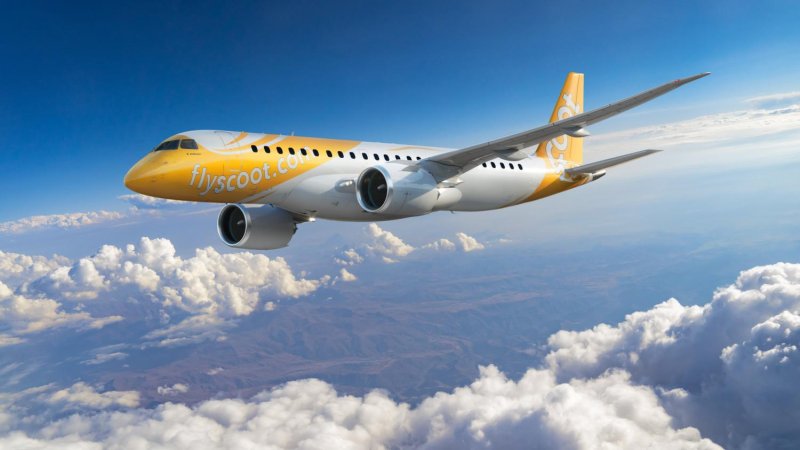
Scoot, the low-cost subsidiary of Singapore Airlines, continues to register strong air travel demand from regions unaffected by the Gulf war across seven destinations in Thailand and plans to expand into secondary regional cities, supported by the delivery of nine Embraer E190‑E2 aircraft.
Lee Yong Sin, vice-president for pricing, ancillaries and sales at Scoot, said inbound passenger numbers on routes to Thailand, served by more than 120 weekly flights, rose 15% in the fiscal year ending March 2026.
He said outbound demand from Thailand also grew by 10% over the past 12 months.
Scoot is monitoring the war in the Middle East, with only the Jeddah route suspended until April 16 due to safety concerns.
Mr Lee said there has been no significant impact on overall demand or forward bookings from unaffected regions, such as Southeast Asia, North Asia and Australia, although fares have been partially adjusted to reflect rising fuel costs.
He said Scoot adopted the same fuel hedging policy as its parent, Singapore Airlines, with coverage of roughly 47% between January and March.
Regarding Songkran bookings this month, Mr Lee said the airline expects average load factors in the high‑80% to low‑90% range, as booking windows have shortened to 1-2 weeks before the holiday.
"Bookings remain strong and we are cautiously optimistic. However, we must remain price‑com- petitive with other low‑cost carriers and adjust according to demand," he said.
Scoot operates a fleet of 60 aircraft across three types: Boeing 787 wide‑bodies, Airbus A320 narrow‑bodies and Embraer E190‑E2 jets, which seat 112 passengers.
Mr Lee said the E190‑E2 enables the airline to serve second or third-tier cities with capacity better matched to demand, including its latest direct route from Singapore to Chiang Rai, launched on Jan 1 with five weekly flights, as well as fitting airports with short runways such as Samui.
The airline wants to maintain its focus on Southeast Asia, where it serves seven destinations in Thailand, 15 in Indonesia, 12 in Malaysia and five in the Philippines.
Immediate expansion of long‑haul European routes is unlikely, as its 24 wide‑body aircraft are fully deployed, he said. Before the war, load factors to Vienna and Athens were already around 90%, and while demand has increased, high utilisation limits capacity growth.
Any expansion of the wide‑body fleet would depend on additional acquisitions by Singapore Airlines Group, Mr Lee said.
Aircraft supply remains constrained, with delivery timelines of up to five years, he noted.
In Thailand, Scoot's customers are mainly aged 25 to 45 and tech‑savvy, with 50% of bookings made through the airline's website or mobile app, said Mr Lee.
