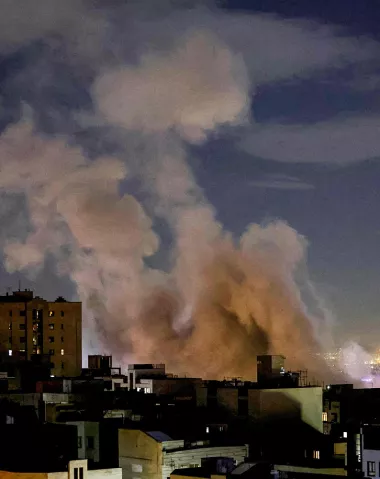
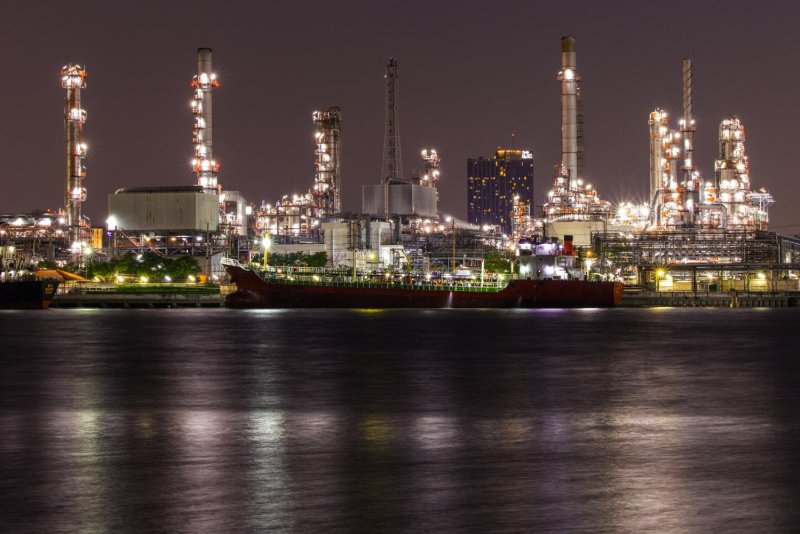
With the US-Israel battle against Iran entering its sixth week, the global economy continues to feel the effects stemming from the closure of a key oil shipping route, the Strait of Hormuz.
Production costs are poised to rise further due to constraints in procuring certain materials. The International Energy Agency warned the energy crisis could persist until late April, which is expected to be the worst period due to a twofold reduction in oil and liquefied natural gas supplies.
Even if the US chose to end the war within the next few weeks, the business sector believes surging oil prices would not ease immediately, forcing firms to seek ways to survive and the government to implement targeted policies.
AVOID DIRECT INVOLVEMENT
After US President Donald Trump issued more threats to Iran on Wednesday, Kobsak Pootrakool, senior executive vice-president and chief economist at Bangkok Bank (BBL), said the war must continue to be monitored.
He said Thailand should avoid becoming involved in the war or it could face direct repercussions from military operations, similar to those experienced by several countries in the Middle East.
Mr Kobsak suggested the Thai government prioritise three pivotal areas in preparing for potential future crises.
First, Thailand should reduce its dependence on the US by gradually lowering exports to the nation from 20% of total volume to 15%, and eventually 10%.
Moreover, the government should strengthen the domestic economy, turning the crisis into an opportunity, he noted. Low interest rates and baht depreciation benefit the export, tourism and agricultural sectors.
As a result of the conflict and growing security concerns in the Middle East, people in the region may seek to relocate to safer areas, with Thailand emerging as a key destination, said Mr Kobsak.
This presents an opportunity for Thailand to attract high-potential businesses, foreign direct investment, tourists and startups, he said.
Arthid Nanthawithaya, chief executive at SCB X, the financial technology conglomerate and holding company of Siam Commercial Bank, said the government should use the country's limited resources and budget to build buffers and resilience in preparation for future crises, rather than focusing solely on short-term solutions.
If the government uses its resources to strengthen the country's competitiveness, it would improve the resilience of both the public and private sectors in dealing with uncertainty and external shocks, he noted.
Thailand's competitiveness across both sectors has deteriorated given the country's structural problems, said Mr Arthid.
He said he anticipates government measures to address the war's impact as it evolves, building on existing measures. Targeted measures are reasonable to assist those affected by the war, rather than blanket measures because of the uneven impact across households and businesses.
Mr Arthid also called on the government to prioritise long-term investment and structural reform, warning against the overuse of limited fiscal resources for short-term fixes.
"We should not be afraid of running a budget deficit or taking on debt if the borrowing is used to invest in the country's future," he noted.
"What is more concerning is using the limited resources solely for short-term problem-solving."
The new administration holds a significant advantage in terms of political stability and strong support, which Mr Arthid described as a critical window of opportunity to advance key economic policies.
Looking ahead, the government should identify targeted sectors to support Thai economic growth in the changing global economic landscape, he said.
The new S-curve growth strategy should focus primarily on smart agriculture, food processing, tourism and wellness, and electric vehicles, said Mr Arthid.
PRIVATE SECTOR ADAPTABILITY
Dhanakorn Kasetrsuwan, chairman of the Thai National Shippers' Council (TNSC), said the Middle East conflict is a major structural risk that is disrupting global trade and affecting Thai exports.
"Thailand is somewhat prepared due to our private sector's flexibility, but we need clearer, more unified government support," he said.
Thailand's logistics sector has become more agile after weathering past crises, such as the pandemic and spikes in shipping costs.
However, there are still weak spots, such as an overreliance on a handful of shipping routes, unpredictable freight and insurance costs, and the lack of a comprehensive national logistics backup plan, said Mr Dhanakorn.
Since the war began, exporters have tried to avoid the Red Sea, adding 10-20 days to shipping times and increasing costs by 20-40%.
Exporters are also diversifying, becoming less dependent on certain markets and expanding into India, other Asian countries, and Southeast Asia.
Other strategies include increasing buffer stocks, adjusting production plans, renegotiating shipping terms, and using International Commercial Terms to reduce risk.
The TNSC supports logistics pooling and multimodal transport in the medium term. Exporters are encouraged to avoid relying on a single route in the longer term.
To ease the burden on businesses, the council is urging the government to offer targeted support for freight costs and to raise the cap on soft loans for exporters.
In the medium term, the government should establish a logistics stability fund, encourage the use of alternative routes, and pursue international agreements on logistics corridors, noted the TNSC.
In the long term, Mr Dhanakorn said Thailand should aim to become a regional logistics hub, invest in multimodal transport infrastructure, and develop a national supply chain database.
UNCERTAIN OUTLOOK
The Federation of Thai Industries (FTI) is uncertain whether the conflict will end this month and urged additional government measures to address the negative impact if tensions in the Middle East intensify.
"It is difficult to predict when the war will end," said Kriengkrai Thiennukul, acting chairman of the FTI.
If the US manages to withdraw from the conflict, the energy crisis will gradually ease, he said.
However, global oil prices will not suddenly drop even if the three countries agree to halt military attacks and turn to negotiations, noted Mr Kriengkrai.
"I think oil prices will take time to return to pre-war levels," he said.
"That means Thais will continue to live with high fuel prices."
Given this prospect, Mr Kriengkrai urged the government to devise additional measures to address the impact of high fuel prices, which may rise further if the conflict escalates.
The FTI and the Joint Standing Committee on Commerce, Industry and Banking (JSCCIB) agree the government should identify the most vulnerable groups in need of support.
"We need a targeted policy to address the problems faced by certain groups," he said.
For example, Mr Kriengkrai wants the government to implement measures to reduce transport costs for entrepreneurs so they can maintain the prices of goods and services.
The new government faces a tough task as it has to shore up the economy while remaining cautious about budget spending, he noted.
The JSCCIB warned the Thai economy may be hard hit this year, with GDP growth dipping to 1.2-1.6%, down from the previous projection of 1.6-2%.
Mr Kriengkrai said the Thai economy is being walloped by energy shocks because it depends greatly on oil and gas imports from the Middle East.
"One lesson from the war is we need to reduce our dependence on fossil fuels," he said.
"We need to develop more renewable energy. We have a large amount of sugar cane and tapioca that can be used to produce biofuels."
PROLONGED DISRUPTION
Visit Limlurcha, chairman of the Processed Food and Future Food Committee of the Thai Chamber of Commerce, said the Middle East conflict was initially expected to last just one month, with knock-on effects for about six months.
If the conflict continues for 2-3 months, its economic impact could linger throughout the year, he noted.
"The Middle East market is taking the hardest hit, but other regions are not immune. Demand has dropped and inflation continues to rise," said Mr Visit.
"If the war intensifies, we could even be looking at a global recession."
He encouraged Thai businesses to view this challenging period as an opportunity to embrace alternative energy and switch to eco-friendly packaging.
"Switching from plastic to bioplastic used to be expensive," said Mr Visit. "But with oil prices climbing and traditional plastic now costing more, the gap between the two is narrowing."
He said with government incentives and rising electricity costs, the payback period for installing rooftop solar panels could fall to 3-3.5 years.
This shift means in the long run, businesses and farmers could rely more on their own electricity.
Prateep Tangmatitham, president of SET-listed developer Supalai, said rising oil prices are pushing up costs, but the shift is likely to be temporary.
"We continue to use our existing cost base, but if contractors face higher material costs, we may step in to procure materials directly and absorb the difference, as we happened previously during spikes in steel prices," he said.
These measures ensure timely payments to contractors and maintains project continuity in the same locations, reducing relocation costs and improving operational efficiency, said Mr Prateep.
To manage potential cost increases from oil price volatility, the company aligns construction progress with actual sales to control expenses more effectively.
"If costs continue to rise, gradual price adjustments may be necessary, particularly as most impacts stem from variable costs such as fuel and transport," he said.
Should the conflict persist, Supalai may consider raising prices after Songkran. For now, it is absorbing some cost pressure, with stronger sales expected to help offset rising expenses.
SMES HIT BY RISING COSTS
Rising logistics costs are pressuring small and medium-sized enterprises (SMEs), said Sangchai Theerakulwanich, strategy chairman of the Federation of Thai SMEs.
As these costs climb, SMEs are finding ways to cut expenses, hoping to keep their product prices stable for as long as possible.
As consumer purchasing power declines, if SMEs raise prices they will likely record fewer sales, he said.
Last week, the Finance Ministry announced plans to launch a soft loan scheme totalling 10 billion baht.
"To truly help struggling SMEs, the loan criteria must be flexible," said Mr Sangchai.
He identified three main groups of SMEs that especially need support: those with non-performing loans, those undergoing debt restructuring, and those that already reached their borrowing limits.
The government should allow businesses that already hit their borrowing limits to access the soft loan programme, said Mr Sangchai.
SAFEGUARDS SUFFICIENT
Despite rising geopolitical tensions and energy price pressures, the Stock Exchange of Thailand's (SET) said existing safeguards are sufficient to navigate ongoing volatility without the need for additional intervention.
Asadej Kongsiri, president of the SET, said while escalating conflict has increased global risk and energy costs, current mechanisms such as the market's circuit breaker system remain adequate to stabilise trading conditions.
Thailand's internationally aligned trading infrastructure, including the circuit breaker mechanism, has proven effective in curbing panic selling, he said.
The SET's mechanism was activated only once historically during a Middle East conflict, compared with multiple activations in South Korea during similar periods of stress, noted Mr Asadej.
Thailand also has strong market fundamentals, including high dividend yields and relatively low volatility, which continue to underpin investor confidence.
Year-to-date, the Thai bourse ranks as the second-best performer in Asia, trailing only South Korea, while slightly outperforming Taiwan.
Unlike South Korea, where sharp gains have been accompanied by heightened volatility, the Thai bourse has exhibited more stable price movements, even during the war in the Middle East, he said.
"Thailand continues to stand out for its attractive dividend yield, averaging 4.4-4.5%, among the highest in the region," said Mr Asadej.
"Combined with comparatively lower volatility, this positions Thai equities as a defensive play during periods of global uncertainty."
Valuation metrics also suggest limited downside risk relative to regional peers, reinforcing the market's appeal to long-term investors seeking both income and stability, he noted.
Listed companies may still face headwinds from rising energy costs and potential disruptions in global supply chains, which could increase operating expenses or delay production cycles.
"Thailand's equity market remains among Asia's top performers this year, supported by low volatility and high dividend yields, making it stand out amid global uncertainty," said Mr Asadej.
"We believe foreign investors will return once conditions stabilise."
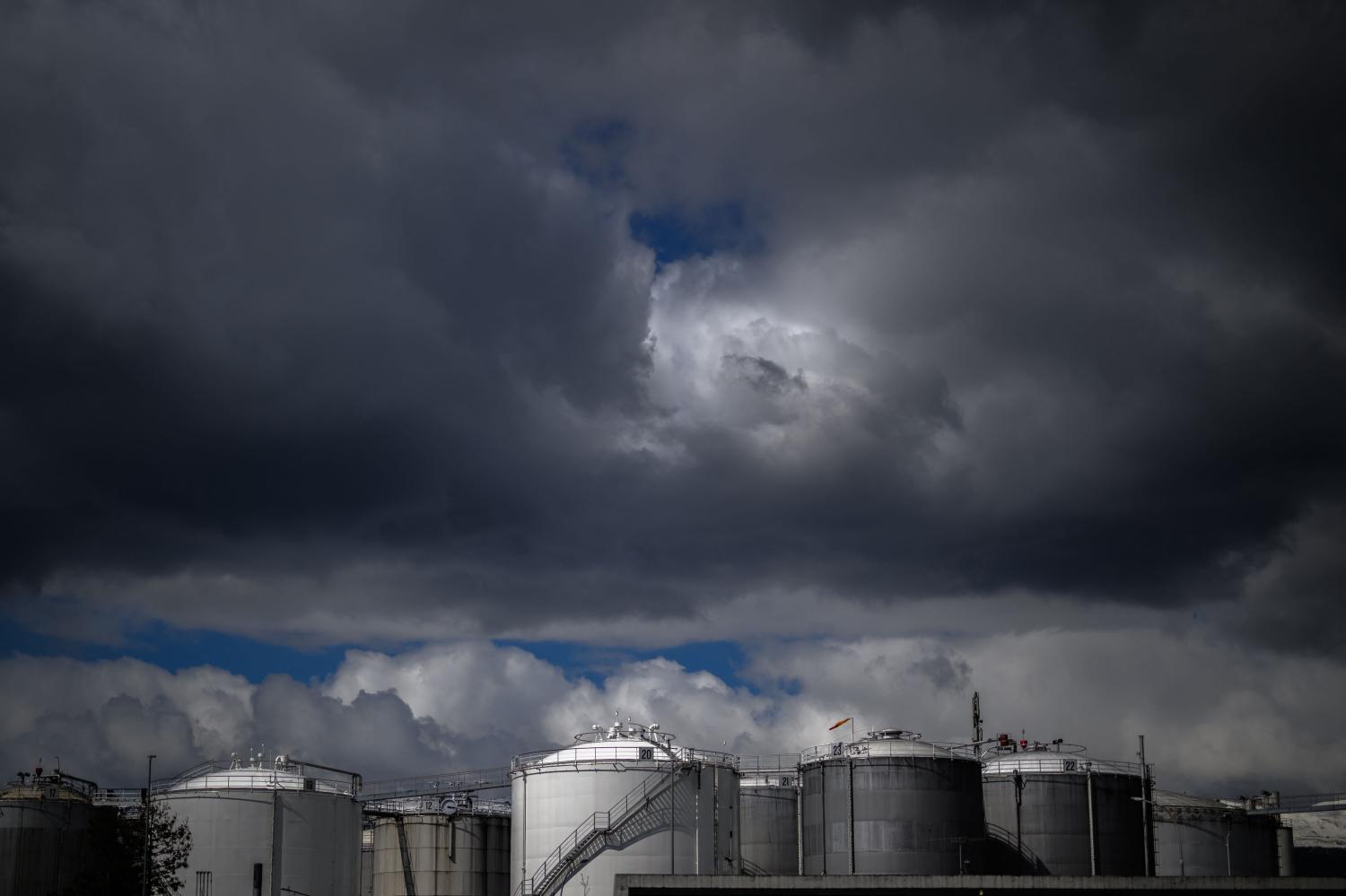
Gasoline and fuel storage tanks under heavy clouds in Vernier, near Geneva. The US-Israeli war with Iran has spread across the Gulf and beyond, disrupting global energy markets and trade. AFP
Additional reports by Kanana Katharangsiporn, Nuntawun Polkuamdee and Kuakul Mornkum