


Consumer confidence in April plunged into crisis territory, recording the sharpest monthly decline globally and across the Asia-Pacific region as economic uncertainty, geopolitical tensions, rising living costs, and dissatisfaction with government efforts to address the economy eroded public sentiment, according to the Ipsos Global Consumer Confidence Index.
The findings suggest cautious consumer sentiment is likely to persist through to the end of the year.
"For the first time, this survey shows that Thai consumer confidence has fallen to its lowest level in the four years since the survey began," said Pimtai Suwannasuk, senior client manager at Ipsos Ltd.
The index found that Thailand's overall National Index fell to 45.5, a decrease of 10.9 points -- the largest decline in the world over the past month and the country's second-worst decline since the Covid-19 shock of 2020.
"We saw at the end of last year that consumer sentiment was quite positive due to the 'Half-Half' scheme and the upcoming election. However, in April, confidence went down because consumers could not see any tangible policies to tackle our economic challenges," Ms Pimtai said.
The index found that 71% of Thais describe the current economic situation as "bad", an increase of 17 percentage points within a single month, reflecting rapidly intensifying anxiety.
Over half of Thais hesitate to spend money on both big-ticket items and household goods, while another 49% state that they could not live without a private car.
Some 66% of Thai consumers report spending less, and with greater caution, 49% reported buying more products on sale, while 47% are taking more time to decide on new purchases.
Almost 49% remain concerned about job security, while 56% said they are less confident about future investments, retirement savings, and their children's education.
Meanwhile, concerns regarding international conflicts remain high among Thais, ranking within the top 10 globally.
Only 36% expect their financial situation to be stronger in the next six months, down from 50% in March.
Even higher-income households are, for the first time, becoming significantly less comfortable with spending, more so than middle- and low-income groups.
"Those in higher-income groups may have a longer-term view that the economy is worsening," said Ms Pimtai.
TOP CONCERNS
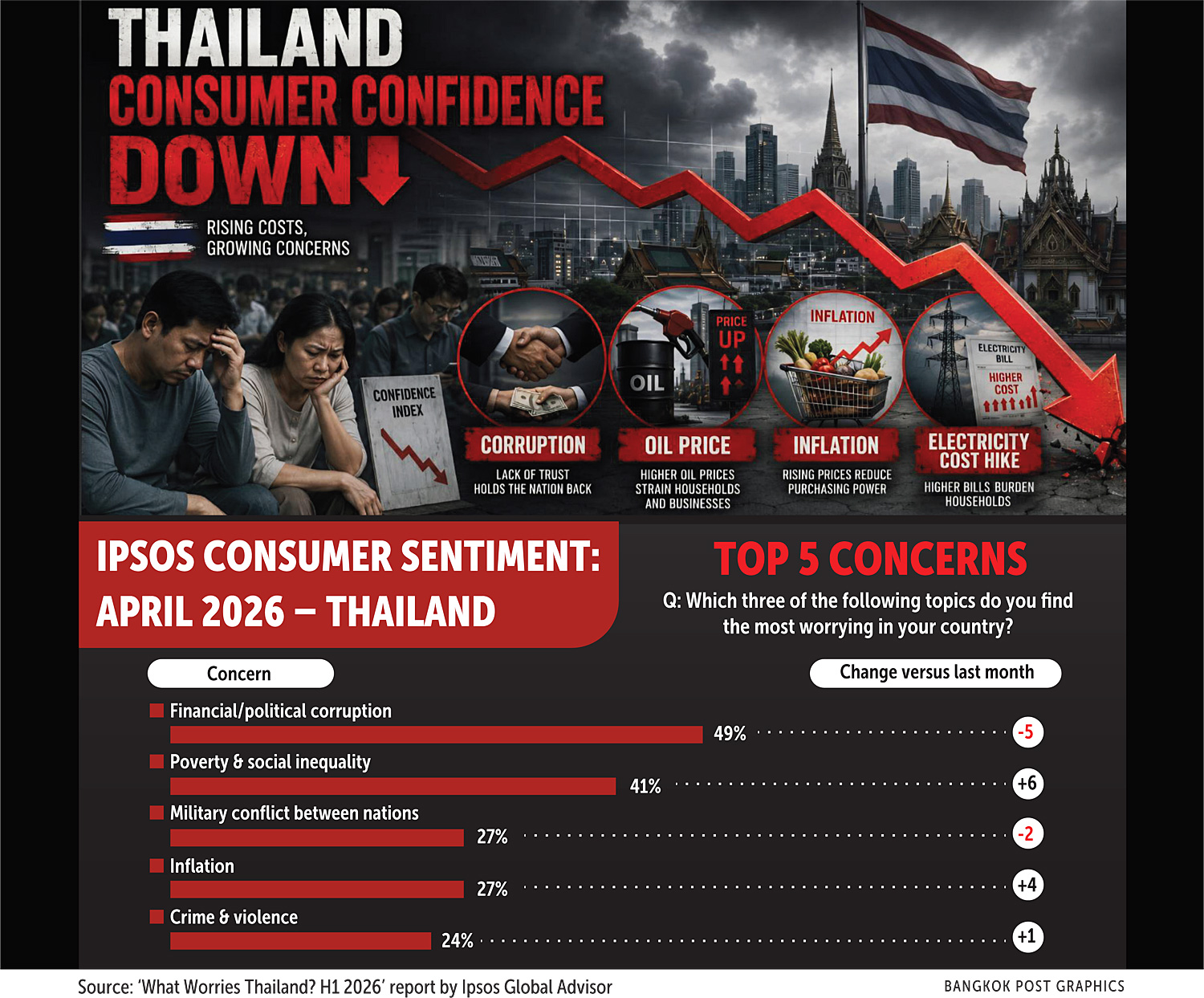
Regarding Thailand's top concerns, nearly half of Thais (49%) identified corruption as their biggest worry, while more than half felt the country was heading in the wrong direction, according to the Ipsos report entitled: What Worries Thailand? H1 2026.
The report is a curation of data drawn from four comprehensive, multi-country Ipsos Global Advisor online surveys conducted between between Nov 21, 2025, and April 3, 2026. The analysis integrates findings from Ipsos Mobility Survey, What Worries the World (April 2026), Ipsos Global Consumer Confidence Index (April 2026), and Attitudes to the Iran Conflict
The Thailand survey involved 500 respondents aged 20-74.
Inflation has also re-entered the top five concerns, alongside poverty, international conflict, and crime.
The latest data reveals significant shifts, particularly the impact of conflicts in the Middle East, which have affected the cost of living, energy prices, and consumer confidence worldwide.
"Thai consumers have entered a period of emotional and financial caution, driven by economic uncertainty, geopolitical instability, and declining optimism about the future. This is changing how they spend, save, plan and evaluate brands."
According to What Worries Thailand? H1 2026 report, 33% of Thais expect tensions between the US and Iran to last until the end of the year, while another 25% believe the situation will last even longer, driving fears of rising energy prices and living costs.
According to Ipsos Mobility Report, 60% of the respondents view electric vehicles (EVs) as a highly attractive option -- a significantly higher proportion than in North American or European markets.
Ipsos suggested that brands need to position value, affordability, reliability and emotional reassurance as the new "brand currency", as consumers increasingly prioritise essential spending and delay discretionary purchases.
"Brands in particular in the highly competitive sector need to maintain prices rather than increase them as consumers will find alternative lower price brands. Buyers need empathy during this challenging time," Ms Pimthai said. "This time, even luxury brands are struggling."
Second, companies should treat sustainability as a practical solution for affordability and resilience, amid accelerating adoption of EVs, renewable energy, and energy-saving behaviours.
Third, businesses must strengthen localised strategies and build more resilient supply chains.
