


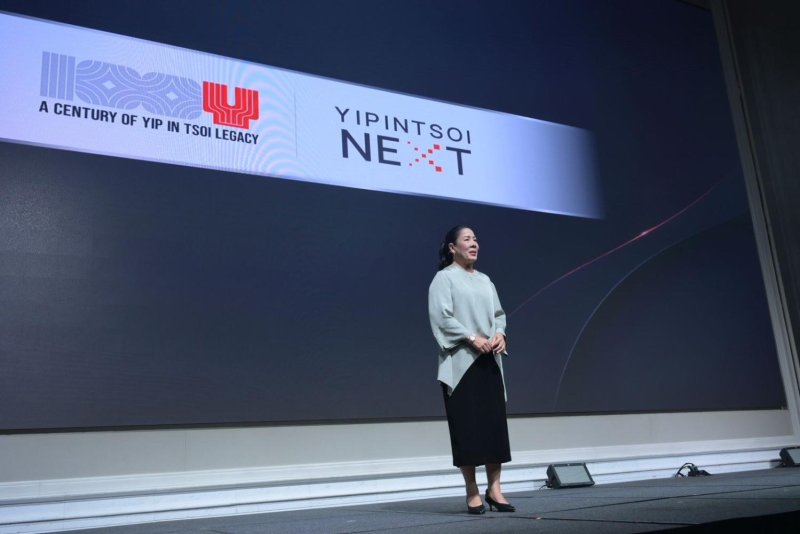
Yip In Tsoi Group, a leading Thai conglomerate, has undertaken its first major organisational restructuring in its century-long history by consolidating its IT business units and technology-related subsidiaries under Yipintsoi Next as it gears up for its next century of growth.
The group plans to list Yipintsoi Next shares on the stock market by 2030.
"The company has transitioned to become a holding company investing in new businesses and startups. To streamline operations and maximise expertise, all IT-related businesses, which previously spanned multiple companies, have been consolidated under a single, powerful umbrella called Yipintsoi Next," said Morakot Yipintsoi, president and chief executive of Yip In Tsoi.
"For more than a century, Yip In Tsoi has successfully navigated opportunities and challenges across every era because we have never stopped evolving and have never been complacent about past successes. This restructure is a redesign of our future, enabling our organisation to grow with greater stability, agility and sustainability over the long term."
Under the new structure, Yip In Tsoi Group expects to operate as a holding company responsible for setting strategic direction, overseeing investments and managing the group's business portfolio.
Yipintsoi Next will serve as the core engine driving the group's digital technology and enterprise solutions businesses on a full-scale basis.
The group plans to focus on three areas, including digital and IT businesses, which account for 60% of total revenue.
The other two businesses are agriculture and alternative energy for agriculture, operated under Yip In Tsoi & Jacks. The group wants to integrate agri-tech, biotechnology and clean energy.
The final pillar targets sustainability and the "silver economy", blending technology seamlessly into daily life, she said.
"By merging four affiliates and the original IT division into Yipintsoi Next, the company is breaking down barriers between its public and private sector teams," said Supak Lailert, chief executive of Yipintsoi Next, allowing them to offer complete solutions to clients and share resources more fluidly.
He said this reduced friction should increase operational capacity and lower costs by roughly 20-25%, enabling the company to create synergies and leverage expertise, particularly from the public sector team, while tapping into a broader range of private-sector industries, expanding beyond banking, finance and energy into manufacturing, education and medical.
"By spinning off and consolidating businesses, the company is separating itself from the parent organisation to gain greater flexibility and agility in adjusting its strategic direction," Mr Supak said.
The company's IT team has more than 1,500 staff covering cloud infrastructure, artificial intelligence (AI) solutions and data analytics, cybersecurity, and the emerging technology-enabled environmental, social and governance domain, such as carbon dioxide tracking data services for SET-listed firms and exporters shipping products to Europe.
He acknowledged this is a challenging period, but IT continues to grow amid the AI transformation trend and business demand for cost optimisation, which requires technology to modernise legacy systems.
Moreover, growing demand for data leakage prevention, AI guardrails and risk diversification amid geopolitical disruption and overdependence on foreign technology vendors is creating new opportunities for local technology providers and increasing demand for tech sovereignty, said Mr Supak.
System integrators are facing challenges as hardware prices increase due to supply shortages and lower margins in cloud computing services, requiring them to provide more customised solutions to customers, he noted.
"We are a highly trusted technology partner that never abandons projects, ensuring completion regardless of the difficulties, which has secured immense trust from both clients and top-tier global technology partners," Mrs Morakot said.
"We aim to respond more quickly to rapidly evolving technology demands. In the next era, relying solely on systems integration businesses will become increasingly difficult. Companies will need to play a greater role as strategic partners and advisors, delivering stronger business outcomes by using technology to address business needs directly."
