


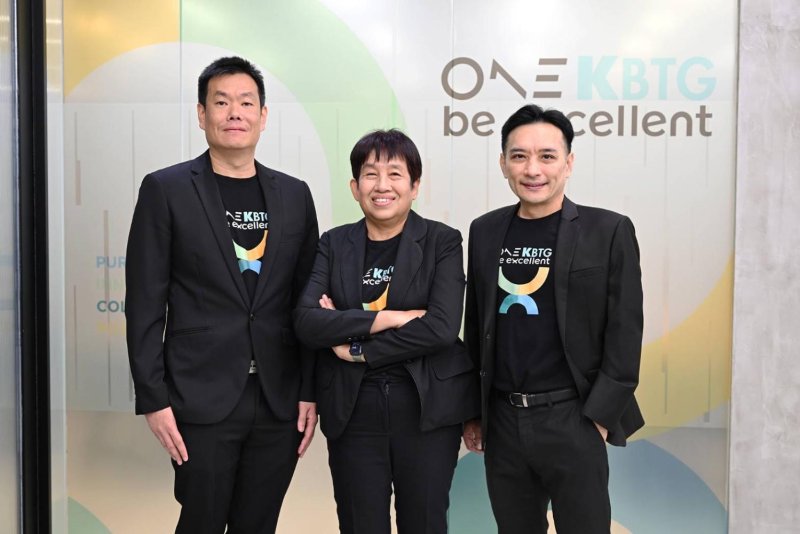
Kasikorn Business-Technology Group (KBTG), the technology arm of Kasikornbank (KBank), is doubling down on its 15-billion-baht investment in technology to accelerate artificial intelligence (AI) transformation, with agentic AI positioned as a driver of operational productivity and banking innovation.
The company's transition to post-quantum cryptography (PQC) by 2029 and greater in-house technology development reflects a strategic effort to reduce vendor dependency and strengthen resilience against geopolitical risks, said Voranuch Dejakaisaya, executive chairman of KBTG.
This year AI is expanding from an experimental stage to a scale and optimisation stage with measurable business outcome impact, she noted.
Technology is in the top three of the group's budget, with annual investment of 15 billion baht, including innovation and operations. Spending is projected to grow 8-10% in 2027-2028, down from double digits in previous years.
Ms Voranuch said KBTG upgraded its core banking systems a few years ago, ensuring it can handle projected transaction volumes until at least 2030.
KBTG is aggressively leveraging AI for the internal development processes by integrating intelligent coding agents and models across every phase of delivery -- from planning and coding to testing and deployment. The company uses AI to analyse old, intertwined code, and reverse engineers it into clear specifications and enterprise architecture documentation, massively accelerating the modernisation process.
The company aims to create systems powered by AI that can foresee potential anomalies and resolve them automatically before they ever result in customer-facing downtime, she said.
The company's strategy relies on three pillars: operational excellence; robust security and productivity; and efficiency in optimising both human capital and technological resources.
KBank handles approximately 25 million mobile banking accounts, which includes a highly active new-generation segment of over 10 million users.
Thadpong Pongthawornkamol, managing director of KBTG, said that in 2026, the company continues its "AI-infused organisation" end-to-end transformation to deliver technology that advances the banking business.
"We continue to be an AI-first organisation that unlocks business and customer impact through AI-powered revenue generation, product innovation, and productivity improvement," he said.
The company is focusing on a shift to in-house technology development, particularly through agentic AI, to reduce reliance on external vendors, increase independence, and mitigate geopolitical risks.
"As AI tools empower internal developers, KBTG no longer needs to rely on outsourcing to access certain skills," Mr Thadpong said.
"We will try more tech sovereignty and build our own capability, including expanding own data centres capacity," said Ms Voranuch.
In 2025, KBTG achieved cost reductions of 8%, or around 300 million baht, but this year its goal is to increase productivity by 15% by using code writing assistants, enhancing credit scoring models, and reducing lending time.
AI also profiles potential victims to reduce fraud. Furthermore, AI can help handle increased operational volumes without increasing headcount.
KBTG now has more than 80 AI use cases under review. Key examples include AI coding assistants to cut costs, which last year saved 240 million baht, and a face recognition system that is used by the company. It also sold this face recognition to 30 other enterprises.
The company is also redesigning workflows so employees can work alongside AI agents, with a target to improve development efficiency by 25% this year.
KBTG is training staff to move from basic AI users to AI builders. It is also building reusable AI platforms to speed up testing, allowing new AI ideas to be tested in as little as one day. Its main AI focus areas are knowledge bots, customer advisory bots, document processing and voice technology.
Chatchawat Asawarakwong, vice-chairman and group chief information security officer at KBTG, said the company allocates 7% of its total IT budget to cybersecurity and will focus on preparedness and the transition to PQC by 2029, one year ahead of the regulatory timeline.
"We build our own tools for inventory assessment for quantum computing that help us save costs," he said.
