


As Thailand approaches the halfway mark of its national climate commitments, businesses are increasingly viewing sustainability not merely as protection against environmental and regulatory risks, but as a pathway to growth amid climate disruption, resource insecurity and energy volatility.
The expansion of Thailand Taxonomy Phase 2 to cover agriculture, construction and real estate, manufacturing and waste management marks another step in the country's transition towards a low-carbon economy.
Business leaders are increasingly treating the framework as a practical tool for identifying investment opportunities, accessing sustainable finance and preparing for tighter regulations.
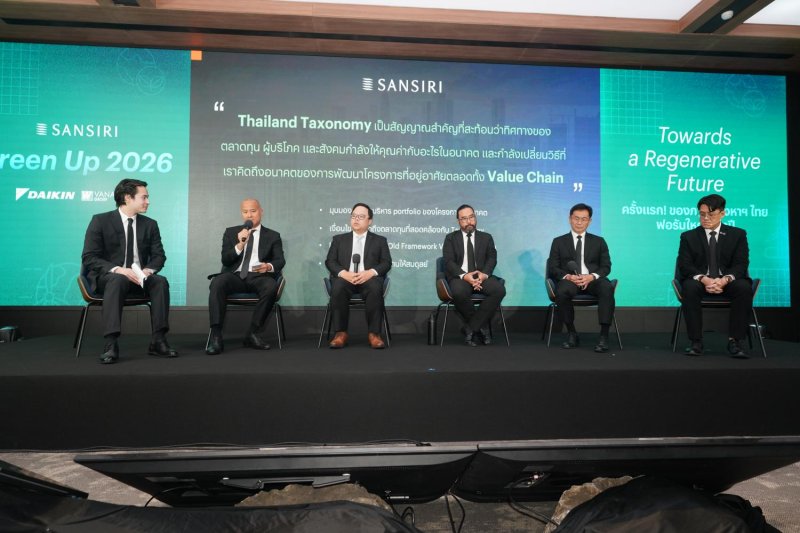
At the Sansiri Green Up 2026 forum, executives from the property, energy and manufacturing sectors agreed that sustainability is no longer an optional corporate initiative, but an increasingly important driver of long-term competitiveness.
For many businesses, the question is no longer whether to transition, but how quickly.
Sansiri Plc, one of Thailand's leading property developers, has emerged as an early advocate of the taxonomy framework, arguing that the financial and operational costs of delay may ultimately outweigh the investments required today.
"Thailand Taxonomy should not be seen solely as a regulation," said Samatcha Promsiri, chief of staff at Sansiri. "It provides businesses with a framework to identify opportunities and chart practical transition pathways."
INVESTING IN TRANSITION
For the property sector, however, sustainability poses distinct challenges.
While premium residential projects can more easily absorb the costs of green technologies and energy-efficient systems, extending such practices to developments aimed at broader consumer segments remains considerably more difficult.
Still, Sansiri has positioned itself at the forefront of sustainable finance, becoming one of the first property developers to secure green bond financing from Kasikornbank (KBank).
The company has obtained funding for six projects worth more than 4 billion baht, with emissions independently measured and verified by Bureau Veritas.
According to Mr Samatcha, sustainability in property development has evolved far beyond design choices or construction materials. Developers are now expected to assess supply chains, resource efficiency and carbon footprints throughout a project's lifecycle.
Equally important, he said, is ensuring that smaller suppliers are not left behind.
"The challenge is making sure SMEs in the supply chain can transition alongside us," he said. "That requires education, collaboration and support."
He also warned against greenwashing, saying sustainability must be embedded in business operations rather than treated as a branding exercise.
Industry leaders at the forum shared a common view: businesses that act early stand to gain strategic advantages, while delayed action could result in significantly higher adjustment costs as regulations tighten and market expectations evolve.
"Not everything has to be done at once," Mr Samatcha said. "Every business has different priorities. The key is deciding where to start and moving forward."
COMPETITIVE EDGE
Natthakorn Kraikul, executive vice-president for strategic sustainability management at PTT, said changing regulations and consumer expectations are already reshaping business models across industries.
"Taxonomy sends an important signal to the market," he said. "Businesses should not wait for others to move first because catching up later can become far more difficult."
To navigate the transition, PTT has identified three strategic pillars.
The first focuses on building climate-resilient businesses, including carbon capture, utilisation and storage, health and life sciences, renewable energy and small modular reactors. The second seeks to improve efficiency across existing carbon-intensive assets through digitalisation and operational optimisation. The third centres on strengthening partnerships through carbon markets, hydrogen development and forestry initiatives.
Mr Natthakorn said sustainability should not be viewed solely as a gateway to financing, but as a long-term strategy for maintaining competitiveness in an increasingly carbon-conscious global economy.
For traditionally carbon-intensive industries, transition pathways are already reshaping product development and industrial strategy.
Wachirachai Koonamwattana, chief sustainability officer of SCG, said the cement industry has spent years adapting its business model to meet rising sustainability demands.
"Finance is a critical accelerator," he said. "Closer collaboration between financial institutions and manufacturers can help align investments with sustainability goals."
SCG has already introduced low-carbon clinker cement across 80% of its cement portfolio and is developing third-generation products capable of cutting emissions by 40-50% while maintaining costs comparable to conventional alternatives.
In the manufacturing sector, companies are also reassessing long-standing business philosophies through the lens of sustainability.
THE COST OF DELAY
Warut Lekajirakul, general manager of Daikin Thailand, a manufacturer of air conditioning and air purification systems, said the company continues to prioritise energy efficiency through advanced cooling technologies and environmentally friendly refrigerants aimed at reducing greenhouse gas emissions.
Rather than viewing taxonomy as a disruptive requirement, businesses should see it as an opportunity to strengthen competitiveness, he said.
"We do not need to change simply for the sake of change," he said. "Taxonomy provides a framework that can make businesses stronger and more competitive."
He acknowledged that implementation remains challenging, particularly for SMEs struggling to understand or access the framework. Additional support measures, he said, may be needed to help smaller operators adapt.
He added that businesses should weigh long-term energy savings more carefully against short-term cost reductions, arguing that decisions made today would shape the country's pathway to net-zero emissions.
For some companies, sustainability has long been embedded in corporate strategy.
ML Dispanadda Diskul, independent director and chairman of the Audit Committee of Vanachai Group, a Thai manufacturer and distributor of engineered wood-based panel boards used as substitutes for natural wood, said the company has pursued sustainability-focused practices for more than three decades.
Rising global concern over climate change has prompted the company to invest in environmentally friendly products, including plans to introduce formaldehyde-free materials alongside decarbonisation measures in manufacturing.
Vanachai also uses rubberwood harvested from ageing rubber trees that no longer produce latex, converting material that might otherwise be burned into productive raw inputs and reducing emissions from open burning.
According to ML Dispanadda, the company's long-term sustainability strategy has strengthened access to financing opportunities, including green loans from KBank.
He said younger generations increasingly prioritise environmental quality and well-being, making sustainability a growing factor in consumer behaviour.
"Most of the solutions businesses need are already available," said ML Dispanadda. "The key is finding the right partners for the transition. This should not be seen as a cost, but as an investment, because the cost of doing nothing could be far greater."
As Thailand moves closer to its mid-term climate goals, business leaders increasingly agree that sustainability is no longer simply about risk mitigation. Instead, it is emerging as a source of innovation, resilience and long-term value creation -- one that could determine which businesses thrive in a rapidly changing economy.
