 Listen


 Facebook
 Reddit
 Copy Link


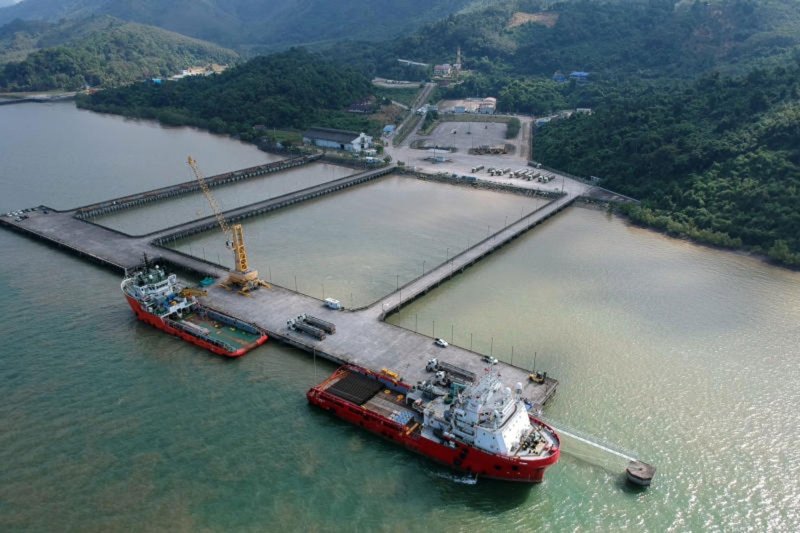
A government committee studying the Land Bridge megaproject has identified its commercial viability as a critical issue, according to Danucha Pichayanan, secretary-general of the National Economic and Social Development Council (NESDC).
“We need to determine whether the project is feasible from a commercial perspective. If it is, we can then consider the appropriate scale of development,” he said on Friday after a meeting chaired by Finance Minister Ekniti Nitithanprapas.
Mr Danucha serves as the secretary to the panel tasked with examining approaches to driving the development of transport infrastructure linking the Gulf of Thailand and the Andaman Sea.
Expected to require an investment of close to one trillion baht, the project envisages upgraded ports in Ranong on the Andaman side and Chumphon province on the Gulf, linked by a road and rail transport network. Supporters believe it will attract shippers seeking alternatives to sailing around Singapore via the congested Strait of Malacca.
The committee is scheduled to hold its final meeting in August before submitting its conclusions to Prime Minister Anutin Charnvirakul, in line with the government’s 90-day review timeframe, said Mr Danucha.
Discussing the potential time savings compared with shipping via the Strait of Malacca, he said the Office of Transport and Traffic Policy and Planning would use data on average cargo transshipment times at the Singapore port to calculate how much time vessels could save by using the Land Bridge.
Geopolitical risks
Mr Danucha acknowledged that geopolitical risks remained an ongoing concern and could weigh on international trade and cargo transport in the coming years.
“We need to assess the risks to Thailand, both if the project is implemented and if it is not,” he said. “This is one of the key issues being examined by the project feasibility subcommittee, which I chair. We are evaluating how globalisation and geopolitical conflicts could affect Thailand.”
The committee has established three subcommittees to conduct detailed studies covering different aspects of the project: feasibility, environmental impacts, and public communications aimed at improving public understanding of the scheme.
Mr Danucha stressed that environmental impacts must be kept to a minimum while weighing the project’s overall costs and benefits.
Among the key environmental concerns are sediment and dust generated by dredging operations, particularly on the Ranong side, and the potential loss of forest areas and natural resources.
“All aspects will be thoroughly examined and we will make an objective assessment of what is feasible, what is not, and what adjustments are needed, so that all parties can accept the outcome,” Mr Danucha said.


