Listen


 Facebook
 Reddit
 Copy Link


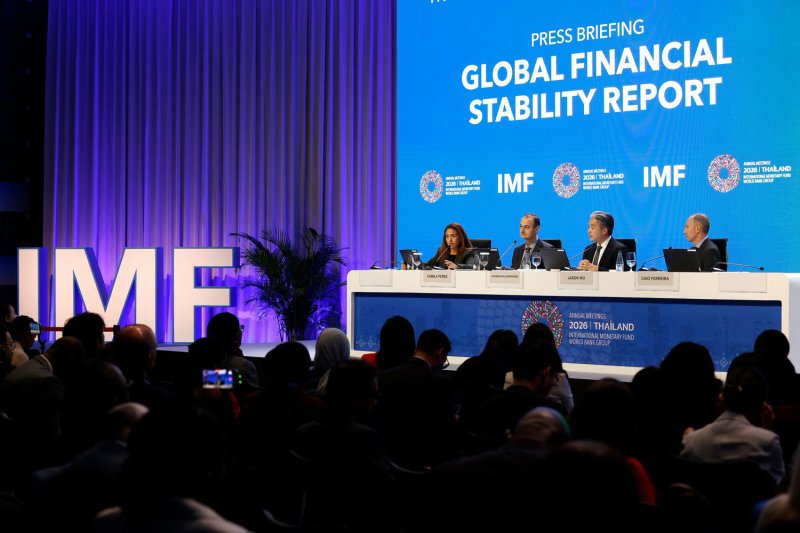
The International Monetary Fund (IMF) has warned that global financial markets could face greater pressure if a sharp correction in artificial intelligence (AI)-related stocks tightens global financial conditions.
Speaking at a session titled Global Financial Stability during the 2026 IMF-World Bank Annual Meetings on Tuesday, Athanasios Vamvakidis, deputy director of the IMF’s Monetary and Capital Markets Department, said markets had remained resilient, supported by solid economic growth and strong corporate earnings. Financial stability risks nevertheless remained elevated.
“An AI-related market correction could intensify market turmoil worldwide. A sharp correction could spill over into the real economy if companies fail to generate the expected returns from their AI investments,” he said.
The IMF’s Global Financial Stability Report highlights several vulnerabilities, including elevated expectations for AI-related profits, massive capital investment and the growing concentration of market performance in the technology sector.
An analysis of 14 publicly disclosed transactions shows that AI investment involves around US$300 billion (10.07 trillion baht) in equity and $650 billion in debt, linked to future revenue commitments of up to $1.4 trillion. These financing structures could amplify losses if actual revenues fall short of expectations.
Beyond the risk of an AI-driven market correction, rising bond yields could also undermine financial stability. The report flags vulnerabilities among non-bank financial institutions, whose exposure to less-liquid assets and private credit markets has increased. These risks could intensify liquidity pressures during periods of market stress.
Mr Vamvakidis also highlighted cybersecurity as a growing concern, driven by digitalisation, dependence on a concentrated group of technology and cloud service providers, and the increasing use of AI by cybercriminals.