 Listen


 Facebook
 Reddit
 Copy Link


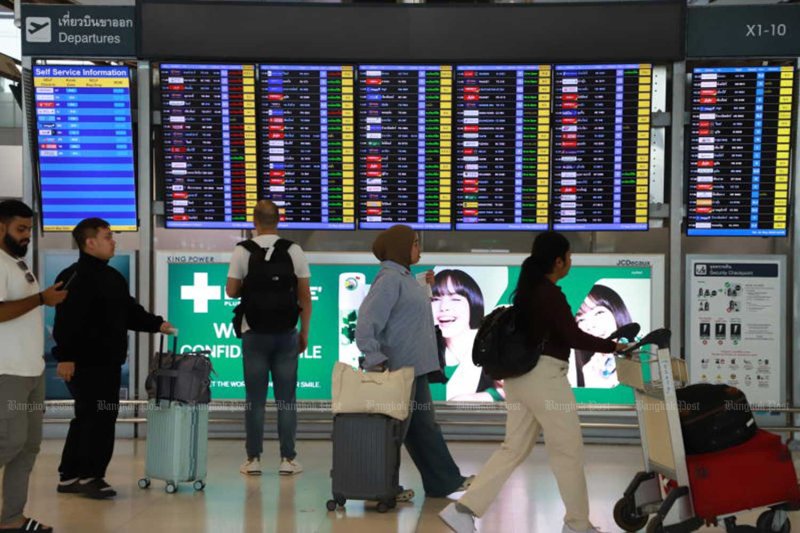
Thai tourism could lose between 50-150 billion baht in revenue a year thanks to the proposed departure tax, compared with the 45.9 billion baht it is expected to raise, with airlines opposing the levy due to its poor timing and the likelihood of it undermining the travel sector's competitiveness.
Adith Chairattananon, honorary secretary-general of the Association of Thai Travel Agents, said a minimum loss of 50 billion baht was based on a study of the impact of taxes on tourist numbers published in the Journal of Travel Research in 2023, which indicated that for every 10% increase in taxes related to tourism activities, tourist demand would decline by 5.4%.
He said the research team from Naresuan University, which also conducted a study on the 450-baht tourism fee, applied those research metrics to Thai tourism and found that the additional 2,570 baht that tourists are expected to pay before entering Thailand accounts for 5.14% of the average tourist spending of 50,000 baht per trip.
The proposed departure tax is initially set at 1,000 baht for travellers of all nationalities, which could translate into roughly 45.9 billion baht in revenue, based on 32.9 million foreign tourists and around 13 million Thai outbound travellers in 2025.
However, Mr Adith said the potential losses from this policy would be more severe, as seen in previous cases in other countries, where tax increases had an impact on arrivals from significant markets.
For instance, the Tourism Goods and Services Tax imposed in the Maldives in 2010 resulted in a decline in tourist numbers from large markets, such as China, India, the UK and Russia.
The potential losses from Thailand's top three tourist markets -- China, India and Malaysia -- could reach 891,000 arrivals based on a 10% decrease, and 446,000 arrivals based on a 5% decrease.
If at least 1 million travellers decided not to visit Thailand due to additional taxes, the country would lose around 50 billion baht in revenue, while the worst-case scenario might see losses of 150 billion baht, which is far greater than the earnings from the tax collection, said Mr Adith.
He said lower demand would also have an impact on employment in the hospitality sector, hampering a fragile economy, as the International Monetary Fund (IMF) has forecast Thai GDP growth of only 2.1%, lagging other prominent economies in the region.
Mr Adith said that tourism operators from different organisations would soon hold discussions to address the issue with the finance minister, possibly after the 2026 IMF-World Bank Annual Meetings in Bangkok end this week.
Tassapon Bijleveld, executive chairman of SET-listed Asia Aviation, the operator of Thai AirAsia, said the Airlines Association of Thailand, which comprises seven airlines, has already expressed its opposition to the departure tax.
The proposed tax is expected to worsen Thailand's tourism competitiveness as the country could be surpassed by other destinations, notably Vietnam, he said.
If the government is in dire need of revenue, raising value-added tax rather than hampering the tourism sector would be a better tactic, said Mr Tassapon.
