 Listen


 Facebook
 Reddit
 Copy Link


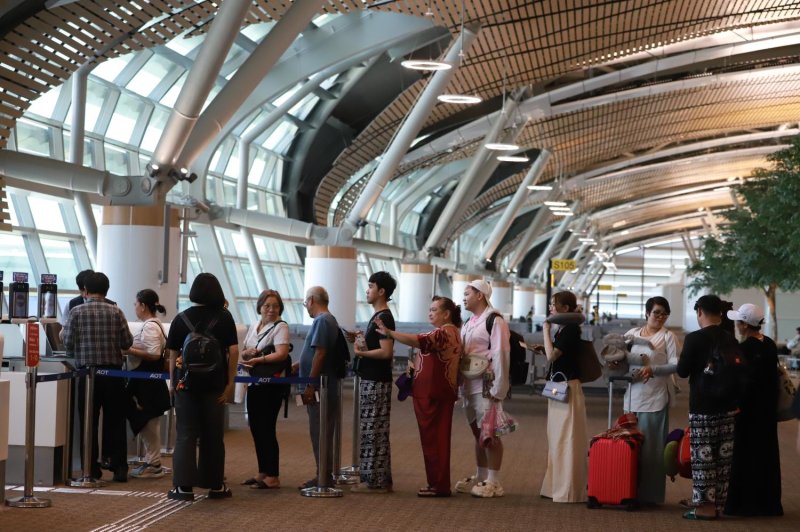
The Finance Ministry is considering reviving a tax on international air departures more than four decades after the levy was first introduced in 1983.
While the proposed measure is aimed primarily at raising government revenue amid persistent budget deficits and rising public debt, the original tax was introduced to curb excessive foreign currency outflows and safeguard the country's balance of payments.
The renewed proposal raises questions about who is liable, how much travellers will have to pay and whether the tax will become a permanent fixture of Thailand's fiscal policy.
Why is the ministry considering a departure tax?
Given persistent budget deficits for several decades and a public debt-to-GDP ratio approaching the statutory ceiling of 70% of GDP, the government needs to generate additional revenue to maintain fiscal discipline.
Taxing departures from Thailand is one of 10 tax measures in the ministry's pipeline.
Of the 10 measures, two have been implemented: the removal of the import duty exemption for low-value goods worth less than 1,500 baht (the de minimis exemption) and the top-up tax for multinational enterprises (MNEs) with annual revenue of at least €750 million (26.8 billion baht) for accounting periods beginning on or after Jan 1, 2025.
The top-up tax is designed to ensure MNEs pay a minimum level of corporate income tax, aligning with the global minimum tax initiative led by the Organisation for Economic Co-operation and Development.
Planned measures include restructuring personal income tax by reviewing various tax deductions, which the Finance Ministry expects will generate an additional 50 billion baht in revenue, and increasing the value-added tax (VAT) rate from 7% to 10%, which is expected to generate an additional 345 billion baht.
The ministry estimates a departure tax will generate an additional 12 billion baht in government revenue.
The primary justification for the levy is to increase government revenue.
In contrast, when the departure tax was introduced in 1983 under the government of Prem Tinsulanonda, its main purpose was to prevent excessive outflows of foreign currency to maintain the country's balance of payments.
Who pays the tax and how much is it?
The departure tax would apply to travellers of all nationalities leaving Thailand, except for individuals whose duties involve transport operations and who are not required to pay a fare when travelling abroad as part of their professional responsibilities.
For those departing by air, the tax would be added to the airline ticket, with the maximum rate capped at 5,000 baht per departure.
However, a ministerial regulation to be issued after the law comes into effect would set the initial tax rate at 1,000 baht per departure, noted the ministry.
The 1983 law capped the tax at 5,000 baht per departure, but a ministerial regulation subsequently set the effective rate at 1,000 baht per departure by air and 500 baht per departure by sea or land.
For the renewed departure tax, exits by land and sea are exempt.
The tax would not apply to travellers who purchased their tickets before the law takes effect, even if they depart on or after the effective date.
As to why foreign nationals residing in Thailand would be subject to the tax, the ministry's rationale is once they decide to live here and use the country's infrastructure just as Thais do, they should be subject to the same taxes as Thais.
Who is exempt from the tax?
For air departures, the exemptions would be similar to those for the passenger service charge:
1. His Majesty the King, Her Majesty the Queen, members of the Royal Family specified by law, and members of the Royal Entourage
2. The Supreme Patriarch and members of His Holiness's entourage
3. Foreign heads of state and their accompanying parties
4. Official guests of His Majesty the King or Her Majesty the Queen, and their accompanying parties
5. Official guests of the government and their accompanying parties
6. Children aged 2 or younger
7. Inspection teams of the Organisation for the Prohibition of Chemical Weapons
8. Passengers travelling on Thai or foreign government aircraft, or other aircraft used for official government purposes
9. International transit passengers who remain within the designated transit area
10. Transit passengers required to remain at the airport while changing aircraft in connection with domestic travel
The Finance Ministry said it may also issue ministerial regulations under the law to grant exemptions to other categories of people, as appropriate.
For example, after the law came into effect in 1983 the government issued ministerial regulations exempting individuals travelling to Mecca, Saudi Arabia, to perform the Hajj pilgrimage, and for those travelling overseas for employment with the approval of the Labour Department.
What are the penalties for refusing to pay the tax?
The law authorises Revenue Department officials to assess and collect the tax, surcharges and additional charges.
These officials also have the authority to issue summonses or orders, and to search for or seize relevant accounts, documents and evidence.
The surcharge is twice the amount of tax payable, or required to be paid or remitted. An additional charge, effectively interest on the outstanding tax liability, can be imposed at a rate of 1.5% per month.
The law also establishes penalties for tax evasion or attempted tax evasion, including providing false information or statements, presenting false evidence, or using other methods to evade the tax.
Penalties may also apply to those who obstruct officials or refuse to cooperate with them, as well as those who fail to fulfil duties required under the law. Such offences may be subject to regulatory fines.
Is the tax intended to be permanent?
This depends on the government in office at the time. Historically, when economic conditions improve, successive governments gradually abolish tax measures.
For example, in 1986 the government abolished the departure tax for travel by land and water, citing the need to bring the measure in line with prevailing circumstances.
Then in 1991, during the tenure of finance minister Suthee Singhasaneh, a ministerial regulation was issued exempting air travellers from the departure tax, ending collection of the levy. The government stated the country's economic conditions had improved substantially, making it appropriate to stop collecting the tax from air passengers.
The draft legislation is undergoing public consultation as required by the Constitution, allowing interested parties to submit their opinions until Oct 29.


