


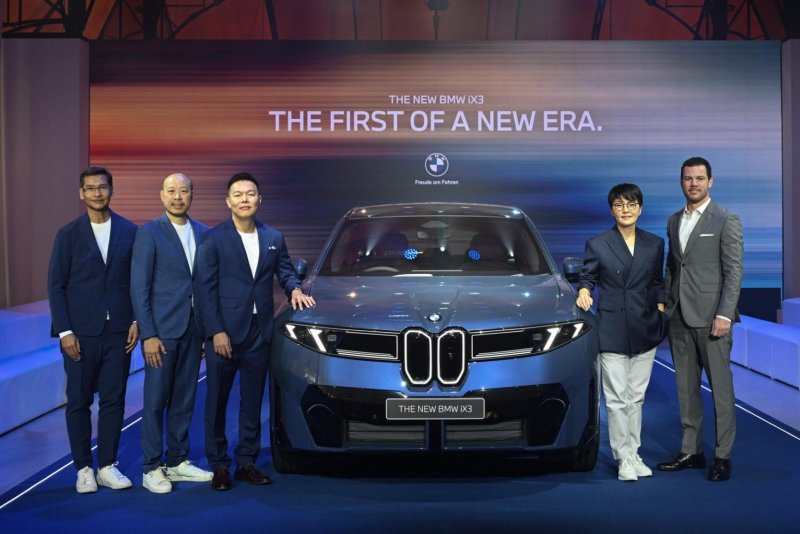
Rising crude oil price volatility, fuelled by escalating tensions between the US and Iran, is threatening to stall Thailand's automotive recovery, with luxury car sales projected to remain flat this year, according to BMW Group Thailand.
Kris Joo, president and chief executive of BMW Group Thailand, said the industry is facing growing concerns that surging oil prices could further weaken consumer confidence, putting more pressure on the currently sluggish economy.
"Tensions in the Middle East have become a new factor that may affect Thailand's automotive industry and domestic car sales in 2026," she said.
Thomas Gorian, director of sales and dealer network development at BMW Group Thailand, echoed this sentiment, warning that the conflict in the Middle East could directly impact the economy and consumer spending.
"We have to closely monitor the war in the Middle East and update how it impacts the economy and business," he said.
BMW had initially forecast growth in Thailand's luxury car segment this year, buoyed by optimism following the general election and the formation of a new government.
However, the company has revised its outlook and now expects sales to remain flat due to the unpredictable nature of the conflict.
Last year, Thailand's luxury car segment fell by more than 10%, dropping to around 26,000 units. BMW's total sales stood at 10,611 units in 2025.
Despite the cautious outlook for 2026, the company expects overall domestic sales to rise by double digits, driven by new model launches, including the BMW iX3 50 xDrive M Sport -- the first vehicle from the Neue Klasse generation.
BMW is conducting a feasibility study to produce this model locally at its Rayong assembly plant, although it is currently imported from China.
The company has reaffirmed its long-term commitment to Thailand, with plans to invest in a battery manufacturing facility in Rayong to support both battery electric vehicles (BEVs) and plug-in hybrid electric vehicles (PHEVs).
Currently, BMW's production mix in Thailand consists of 60% internal combustion engine vehicles, 30% PHEVs, and 10% BEVs.
The company remains confident that the upcoming Bangkok International Motor Show later this month will boost consumer sentiment and help sustain momentum in the automotive industry.
