


Japanese car giants are holding firm in Thai satisfaction stakes as electric vehicle (EV) growing pains emerge.
The landscape of the Thai automotive industry is undergoing a seismic shift, yet the latest data suggests that traditional engineering and established Japanese marques still hold a psychological edge over the burgeoning EV sector.
While the "quiet revolution" of electrification dominates headlines, a new study reveals that, when it comes to the daily reality of ownership, Thai drivers are finding their highest levels of satisfaction with internal combustion engines (ICE) and hybrid technology.
According to the inaugural 2026 Thailand Product Customer Experience Index (Product CXI) Study released today (March 31) by Differential (Thailand) Ltd, the "old guard" of the automotive world is successfully fending off challenges from new market entrants.
The study, an independent third-party evaluation, measured the experiences of over 2,600 owners across 14 popular brands, focusing on design, usability, and technology.
HERITAGE MEETS INNOVATION
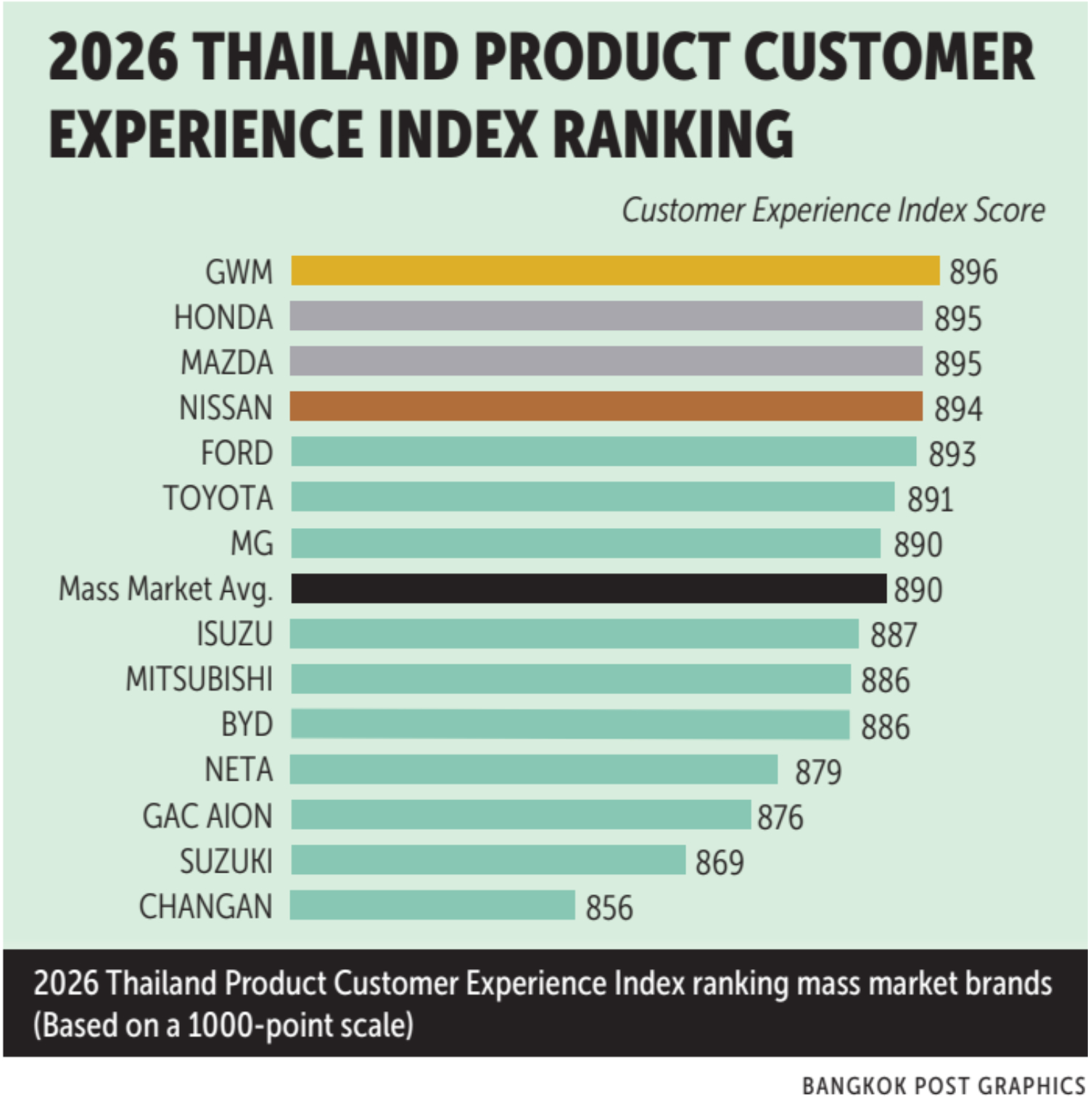
In a surprising turn for those betting solely on heritage, Great Wall Motor (GWM) secured the top spot in the index with a score of 896 out of 1,000.
However, the ranking remains a crowded field, with Japanese precision continuing to shine.
Honda and Mazda followed closely in a joint-second position with 895 points, while Nissan (894), Ford (893), and Toyota (891) all performed above the industry average of 890 points.
Notably, MG landed exactly on the industry average, while several other brands fell short of the mean score, suggesting a widening gap between those who prioritise the "customer journey" and those focused merely on sales volume.
EV 'SATISFACTION GAP'
One of the most striking findings for the 2026 outlook is the disparity between powertrain types.
Despite the government's push for electrification, battery electric vehicles (BEVs) -- largely represented by Chinese manufacturers -- recorded an average satisfaction score of 884 points.
This trails behind the 891 points recorded for ICE and hybrid vehicles.
Siros Satrabhaya, managing director of Differential Thailand, noted that while the tech-forward nature of EVs is appealing, the infrastructure and hardware are still catching up to consumer expectations.
"The battery and the charging process remain the primary pain points," Mr Siros said.
"Issues such as the duration of charging and the convenience of using a home charger are currently acting as a drag on the overall experience."
CABIN LUXURY A PRIORITY
The study highlights the fact that Thai consumers have moved beyond viewing a car as a mere tool for transit.
Today, the cabin is treated as a "premium third space".
Owners reported the highest satisfaction with aesthetic touches, such as interior ambient lighting and the harmony of materials used in the décor.
Functionality also remains para- mount.
The utility of mobile charging ports was cited as a critical "must-have" feature, alongside intuitive steering wheel controls and advanced driver assistance systems (ADAS) that enhance safety.
However, the industry is struggling to meet expectations regarding NVH (Noise, Vibration, and Harshness).
Owners expressed a desire for better soundproofing and cabin quietness, as well as improved audio systems that deliver clearer bass and more precise acoustics.
PROMOTERS DRIVE GROWTH
From a business perspective, the study provides a stark warning for manufacturers who ignore the Product CXI (customer experience interactions).
Approximately 70% of respondents were identified as Promoters -- loyalists who scored their vehicles an average of 913 points.
These owners are the primary drivers of organic growth, actively recommending their vehicles to family and peers.
On the other side of the ledger, the remaining 30% -- comprising "Passives" and "Detractors" -- scored a significantly lower average of 837 points.
This 76-point chasm illustrates the financial risk of a poor product experience: a dissatisfied customer is not just a lost future sale, but a voice that can actively discourage others from joining the brand.
'LOYALTY' TO SHAPE 2026
As competition intensifies, particularly with new brands entering the Thai market, the focus must shift from "attraction" to "loyalty".
The study concludes that while exterior styling and safety systems remain the most important drivers of satisfaction -- the long-term winners will be those who can solve the usability equation.
For the EV sector specifically, the message is clear: the novelty of electric drive is no longer enough.
To close the gap with Japanese ICE counterparts, EV makers must refine the charging behaviour of the car, ease of use of the charging port and home-integration experience.
Siros Satrabhaya is managing director of Differential Thailand.
