



Thailand's domestic car market accelerated in March, with sales climbing 7% year-on-year to 59,865 units, driven by surging demand for electric vehicles (EVs) as consumers sought relief from rising oil prices amid Middle East tensions, according to the Federation of Thai Industries (FTI).
The 12-day Bangkok International Motor Show also provided a significant boost to sales.
Surapong Paisitpatanapong, spokesman for the FTI's Automotive Industry Club, said bookings at the event reflected growing interest in EVs, with global crude oil prices affected by the Israel–US conflict with Iran.
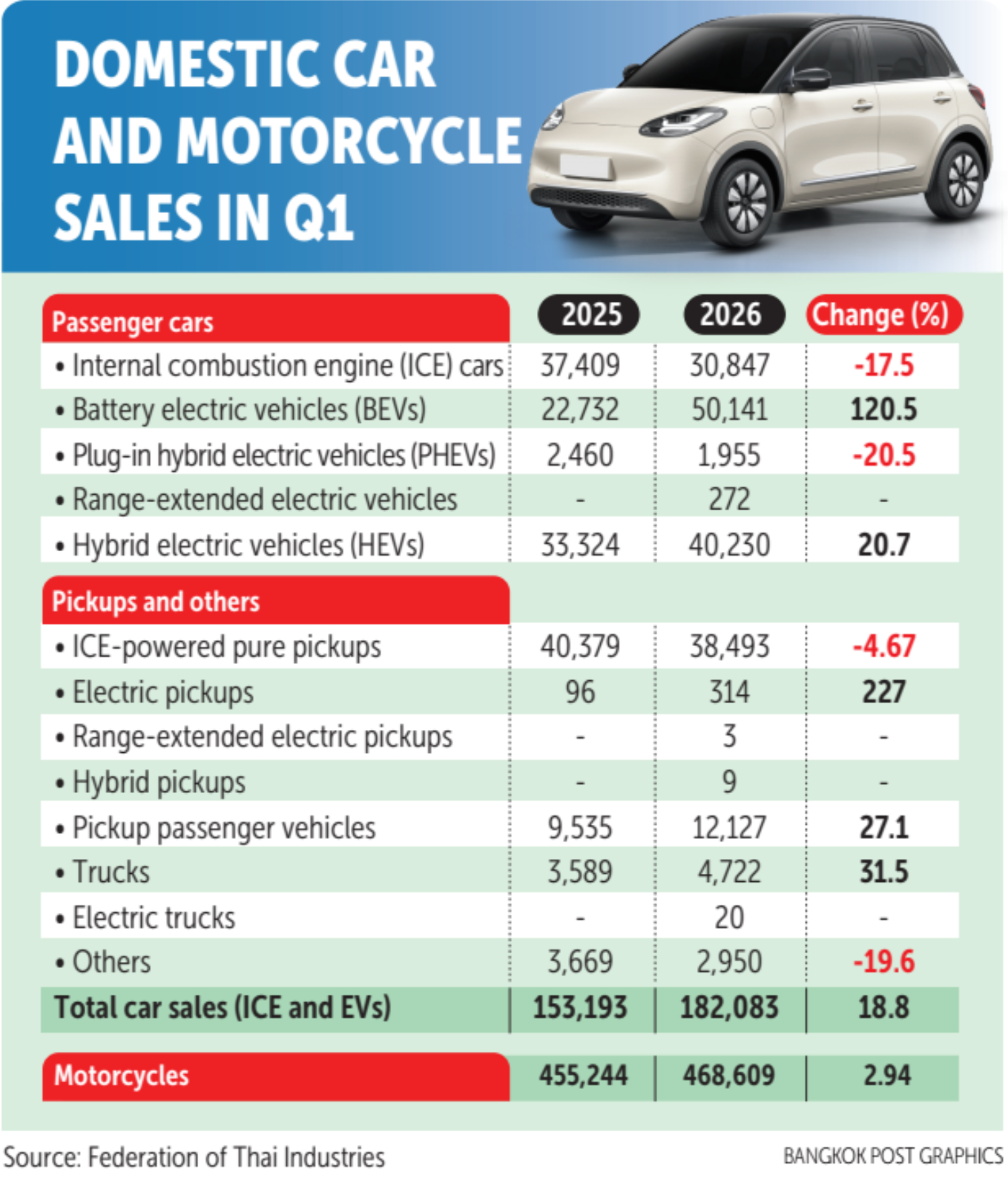
Organisers reported that battery EVs (BEVs) accounted for 60% of total bookings, while internal combustion engine (ICE) vehicles made up 40%.
The Motor Show, held from March 25 to April 5, recorded 132,951 bookings. BYD led with 17,354 orders, followed by Toyota with 15,750 and Omoda Jaecoo with 15,088.
While EVs surged, ICE-powered pickups continued to struggle. Sales of pure pickups fell 6% to 13,991 units, as banks and financing companies tightened lending criteria due to concerns over non-performing loans and high household debt, Mr Surapong said.
For the first quarter of 2026, Thailand's total car sales rose nearly 19%, again driven by BEV demand.
Mr Surapong welcomed the government's proposed car trade-in policy, which aims to encourage the adoption of BEVs and hybrid EVs.
He said the policy would benefit Thailand's automotive industry and supply chains, including parts, electronics and tyres, while also boosting employment.
The FTI also urged the government to include vehicles using biodiesel B20, a blend of diesel and 20% palm oil-derived methyl ester, in the car trade-in scheme, as they also depend less on oil.
B20 is already common in heavy machinery, trucks and buses, although compatibility checks are needed for smaller vehicles.
On the export front, Thailand's car shipments in March fell 0.64% year-on-year to 80,394 units, with exports to the Middle East dropping nearly 16% following the closure of the Strait of Hormuz.
However, exports increased to Australia, Africa, Europe, Central America and Latin America.
For the first three months of 2026, total car exports declined 1.99% to 219,994 units.
Despite export challenges, car production in March rose 2.6% year-on-year to 133,413 units, driven by higher passenger car output.
