
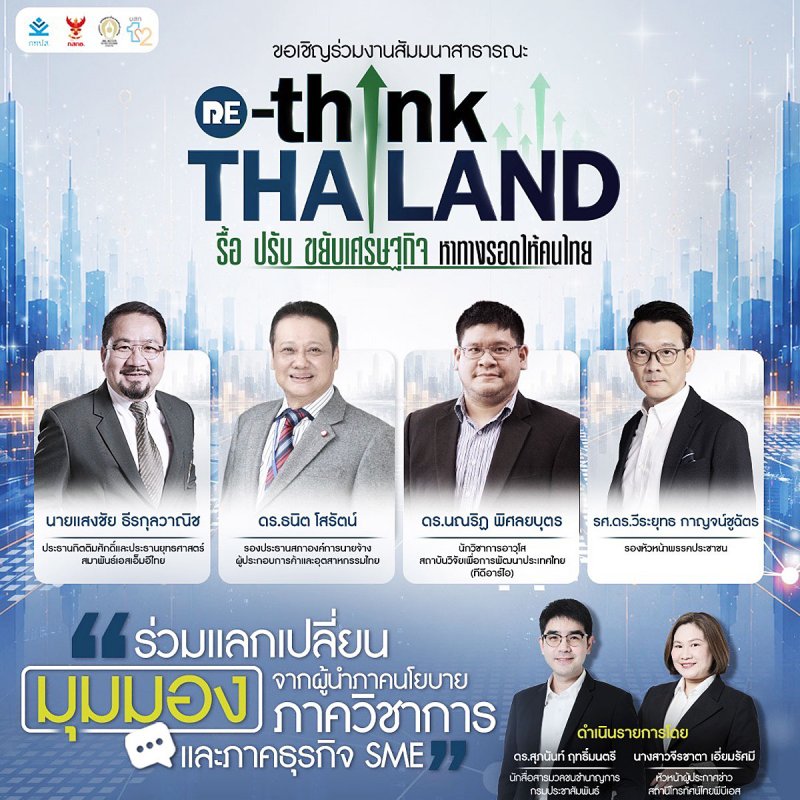
Thailand is preparing to host a public seminar aimed at tackling mounting economic challenges, bringing together leading voices from business, academia and policymaking to map out how the country, and those living and working in it, can adapt and move forward.
The event, titled “RE-THINK THAILAND: rethink, reform and reboot the economy for survival”, will encourage participants to revisit assumptions about the Thai economy and explore practical responses to ongoing uncertainty. Organisers say the goal is to equip attendees with clearer perspectives and actionable strategies as economic conditions continue to shift.
The seminar will be held on Saturday, June 20, 2026, from 9.30am to 12pm at Hall 1–2 on the 10th floor of the SCG headquarters multi-purpose building in Bang Sue, Bangkok. It is open to the public, with free online registration, offering an accessible opportunity for both Thais and expatriates to engage with the topic.
A key highlight will be a panel discussion featuring prominent figures from across sectors. Saengchai Theerakulvanich, honorary chairman and strategy chairman of the Federation of Thai SMEs, is expected to provide insights into the pressures facing small and medium-sized enterprises, widely regarded as the backbone of the Thai economy.
Joining him are Dr Thanit Sorat, vice-chairman of the Employers’ Confederation of Thai Trade and Industry; Dr Nonarit Pitsaleyabutr, a senior research fellow at the Thailand Development Research Institute; and Associate Professor Dr Weerayut Kanchoochat, deputy leader of the People’s Party. Together, the panel is set to offer a blend of policy analysis, business experience and academic insight.
Organisers say the discussion will focus on how Thailand can respond more effectively to global economic shifts, from supply chain disruption to changing investment patterns. The aim is not only to present ideas but also to encourage dialogue that could lead to practical recommendations.
The session offers a window into how local stakeholders are interpreting current trends and planning ahead. As economic conditions evolve, such conversations may prove valuable for those seeking to understand the broader direction of the country they live and work in.