Listen


 Facebook
 Reddit
 Copy Link



There was a time when luxury watch collecting in Thailand was primarily defined by two metrics - brand recognition and resale value. But walk into the Grand Prix d'Horlogerie de Genève (GPHG) Nomination Tour at Gaysorn Amarin this week, and the conversation sounds entirely different.
Instead of asking about price tags, local enthusiasts are asking about micro-rotors, grand feu enamel and hand-finished bridges, questions that delve straight into the soul of haute horlogerie.
This shift in curiosity explains why Bangkok was selected as one of only four global destinations - alongside Mumbai, Geneva and London - to host the GPHG 2026 World Tour from Oct 15–18. Often dubbed the "Oscars of Watchmaking", the prestigious travelling exhibition returns to Thailand’s capital eight years after its local debut, bringing 78 nominated timepieces ahead of the 26th annual awards ceremony on Nov 7 in Geneva.
For Narun Thamavaranukup, managing director of PMT The Hour Glass and the event's host, the arrival of the GPHG highlights a profound transformation in how Thais view the craft.
“At PMT The Hour Glass, our mission is to advance watch culture,” Narun said. “Advancing watch culture means encouraging people to look beyond the watch itself and explore the stories behind it: who made it, why it was crafted in a particular way, what challenges the makers set out to solve, and why a particular dial takes 2,000 hours to create.”
“It shows the change between becoming an owner and becoming someone who understands the art of watchmaking. When you cross that line, you don’t really come back,” he added.
- Younger, sophisticated generation -
Driving this culture shift is a noticeable demographic evolution. In 2018, the average local luxury watch client was between 45 and 50 years old. Today, that average age has dropped to 35 to 40.
This younger demographic has entered the market with unprecedented access to information. Thanks to digital media and social platforms, emerging collectors are bypassing traditional entry-level hurdles and diving straight into the technical nuances of independent watchmakers.
“Thai people have great understanding of arts and crafts, great respect for artists, and that has transpired into the understanding and appreciation of watchmaking as a whole,” Narun said. “The beauty of Thai watch collectors is that they collect everything that is quality.”
This rounded perspective allows collectors to look past pure brand prestige and appreciate the raw mechanics, hand-finishing and decorative arts behind each creation.
“When they collect or study independent watchmakers, they learn not only the brand. They learn about the mechanism, the movement, the finishing, the craft,” Narun explained. “And then when they go back and look at the watches made by the most established brands, they continue to appreciate the crafts and see why they are fantastic watches... It’s just appreciation but in a more rounded way.”
- Level playing field -
The GPHG exhibition exemplifies this exact dynamic. Inside the hall, mass-produced luxury pieces share space with artisanal masterpieces crafted in single-digit quantities.
“You have the brands that are producing tens of thousands of watches and also brands that are producing a handful of watches, maybe less than 50 a year, all in one room being judged by the same criteria,” Narun observes.
The 2026 edition of the awards also reflects broader changes across the global industry. Long-standing gendered categories like "Men’s" and "Ladies’" have been replaced by "Essential Watch" and "Complication Watch," re-framing timepieces by purpose and mechanical prowess rather than target gender. A new "Gemset Watch" category also underscores gem-setting as an artistic discipline in its own right.
- Putting Thailand on the map -
For PMT The Hour Glass, hosting the GPHG is less about immediate retail and more about elevating the regional ecosystem as a whole.
“For tours like the GPHG, it shows three things,” Narun emphasizes. “Firstly, for the smaller brands, we give them the opportunity of a stage to showcase their skills. For bigger, institutional brands, we show there is depth and sophistication in the Thai market that’s growing, giving them confidence when they want to increase investment to the market. Thirdly, it shows that we’re doing this for the whole industry.”
Ultimately, as Bangkok takes centre stage in the horological world this season, the message to collectors old and new remains grounded in patience and appreciation.
“At the end of the day, collecting watches really is a passion that requires time and patience,” Narun said. “Each watch has its own history, tradition and innovation. Each watch tells a story - of the makers, the brand and, of course, the eventual owner.”
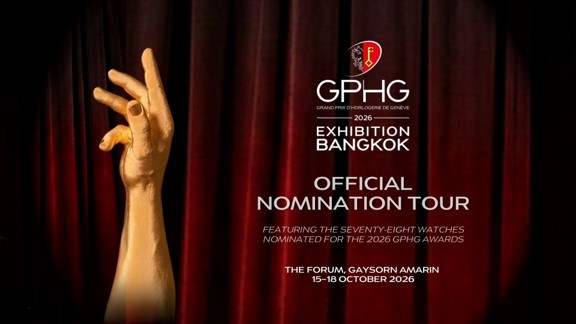
The Grand Prix d'Horlogerie de Genève nomination tour is at Gaysorn Amarin from Oct 15-18. (Photo: PMT The Hour Glass)