
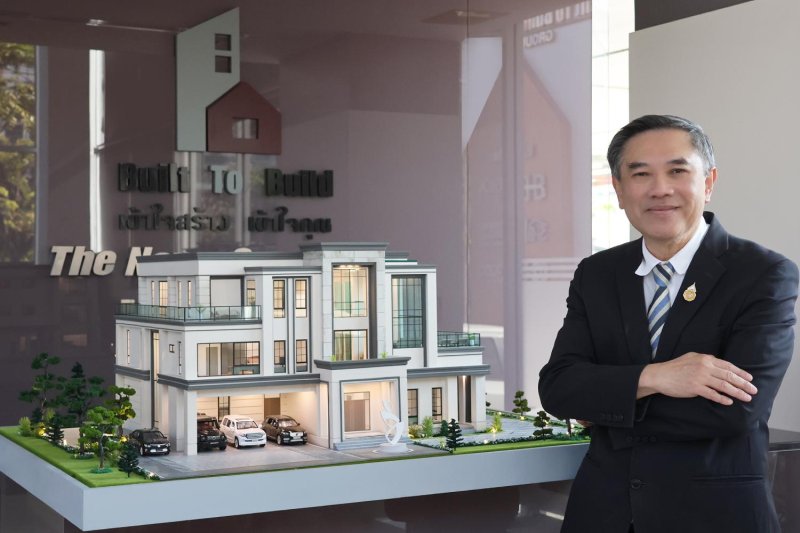
Homebuilder Built To Build Group says it will freeze prices for contracted clients despite rising oil prices fuelled by war in the Middle East, expressing confidence the conflict will subside by the end of this month.
Sutee Ketsiri, the group's managing director, said the war has complicated business, which was already affected by the trade war, geopolitical conflicts, an economic slowdown and political uncertainty.
"The homebuilding business is affected, similar to housing development, but to a lesser extent because developers require heavy upfront investment, while homebuilding projects rely on customers' progress payments," he said.
If oil prices remain less than US$110 per barrel and the war lasts no longer than three months, the group should be able to manage the impact, said Mr Sutee.
However, if prices rise above $120 per barrel and persist for more than three months, home construction prices may need to be revised.
The group has around 150 housing units under construction, with 30-40 units booked or under contract. Rising oil prices could increase construction costs for these units.
"Higher oil prices could raise construction costs by 5-7%, which would translate into an increase of roughly 3% in house prices," he said.
"In principle, we may have to accept a margin reduction of around 2-4% from this impact."
However, the company will not pass the burden on to customers. Instead, it will focus on improving construction precision, reducing waste during the building process, and completing projects on schedule to control overhead costs and limit the decline in profit margins, said Mr Sutee.
"In such a crisis, we will continue focusing on quality. We will not raise prices, but we will not cut them either, avoiding a price war because that benefits no one," he said.
"A price war could lead to contractors abandoning projects or inconsistent construction standards."
The group expects to generate 900 million baht in sales this year, up from 800 million baht in 2025, which declined from 900 million in 2024.
Of total sales last year, half came from houses priced between 2-9 million baht, while units priced 10-20 million baht comprised 20%, with the remainder homes priced 20 million baht and above.
"Many customers looking for houses priced between 2-5 million baht faced mortgage rejection rates as high as 40%, while those seeking units priced 5-9 million baht had weaker purchasing power," said Mr Sutee.
He said the market should improve after the political transition period passes and the government's budget framework becomes clearer.
In addition, a positive signal came from the Bank of Thailand's recent interest rate cut of 25 basis points to 1%.
"Lower interest rates could help stimulate purchasing power," said Mr Sutee.
"The homebuilding business is likely to recover faster than residential development because it does not carry large inventories and can adjust more quickly to actual market demand."