



Condominiums and rental homes in key destinations, including Bangkok, Phuket, Pattaya, Samui and Chiang Mai, are likely to benefit from migration from countries affected by the Middle East conflict, according to property consultancy Colliers Thailand.
Phattarachai Taweewong, research and communication director, said Thailand has numerous advantages, including a competitive cost of living, internationally recognised healthcare, well-developed infrastructure in major cities, and established expatriate communities in many areas.
"If a certain level of relocation occurs, it could positively impact Thailand's property market in several ways, particularly through rising demand for long-term rentals, as these groups typically begin by renting to assess the environment," he said.
This would help boost activity in the condominium and rental housing markets in key destinations.
If the situation in their home countries is prolonged, it could lead to genuine end-user demand, with high-net-worth buyers potentially deciding to purchase property in Thailand for long-term residence or asset diversification.
"Property investment in the luxury and resort segments in internationally oriented destinations such as Phuket, Pattaya, Bangkok, Samui and Chiang Mai could benefit from buyers seeking both safety and quality of life in a global environment," Mr Phattarachai added.
In addition, it could drive growth in related sectors, as an influx of long-term foreign residents would support demand for small office spaces, international schools and healthcare services, benefiting specific segments of the commercial property market.
"However, such opportunities will depend on government policy, including long-term visa schemes, investment incentives, and clear regulations on foreign property ownership," he said.
If these measures are improved to better support long-term residency, Thailand's ability to attract relocating buyers could increase significantly.
At the same time, with clear and supportive government policies, Thailand has the potential to turn geopolitical challenges into a strategic opportunity for the property market over the medium to long term, Mr Phattarachai added.
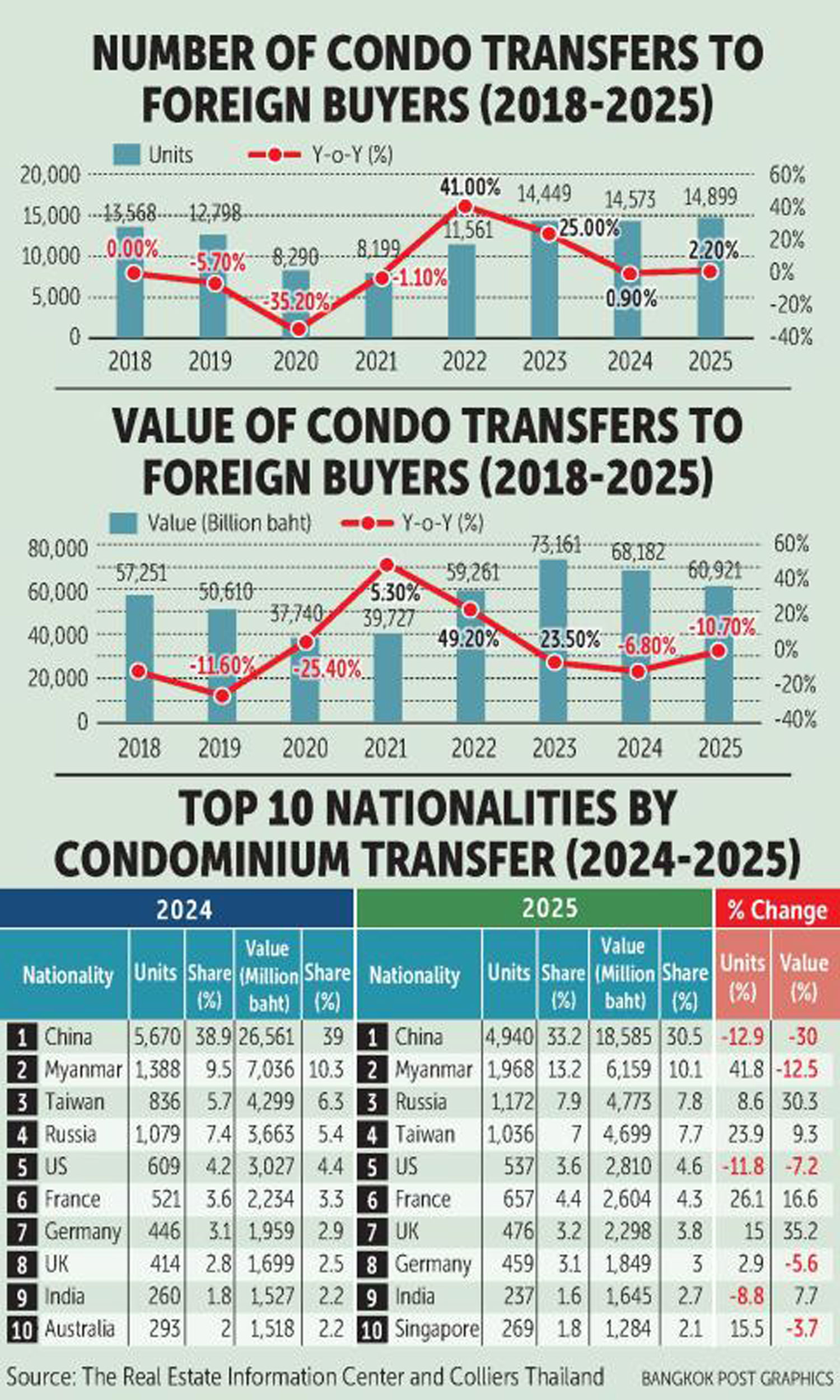
FOREIGN DEMAND REBALANCES
According to the Real Estate Information Center, condominium transfers to foreign buyers remained relatively stable at around 13,000 units per year during 2018-19, before plunging by 35.2% in 2020 due to Covid-19 and travel restrictions.
The number remained subdued in 2021, but the market began to recover strongly in 2022, soaring by 41%, and continued to grow in 2023, returning to near pre-pandemic levels.
Growth slowed to below 3% annually in 2024-25, indicating a stabilisation at a relatively high level, Mr Phattarachai said.
"Thailand's condominium market has demonstrated strong resilience among foreign buyers, rebounding from the crisis and returning to levels close to or even exceeding those seen before the pandemic, reflecting sustained long-term confidence in the Thai property market," he said.
In terms of value, condominium transfers to foreign buyers totalled 60.9 billion baht in 2025, down 10.7% from 2024, signalling a slowdown in purchasing power.
The decline was driven by global economic uncertainty, high interest rates and currency volatility, all of which have weighed on investment decisions by foreign buyers.
In addition, a shift in demand towards mid-priced or smaller units has contributed to the decline in total value, even as transaction volumes may not have decreased proportionally.
The transfer value of over 60 billion baht remains high compared with the pandemic levels, underscoring the importance of foreign demand to Thailand's property sector, albeit with more cautious growth.
The top 10 foreign buyer nationalities in 2024 and 2025 showed a significant shift in demand patterns, particularly with a decline in the Chinese market.
While China remained the largest source of buyers, the number of units fell by 12.9% and the transfer value dropped by as much as 30%, reducing its share from 39% to 30.5%.
At the same time, the market has become more diversified. Myanmar recorded a sharp increase of 41.8% in unit transfers, although the total value declined, indicating growth in the mid-priced segment.
Buyers from Russia, Taiwan and the UK posted growth in both volume and value, with Russia in particular recording more than a 30% increase in transfer value.
"Overall, 2025 marked a rebalancing of foreign demand, shifting from heavy reliance on the Chinese market towards a more diversified regional base," Mr Phattarachai said.
"Although some nationalities showed weaker performance, the broader trend highlights the increasing diversity and resilience of foreign buyers in Thailand's property market."
