


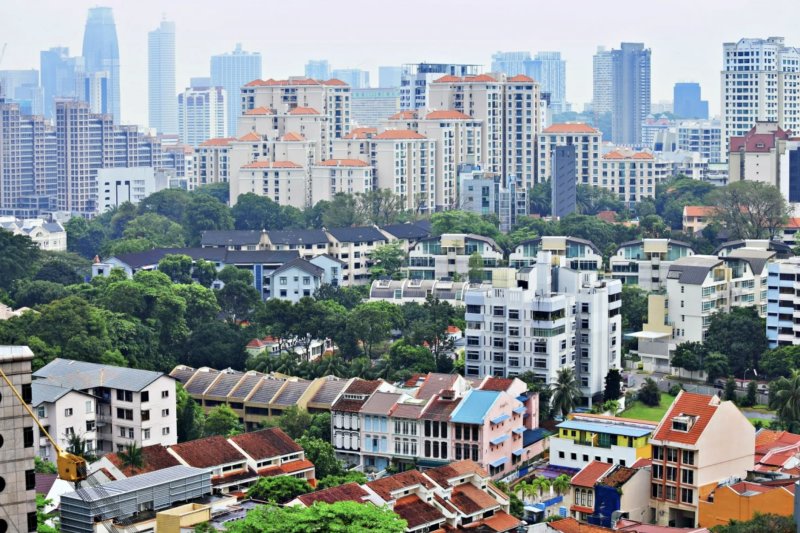
HONG KONG — China has become one of the largest sources of investment in land parcels and other properties in Singapore, as the safe-haven status of Southeast Asia's top financial hub continues to attract global capital, according to analysts.
China-linked developers and business entities have become more active in the market, said Alan Cheong, executive director for research and consultancy at Savills Singapore. "Chinese developers who have had experience in Singapore are now familiar with the rules, regulations and market behaviour. They are expected to continue bidding to replenish their landbanks."
Mainland Chinese firms were the second-biggest investors in Singapore in 2025, accounting for 21% of the total of S$14.16 billion (US$11.07 billion) in fixed-asset investment across all sectors, versus 2.5% a year earlier, according to a February report from the Singapore Economic Development Board. Europe moved into the top spot, with its share staying steady at around 25%, while the United States fell to third from first as its share dropped to 17.3%% from 55.5%.
Recent notable transactions include a nearly 145,500-square-foot lot on Dover Drive, which was acquired by CNQC Realty (Prime), Forsea Residence and Jianan Realty Investments at the end of the first quarter for S$951 million. The site is likely to yield 625 residential units.
In April last year, Kingsford Group, via Kingsford Huray, won a tender for a 222,161 sq ft plot called Lentor Gardens, in the Lentor Hills estate, for S$429.23 million. In November, the China-based developer also picked up a 147,350 sq ft plot on Telok Blangah Road via a tender for S$918.3 million. The residential sites are expected to yield more than 1,240 units.
In March last year, SingHaiyi Group and Haiyi Holdings acquired a parcel on Bayshore Road with an area of about 112,992 sq ft, which is expected to yield 515 units, for S$658.9 million. In the same month, a group comprising Qingjian Realty, China Communications Construction Company's unit Forsea Residence and Hoovasun Holding, which is fully owned by Singapore citizen Zhang Song, paid S$315 million for Media Circle (Parcel A), with an area of 82,125 sq ft. The plot is likely to accommodate 345 flats.
While local developers secured most of the sites that were put up for tender, interest from mainland groups and their affiliates increased bidding activity for Government Land Sales programme sites, with average bidders rising to 5.35 per site in 2025 from three in 2024, according to Cushman & Wakefield.
"Momentum in the private residential market, supported by healthy new‑launch take‑up rates and low levels of unsold inventory, has reinforced developer confidence and appetite for land banking," said Wong Xian Yang, head of research for Singapore and Southeast Asia at the consultancy.
As for the commercial property segment, mainland developers were less likely to be active players, although several transactions had been linked to them, according to analysts.
"Residential projects are typically built for sale, with returns realised over a shorter development cycle, whereas most commercial projects, aside from those that are bought for strata sales, are undertaken with a long‑term rental income strategy in mind," Wong said.
An example of commercial property deal linked to a mainland investor is a partnership between Ascott, the lodging business unit of CapitaLand, and New Vision Holding for the mixed-used hotel and residential project Ascott Shenton Way Singapore, which broke ground in the central business district in January. New Vision is a unit of Hsteel, whose chairman, You Zhenhua, was born in Fujian but is a Singapore citizen.
Beyond Singapore's appeal, investment in overseas assets may help mainland developers and other companies assure creditors of some relief in cases of default.
"Foreign assets can help limit losses for international creditors, providing easier seizure of assets if needed," said Gary Ng, senior economist for Asia-Pacific at Natixis CIB. "But they do not solve all problems."
Overseas asset sizes were likely to remain tiny relative to overall liabilities, he said. "And if the overseas projects are invested and executed poorly, they may indeed exert even more pressure on developers," he added. "The policy priority is always in the domestic market."
In the case of Country Garden, its joint venture US$100 billion project called Forest City in Johor, Malaysia, played a crucial role in a Hong Kong court's approval of the distressed developer's restructuring scheme in December.
Under the deal, the controlling shareholder of what was once the mainland's largest home builder by sales - the Yang family - acquired the unit holding the mega development, allowing the developer to move the project off its balance sheet, leading to an improvement in the company's finances.
"What made the restructuring proposal successful for Country Garden was that it has some offshore resources compared with other Chinese developers," said Jonathan Tang, director for restructuring, turnaround and cost transformation at Deloitte China.
Still, the fact that many Chinese developers were facing liquidity problems amid a prolonged slump in the real estate sector meant that investing overseas would remain limited overall, said Jeff Zhang, equity analyst at Morningstar.
