 Listen


 Facebook
 Reddit
 Copy Link


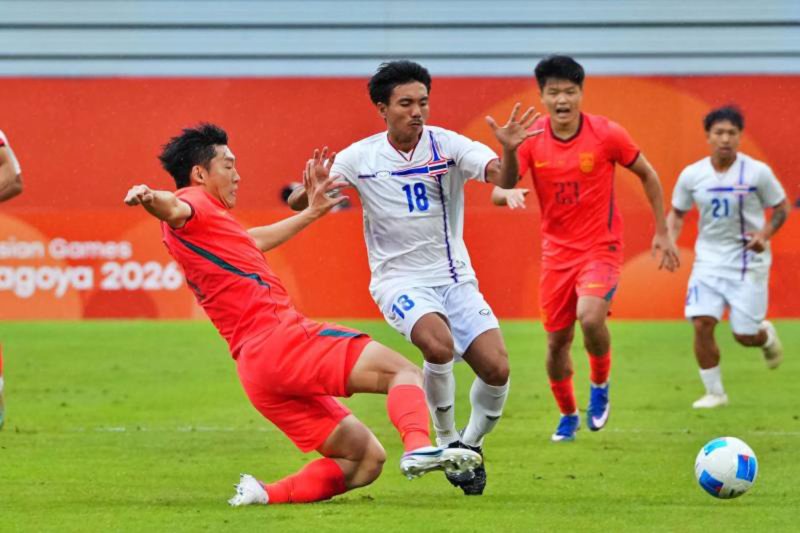
Thailand’s Asian Games football campaign came to a sobering end at Toyota Stadium on Saturday, undone by a clinical second-half burst from China that sealed a 3-0 quarter-final defeat and, with it, an early flight home from Japan.
Coach Thawatchai Damrong-ongtrakul had fielded his strongest available side, led by Yotsakon Burapha and Thanakrit Chotmuangpak, hoping to repeat the spirit of their 2-2 draw with China at the Xi’an Tournament earlier this year.
For long stretches, the Thais did show their mettle, but things turned on moments Thailand could not control.
China threatened first, with Zhu Chenjie forcing a smart save from goalkeeper Chommaphat Boonloet, who then denied captain Wu Xi in a tense opening period.
Thailand pushed forward in response, funnelling long balls up to striker Jehhanafee Mamah, but China’s back line held firm and the Thais struggled to establish any foothold in Chinese territory.
The breakthrough, when it came, was cruel.
Deep into first-half injury time, Wu Xi’s free-kick was warded away by Chommaphat, only for the loose ball to cannon off defender Auttapon Sangtong and loop into his own net. China led 1-0 at the break — a lead built on fine margins rather than dominance.
The second half told a different story. Two minutes after the restart, Hu Hetao pounced on a loose ball following another Chommaphat save to double China’s advantage, and by the 63rd minute substitute Zhang Yuning had made it three, turning home a Zhu Chenjie header from close range. Thailand’s resistance, so stubborn in the first half, had unravelled in the space of 16 minutes.
To their credit, Thailand did not fold entirely. Worawut Noisri tested goalkeeper Li Hao in the 70th minute, and Krittapak Seangsawat twice tried his luck from distance, including a late effort in stoppage time that flashed wide. But the damage was done, and China held on comfortably to book a first-ever U23 semi-final appearance, where they will meet defending champions South Korea.
For Thailand, it marks a return to familiar frustration: they have not reached the last four since Incheon 2014.
Speaking afterwards, Thawatchai was candid about the gulf exposed by the result.
“Today, we have to accept that China is really strong,” he said. “We tried to open with an attacking game, but we could not sustain it, and conceding right at the end of the first half meant our plan didn’t work.”
He pointed to China’s continuity as a key factor. “Many of our players are now with the senior national team, while the Chinese squad have stayed together, with some senior players brought in to help control matches. That made things harder for us.”
Thawatchai insisted the tournament, which also included fixtures against Japan, offered valuable lessons.
“Facing high-quality teams like Japan and China showed us exactly where we need to develop. It’s a good experience for the players and for me, as we look to build for the future.”
