
The trio of Advanced Info Service (AIS), Central Group and Japan Airlines have strengthened their collaboration on environmental, social and governance (ESG) missions to ensure an improved and sustainable future.
Their partnership creates a national model based on the circular economy and highlights a comprehensive approach that connects consumers, collection points, and international recycling facilities.
The companies want to build consumer confidence in their responsible electronic waste (e-waste) management, while encouraging behavioural change.
The trio recently brought the winners of last year's "Drop E-Waste Fast, Fly to Japan Free" video contest to Japan for a "learning journey" on global electronic waste management.
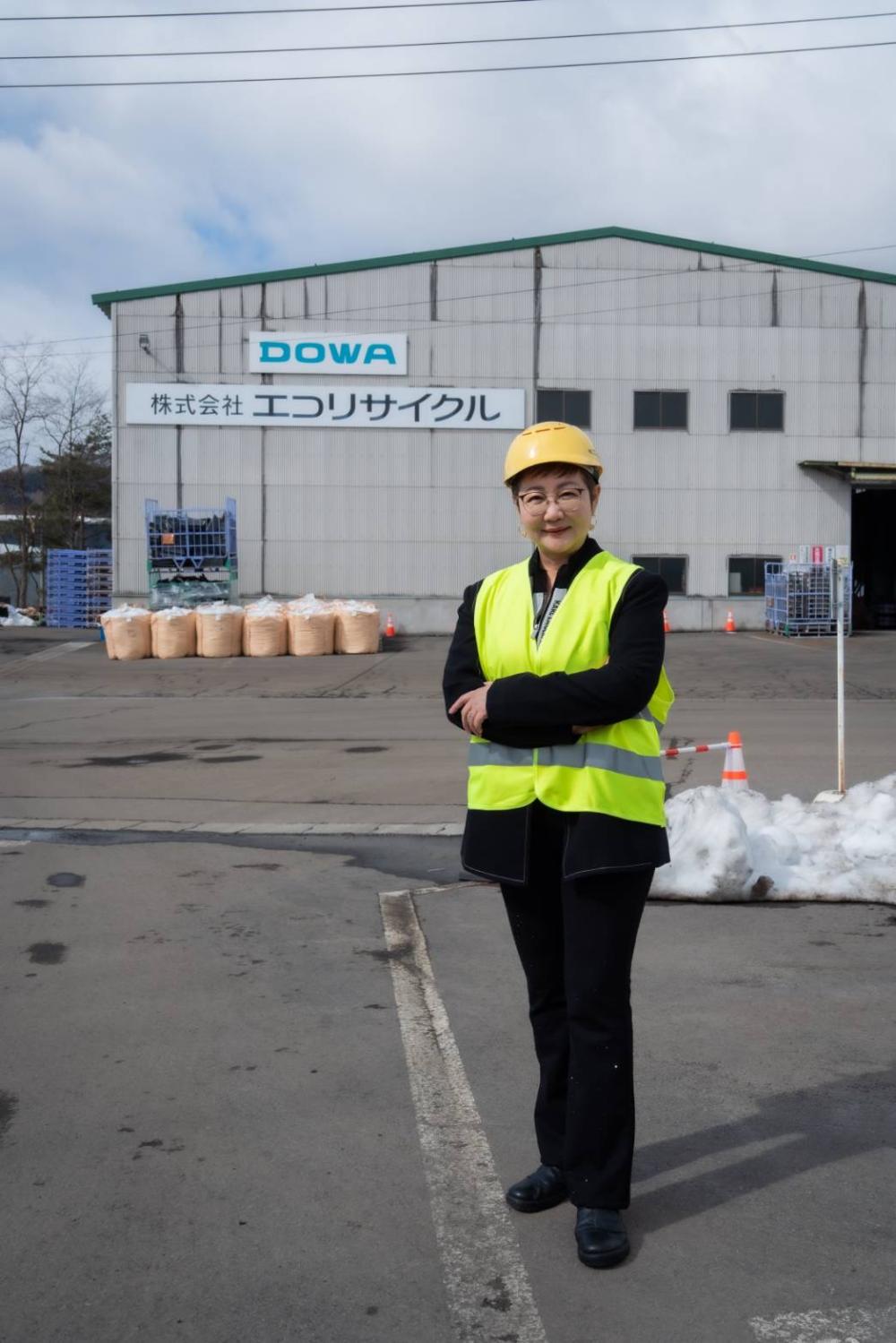
Mrs Saichon says AIS is committed to transparent and sustainable e-waste management.
First-hand experience
Saichon Submakudom, chief of corporate communications at AIS, said the trip offered participants a first-hand experience of the complete e-waste recycling process, from collection points in Thailand to advanced recycling facilities in Japan.
The campaign received strong public engagement, generating 159 creative video submissions and more than 3.5 million views nationwide.
Beyond raising awareness, the initiative encouraged action with 42 e-waste collection points located in Central malls across Thailand.
The collection boxes serve as starting points on a global recycling path that ensures responsible and sustainable e-waste management, she said.
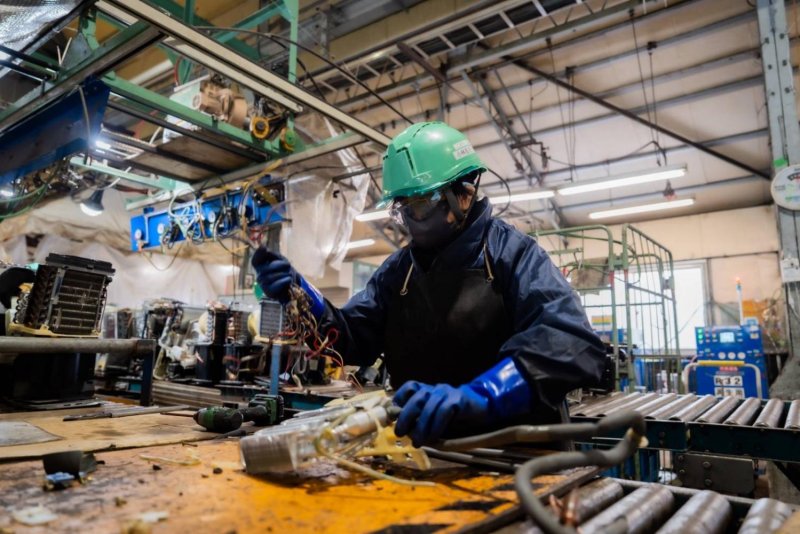
During the visit to Japan, the winners toured the facilities of Eco-Recycle Co Ltd and Kosaka Smelting & Refining Co Ltd, both part of Dowa Holdings.
These facilities process various types of e-waste, dismantling electronic devices to maximise recycling under Japan's strict e-waste management regulations.
The Kosaka plant specialises in extracting precious metals from e-waste components such as printed circuit boards found in mobile phones. These components contain valuable materials such as gold, silver and copper.
"This collaboration reflects AIS's commitment to transparent and sustainable e-waste management," said Mrs Saichon.
She said the prize is not only a travel experience, but also a sustainability learning experience, allowing them to witness the entire recycling journey.
"This helps build confidence that every piece of e-waste is handled according to the zero e-waste to landfill standard," said Mrs Saichon.
Assisting the trio was Waste Management Siam (WMS), also a member of Dowa Group, connecting consumers to world-class recycling facilities.
SAY NO TO E-WASTE
She said the collaboration expands from the long-running "Thais Say No to E-Waste" initiative that AIS and Central Group have jointly operated since 2020.
AIS has positioned itself as Thailand's central platform for managing e-waste, teaching consumers it does not belong in a landfill, said Mrs Saichon.
Central supports the expansion of collection points across its malls nationwide, linking retail spaces with standardised waste management systems to make proper e-waste disposal accessible and convenient for the public.
AIS also established a "Decarbonisation Roadmap" as a commitment to offering solutions for climate change.
Atchara Visuthivongsarat, deputy chief marketing officer at Central Group, said the company wants to maximise resource efficiency through the "Reduce, Reuse and Recycle" approach to minimise long-term environmental impact.
Central aims to reduce landfill waste by at least 30% by 2030 and move towards zero landfill waste by 2050 through its "Love The Earth – Zero Waste Now" initiative.
Central offers 42 e-waste collection points nationwide in collaboration with AIS, enabling convenient disposal.
"As a retail leader with comprehensive waste management systems, Central continues to engage customers, employees, business partners and communities to strengthen the country's resource management efforts and contribute to achieving net-zero goals," said Ms Atchara.
Takafumi Sawada, regional manager for Thailand, Indochina, and the South Asian subcontinent at Japan Airlines, said JAL recognises its responsibility towards the environment and society, and is committed to becoming a trusted global airline.
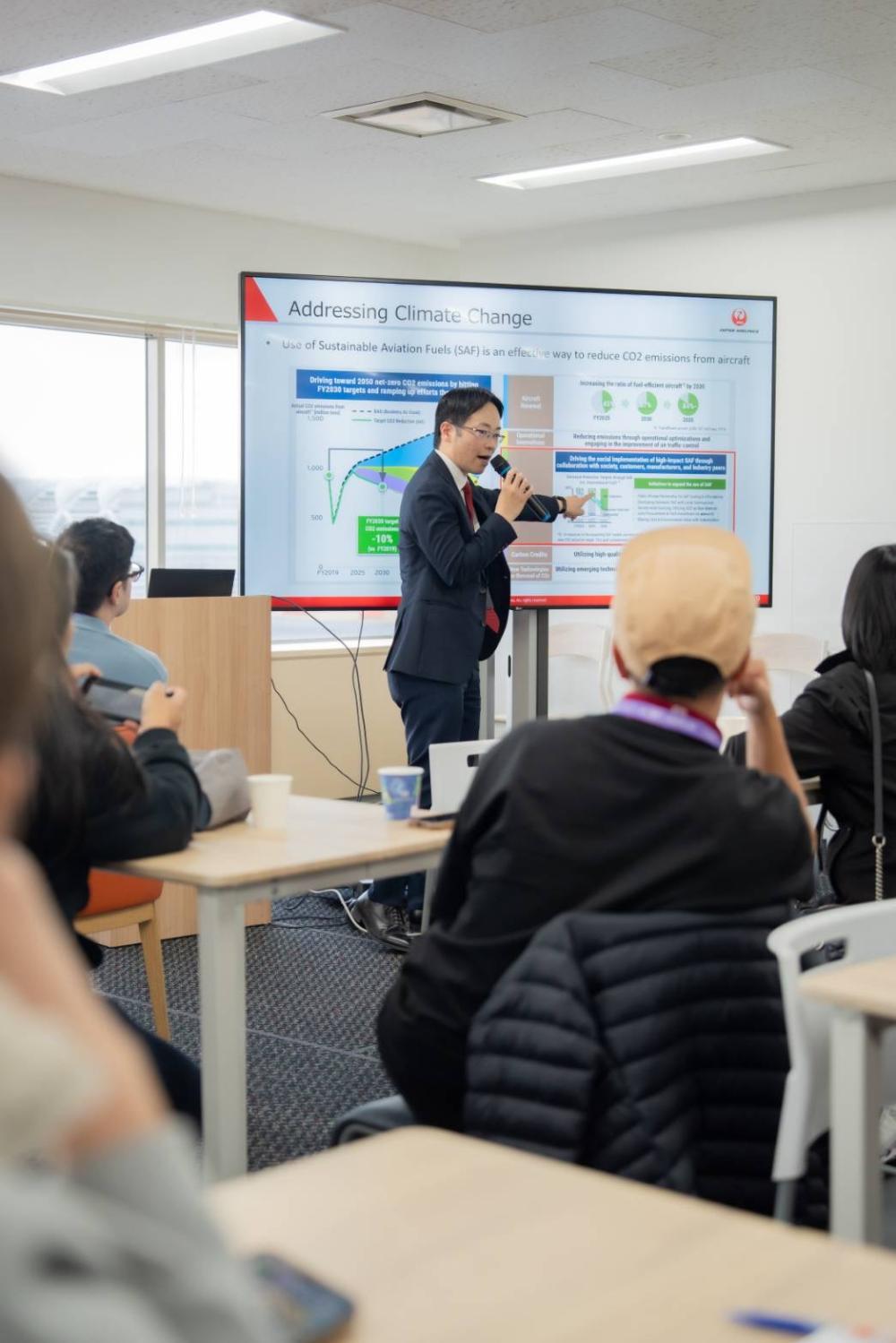
Mr Shinosuke tells the prize winners about JAL's vision for 2030.
SUSTAINABLE FLYING
The airline set a target to achieve carbon neutrality by 2050 by reducing carbon dioxide emissions and increasing the use of sustainable aviation fuel (SAF) produced from used cooking oil during flights.
JAL aims to increase the proportion of SAF it uses to 10% by 2030 while continuing to modernise its fleet with energy-efficient aircraft such as the Airbus A350 and Boeing 787.
The airline follows the "Reduce, Reuse, Recycle and Redesign" principle by eliminating single-use plastics and developing biodegradable food containers to reduce environmental impact.
Fukuda Shinosuke, director of planning for ESG promotion at JAL, said the company's vision for 2030 is to build a society where everyone can live with safety, security and peace of mind.
He said ESG strategy is a priority for JAL to realise value creation and growth.
For environmental policy, JAL works in an integrated manner on carbon neutrality, nature positivity and the circular economy, addressing climate change and effective use of limited resources as management targets, said Mr Shinosuke.
SAF usage is an effective way to help reach the airline's 2050 target of net-zero CO2 emissions, starting by hitting the 2030 goal and ramping up efforts thereafter, he said.
The 2030 target is a 10% reduction in CO2 emissions compared with 2019.
According to JAL's strategic sustainability roadmap, it is implementing immediate actions across three pillars: usage of SAF; eliminating single-use plastics; and pioneering paper cup recycling.
The airline also wants to spearhead the transition to a low-carbon fleet through domestic innovation and global expansion.
JAL's "Fry to Fly" project upcycles used cooking oil from Japanese households and businesses into high-quality SAF, transforming community waste into a strategic energy resource.
In addition, the airline is aggressively expanding SAF usage on major international routes, including San Francisco, Los Angeles, Chicago, Shanghai and Singapore, with plans to include Bangkok and Manila by fiscal 2026.
PLASTICS OUT
The carrier achieved a 96% reduction in single-use plastics in fiscal 2024.
JAL is committed to phasing out all new petroleum-based single-use plastics at every touchpoint, ensuring its operations on the ground are as sustainable as journeys in the skies.
The airline transitioned to plant-based tableware, paper meal tray liners, and biodegradable food container lids. All petroleum-based beverage bottles are being replaced with recycled or sustainable alternatives.
Moreover, JAL phased out disposable plastic covers for strollers and wheelchairs, instead introducing reusable, heavy-duty fabric covers that significantly reduce the volume of single-use plastic film traditionally discarded after a single flight.
In cargo logistics, the airline is shifting to recycled plastic wrap, ensuring that materials are derived from existing plastic waste rather than new petroleum-based sources.
Turning waste into gold
Dowa Eco-System Co Ltd, a subsidiary of Dowa Holdings in Japan, developed an advanced recycling process capable of reducing landfill waste to 9%.
As part of the broader DOWA Group, which comprises 12 subsidiaries, the organisation plays a significant role in the global e-waste recycling infrastructure.
In Thailand, e-waste collected from private sector partners such as AIS and Central Group is transferred to WMS, a waste treatment company under DOWA Group.
WMS manages the waste before forwarding certain materials to Japan for further processing, particularly those that cannot yet be treated in Thailand.
Among the group's subsidiaries, Eco-Recycle and Kosaka Smelting & Refining perform complementary roles within the recycling chain.
Fumihiro Kajihara, managing director of Eco-Recycle, said the company serves as the primary facility that receives a wide range of e-waste.
The plant dismantles appliances and electronic devices into individual components in order to maximise the amount of material that can be recycled.
According to data from 2024, the facility processed 11,100 discarded electronic appliances.
During the separation process, components such as LED lamps, display panels and circuit boards were extracted and sent to specialised plants for further treatment.
From this volume of waste, the company successfully recovered roughly 713 grammes of gold, 3,585 g of silver and 229 kg of copper. Only around 9% of the remaining material became non-recyclable residue, which was ultimately disposed of in landfills.
Kosaka Smelting & Refining is responsible for processing electronic components such as circuit boards from mobile phones and other devices.
These materials contain various precious metals including gold, silver and copper, which can be extracted through highly advanced metallurgical processes.
Kazuhiro Shima, director of Dowa Eco-System, said the Kosaka facility is recognised as one of only three such plants worldwide capable of extracting more than 20 types of valuable metals from e-waste.
The facility's technological capability has made it a global leader in e-waste recycling.
This comprehensive system reflects Japan's commitment to transparency and high standards in e-waste management, he said.
At a time when energy challenges, rising gold prices and growing environmental awareness are reshaping global industries, the recovery and reuse of valuable metals from e-waste offers a sustainable path, said Mr Shima.