
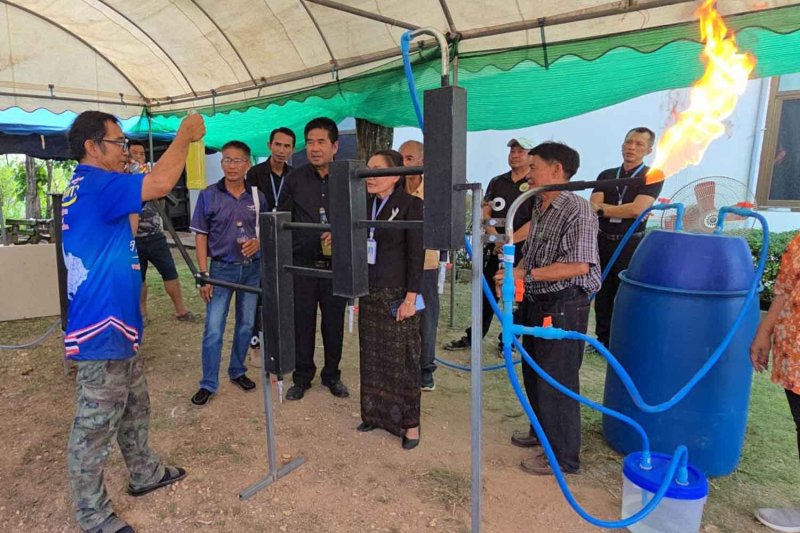
Local authorities in Khon Kaen have launched a pilot initiative to convert plastic waste into fuel, aiming to help communities reduce fuel expenses amid soaring petrol prices.
Phon Phek Tambon Administrative Organisation (TAO) CEO Auychai Pulan recently led a workshop promoting plastic-to-fuel conversion for residents. The aim is to help reduce fuel cost and also help reduce waste in the communities, he said.
Around 10kg of plastic can produce 4-8 litres of usable fuel, depending on the type of plastic, said Decha Chansri, head of the Innovation Centre Network for Plastic-to-Fuel Conversion.
Mr Decha demonstrated the pyrolysis process, which uses heat in an oxygen-free environment to break down plastic into fuel without producing harmful pollutants. "The technique does not generate pollution or toxic substances as it does not involve combustion," he said.
Mr Decha said the process melts plastic under high pressure until it vaporises, which then condenses into fuel oil, including petrol, diesel and cooking gas.
Villagers with basic mechanical skills can build a pressure tank for under 5,000 baht, with training provided locally. "Within five hours, 10kg of plastic can yield 4-8 litres of fuel, a process far faster than natural decomposition," he said.
Diesel production requires a mix of various plastics types including High-Density Polyethylene (HDPE) such as shampoo bottles, motor oil bottles; and Low-Density Polyethylene (LDPE) such as grocery bags.
It also requires Polypropylene (PP) including straws and bottle caps; and Polystyrene (PS) such as styrofoam cups and egg cartons, achieving a cetane rating of 65%, higher than the Energy Ministry's standard of 50%, he said.
"Petrol can be produced from all plastic types, while foam containers can yield fuel with octane levels up to 100%, suitable for all engines," he said.
He also showed how fuel produced from 10kg of plastic powered a lawn mower.
Permanent secretary of TAO of Phon Phek, Phasuk Piasangka, said the initiative also promotes systematic waste collection.
"If all 15 villages participate, communities can turn plastic waste for fuel, generating additional income while reducing local waste. A central extraction facility will be established to serve as a learning hub."
Residents are enthusiastic: Rawistha Thesiha, 38, said it is so good, he wants his neighbours to join.
"The plastic waste we throw away every day in large quantities can be converted into fuel. Producing fuel from waste for our own use is especially useful during this period of high and scarce fuel prices," he said. The equipment is affordable and the raw materials come from everyday waste."