


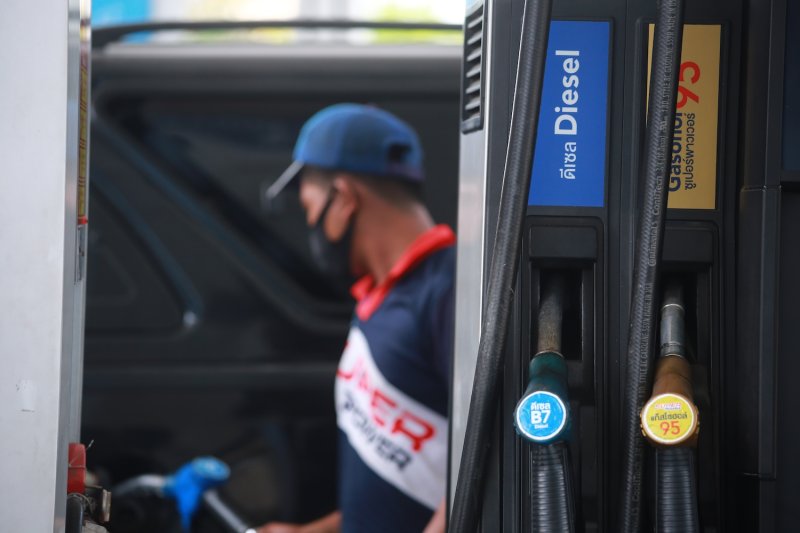
The pump price of diesel, previously capped at 30 baht a litre, will increase by 50 satang on Wednesday, and will continue to rise gradually to 33 baht to reduce the burden of subsidies, authorities said on Tuesday.
The price of gasohol 95 will rise by 1 baht a litre, while gasohol E20 will decrease by 79 satang on Wednesday, according to Energy Minister Atthapol Rerkpiboon.
The Ministry of Energy apologised on Tuesday for the current fuel shortage in Thailand, which has affected a wide range of activities from transport and logistics to hospitals and garbage collection.
The country has 101 days of oil reserves when all scheduled deliveries are included, according to Sarawut Kaewtathip, the director-general of the Energy Business Department.
Thailand has six oil refineries that can refine 175 million litres of fuel daily, including 32-33 million litres of benzine, 75-80 million litres of diesel, 25 million litres of jet fuel, 13 million litres of heavy fuel oil, and 6-7 million kilogrammes of LPG.
Mr Sarawut said the ministry had identified the bottlenecks in refining and delivery of fuels to service stations, where long queues were seen in several provinces on Tuesday.
Refineries sell most of their products to major distributors and sometimes to middlemen, also known as jobbers, Mr Sarawut said.
The major distributors mostly deliver to their own branded service stations. They also sell to jobbers who in turn supply independent petrol stations as well as industrial and other customers.
When the conflict in the Middle East broke out, he said, the major distributors reduced supply to the jobbers in order to concentrate on supplying their own brands. As a result, many independent service stations ran short of fuel and everyone converged at branded stations, resulting in long queues.
Authorities subsequently asked refiners to increase their capacity, while major distributors were told to supply more fuel to jobbers.
As well, permission was sought from the police and Bangkok Metropolitan Administration to extend the number of hours tanker trucks are allowed to operate in order to ensure sufficient supplies at service stations.
More shipments en route
Discussing oil stockpiles in Thailand, Mr Sarawut said there was currently enough for 42 days. But 1.9 million barrels of oil coming from Angola and 625,000 from the US will cover an additional 29 days. As well, agreements with other suppliers represent another 30 days, bringing the total to 101 days.
Mr Sarawut said that on Sunday and Monday, ministry officials inspected 1,502 petrol stations across the country. It found 151 were closed because fuel had run out, 1,039 were operating but some fuels were unavailable, and 306 were fully operating.
“We would like to apologise for what has happened and we would like to inform the public that we still have enough oil reserves. So, there is no need to hoard,” he said.
Deputy Prime Minister Phiphat Ratchakitprakarn, in his capacity as director of the Centre for Middle East Situation Administration, also discussed the energy crisis with senior officials at a meeting on Tuesday afternoon.
He said diesel products would be gradually adjusted from B7 to higher blends of biofuel, including B10 and B20, with large vehicles encouraged to switch to B20 to support the transport, agricultural and construction sectors.
The move aims to ensure industrial users can purchase fuel directly from refineries, intermediaries or jobbers, amid recent cases where some jobbers have halted sales to industrial customers, forcing trucks to refuel at service stations and causing shortages that have affected the public.
As well, he said, at the suggestion of Prime Minister Anutin Charnvirakul, authorities will now also announce ex-refinery and depot-level oil prices to increase transparency.
