The government may be forced to implement fuel tax reductions if the Oil Fuel Fund proves insufficient to stabilise domestic prices, Deputy Prime Minister Ekniti Nitithanprapas has warned.
Mr Ekniti, who also serves as the finance minister, said the Finance Ministry has already prepared contingency plans for a reduction in fuel taxes should the situation deteriorate.
However, he stressed that any final decision would rest with the incoming government. "If the fund is no longer able to maintain price stability, tax measures will become necessary," he said.
He compared the current situation with the Russia–Ukraine war, when the government spent about 270 billion baht through a combination of Oil Fuel Fund subsidies and cuts to fuel excise taxes to cap retail prices.
This time, however, fiscal constraints are tighter. "Our fiscal position is weaker than it was then, and we must be mindful of maintaining Thailand's credit rating," he said.
Despite market turbulence, authorities have insisted that domestic fuel supplies remain sufficient.
Customs Department director-general Phantong Loykulnanta confirmed that crude oil imports have not declined. On March 20, Thailand imported 276 million litres of crude oil, with average daily imports exceeding 100 million litres.
Danucha Pichayanan, secretary-general of the National Economic and Social Development Council, said refiners have stepped up production to meet rising demand.
Major operators, including PTT and Bangchak Corporation, have increased refining output by around 9%, with a particular emphasis on diesel. Retail sales have also surged, with PTT Oil and Retail Business reporting petrol sales up 25% and diesel up 35%.
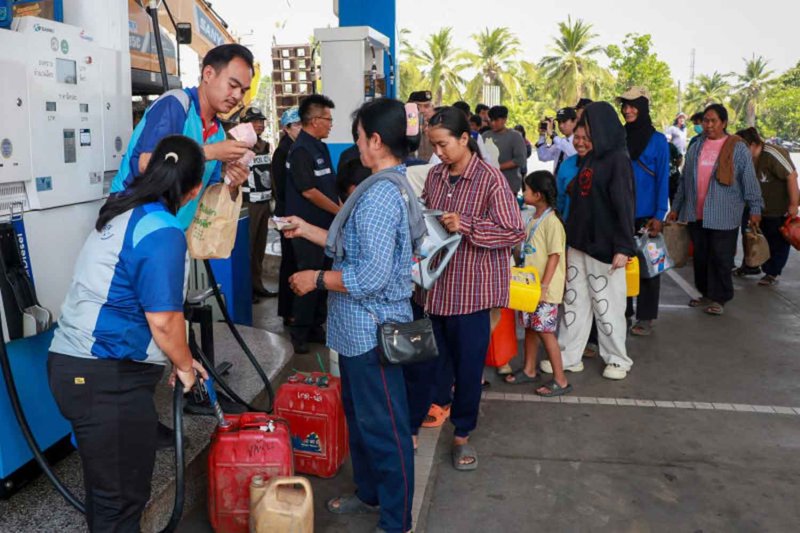
To ease pressure on service stations, the government has expanded fuel distribution to wholesale distributors, ensuring industrial users do not compete directly with retail consumers.
Refiners such as Thai Oil, PTT Global Chemical, IRPC and Bangchak have increased deliveries accordingly, although officials noted it may take one to two days for supplies to fully reach all areas. The public has meanwhile been urged to conserve energy.
In a further effort to improve oversight, authorities are preparing to launch a real-time dashboard to track fuel distribution from refineries to end users. The system is expected to go live within a few days and will allow regulators to prevent hoarding. Provincial authorities have also been instructed to inspect fuel stations nationwide.
Mr Danucha said Thailand is not exporting fuel to any country beyond neighbouring countries. Shipments are limited to Laos and Myanmar, capped at 5 million litres per day.
The Energy Ministry has maintained that the Oil Fuel Fund is still capable of cushioning price increases, even as global oil prices have surged from around US$90 per barrel (2,930 baht) in recent weeks.
Nevertheless, officials acknowledge that domestic retail prices may need to adjust to reflect rising costs.