


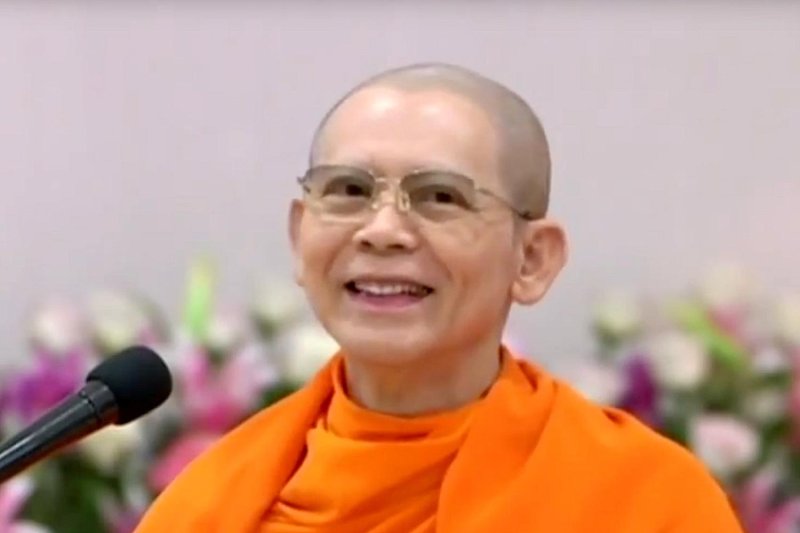
The case against Phra Dhammajayo has been terminated after exceeding the 10-year statute of limitations, bringing an end to long-running proceedings without a trial.
In 2016, the former abbot of Wat Phra Dhammakaya was charged by the Department of Special Investigation (DSI) with money laundering, receiving stolen assets and forest encroachment, linked to the multi-billion-baht embezzlement at Klongchan Credit Union Cooperative (KCUC) in 2013.
A 23-day search across more than 2,000 rai of the temple in Pathum Thani's Khlong Luang district in 2017 failed to locate him. Now aged 82, he did not surrender, citing critical health issues, and has remained missing since.
Who is Phra Dhammajayo?
Phra Dhammajayo, born Chaiyabun Suthiphon in 1944 in Sing Buri's Phrom Buri district, grew up in a family that frequently relocated due to his father's role as an official in the Department of Industrial Works, before eventually settling in Bangkok.
According to Wat Phra Dhammakaya, he developed an early interest in Buddhism while studying at Suankularb Wittayalai School, where he founded a Young Buddhist Club and took part in religious activities.
In 1963, after gaining admission to Kasetsart University, he sought out Maechee Jan Khonnokyoong, a nun who later became his mentor, to study Dhammakaya meditation taught by Phramongkolthepmuni, or Luang Pu Sodh Candasaro of Wat Paknam Phasi Charoen, in the early 20th century.
Mr Chaiyabun was ordained in 1969 and received the monastic name "Dhammajayo", meaning "Dhamma conqueror".
He later assisted his mentor in teaching, drawing a growing number of followers. In 1970, with initial funds of only 3,200 baht, Wat Phra Dhammakaya was established on a 196-rai plot of land donated by a devotee.
How significant is the temple's influence?
In its early years, Wat Phra Dhammakaya focused on students and young people, notably through the Dhamma Tayat Programme launched in 1982, which later produced followers who went on to lead Buddhist clubs at universities.
The temple also pioneered large-scale meditation gatherings and adopted modern outreach tools, including satellite television, online courses and marketing strategies, to attract middle-class and wealthy followers both in Thailand and abroad.
Controversy emerged during the 1997 Asian financial crisis, when critics questioned the temple's perceived opulence amid widespread economic hardship, particularly among the middle class.
Since then, Wat Phra Dhammakaya has faced sustained scrutiny from sections of the media and Buddhist scholars, including allegations of doctrinal misinterpretation and criticism of its dome-shaped architecture. Phra Dhammajayo was also accused of land embezzlement, though the case was later dropped.
Despite this, the temple has continued to expand its activities and influence, attracting a wide network of followers, including prominent figures such as former prime minister Thaksin Shinawatra, who is currently in detention.
What did the DSI accuse Phra Dhammajayo of?
Plea Dhammajayo was accused by the Department of Special Investigation (DSI) of money laundering and receiving stolen property linked to the 2013 embezzlement scandal at Klongchan Credit Union Cooperative (KCUC).
Members of the co-operative alleged that then chairman Supachai Srisupa-aksorn had siphoned more than 10 billion baht, leaving the institution unable to meet withdrawals. He admitted the offence. The Supreme Court sentenced him to multiple terms totalling hundreds of years, capped at 20 years under the law for public fraud and forged documents. He was also ordered to repay 5.6 billion baht to 2,455 victims and about 10.8 billion baht to KCUC.
In 2016, Prakit Philangkasa, then chairman of the KCUC committee, disclosed that cheques worth about 1 billion baht had been channelled through followers of Phra Dhammajayo, with part of the funds allegedly reaching the abbot and the temple.
Although Supachai maintained the transfers were donations, the DSI pursued charges against Phra Dhammajayo, arguing the money originated from the embezzlement scheme.
Despite arrest warrants, the abbot did not report to investigators, with followers citing serious health concerns. The Criminal Court approved a warrant on May 17, 2016, following an earlier request on April 25.
On Feb 16, 2017, officials launched a high-profile search of Wat Phra Dhammakaya under Section 44 of the interim constitution, authorised by then prime minister Gen Prayut Chan-o-cha. The operation, which lasted 23 days and covered more than 2,000 rai, failed to locate him.
Phra Dhammajayo has not been seen publicly since.
On March 26, 2026, the DSI confirmed the case had been dropped after exceeding the statute of limitations, with complainants notified on March 20 under Section 39(6) of the Criminal Procedure Code.
What lessons can be learned?
The termination of the Phra Dhammajayo case raises several systemic concerns. First, the 10-year statute of limitations served as a loophole, allowing a fugitive to effectively "run out the clock".
Second, it exposed enforcement gaps, showing that even extraordinary state powers may struggle to penetrate influential communities. Third, it highlights regulatory blind spots in religious financing, which may pose risks to financial transparency and oversight.
Finally, the outcome risks deepening public cynicism towards the justice system. It also suggests that, without legal reforms -- such as suspending limitation periods for fugitives -- questions over the effectiveness of legal processes will persist in high-profile cases.


