


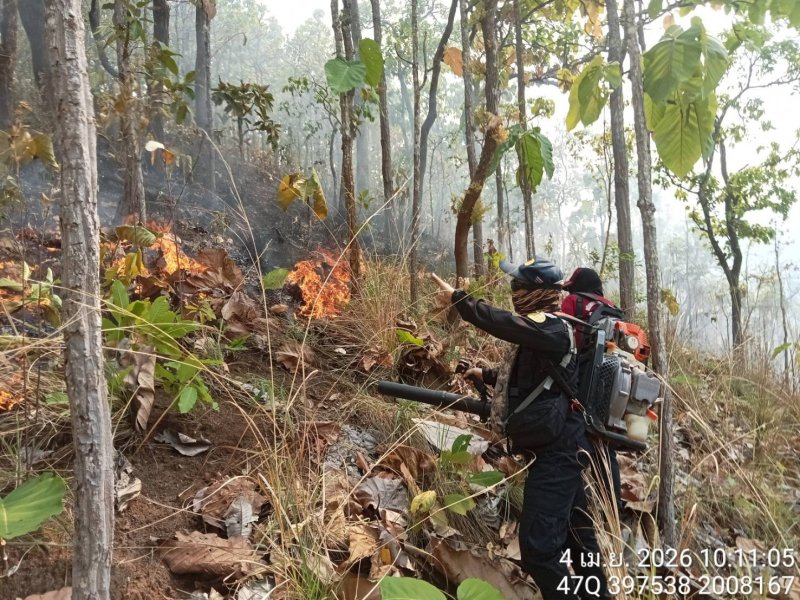
MAE HONG SON - A deepening wildfire crisis in this northern province has left authorities battling 186 satellite-detected hotspots and hazardous PM2.5 pollution at red-alert levels.
The difficult mountainous terrain was hampering the efforts of firefighters who also face the added peril of a shortage of food and drinking water.
Provincial governor Wiboon Waewbandit said on Sunday that fires continue to spread across several districts, particularly Mae Sariang where nearly all villages in seven tambons have been declared disaster zones. The Western Forest Complex (Salawin forest) in tambon Sao Hin is among the heavily affected areas.
The governor, who visited the area on Saturday, said the rugged landscape made access difficult, preventing crews fully extinguishing flames and allowing dense smoke to accumulate over a period of weeks.
Mr Wiboon said officials had been instructed to step up community outreach to stop forest burning and warned that strict legal action will be taken against those who ignore the ban.
- Satellite data shows rising fire activity -
Data from the Suomi NPP satellite’s VIIRS system detected 186 hotspots in the province early Sunday morning. Firefighting teams from multiple agencies were deployed across Muang, Pai and Pang Mapha districts, containing several blazes but struggling in areas where fires remain unreachable due to the steep terrain. Some fires were linked to illegal forest foraging, Mr Wiboon said.
As operations continue, fire crews working in remote high-risk areas were facing shortages of food and drinking water, prompting appeals for public donations to support frontline efforts.
- Temples mobilised to help -
Phra Dhammasenabodee, governor of Ecclesiastical Region 7 and abbot of the iconic Wat Phra That Doi Suthep in Chiang Mai, issued an urgent directive to ecclesiastical officials at all levels in Chiang Mai, Lamphun and Mae Hong Son, instructing every temple to work in close cooperation with state agencies and civil society to fully support wildfire suppression efforts.
Under the order, temple grounds may be used, where appropriate, as shelters, rest areas or coordination centres for firefighting operations. Temples are also asked to prepare and provide drinking water, dried food and essential supplies to assist officials and volunteers deployed in affected areas.
Mae Hong Son’s public health chief Thotsapol Ditsiri advised people to avoid outdoor activities where possible and wear protective masks when outside, while children, the elderly, pregnant women and those with chronic illnesses were advised to stay indoors in enclosed or clean-air environments.
The Centre for Air Pollution Mitigation (CAPM) reported on Sunday morning that PM2.5 levels exceeded safety standards in 42 provinces, covering Bangkok as well as the northern, northeastern, central, western and eastern regions, with the North currently the most critically affected area.
Mae Hong Son ranked second among the five worst-affected provinces, recording concentrations of 126.8–286.9 microgrammes per cubic metre, alongside Chiang Mai, Chiang Rai, Lamphun and Nan.
