


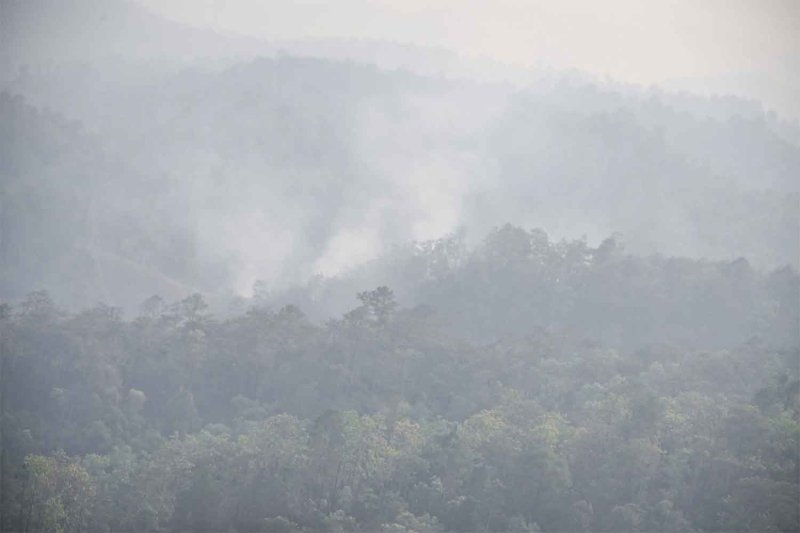
Severe haze in northern Thailand has intensified pressure on the government to adopt stronger legal tools, including advancing the contested Clean Air Bill.
Withoon Lianchamroon, secretary-general of Biothai which is a local advocacy group on food security and sustainable farming, warned the crisis could worsen without decisive intervention.
"We have no time to lose. The heavy air pollution in the North might grow worse if there is no effective act to control the pollution at its source," he said, pointing to persistent gaps in enforcement and the need for long term policy change.
Dangerous levels of PM2.5 have persisted for several days across the Northern provinces, prompting governors of Chiang Mai, Lamphun and Phayao to declare emergency disaster zones on Saturday.
The PM2.5 pollution poses heightened risks to vulnerable groups such as children, the elderly, and those with underlying health conditions.
Dr Arintaya Phrommintikul, director of Maharaj Nakorn Chiang Mai Hospital, warned PM2.5 is a "silent threat" to health, with nosebleed cases rising 1.5 times during the haze season. She outlined both acute and long term impacts, including respiratory irritation, eye and nasal inflammation, and increased cardiovascular risks.
"Each 10 µg/m³ rise in PM2.5 raises heart disease and stroke risks by 6-8% among the vulnerable groups," she said. The Chiang Mai Provincial Public Health Office is monitoring the pollution.
The Geo-Informatics and Space Technology Development Agency on April 2 recorded more than 3,763 hotspots nationwide, with over 70% in forest areas in the north. The scale and location of these hotspots have raised concerns about forest management and fire prevention strategies.
The Department of Pollution Control expects conditions to worsen until the first week of April due to poor air circulation and stagnant atmospheric conditions.
Political debate has intensified over the Clean Air Bill, which has become central to discussions on long term solutions. Phattarapong Leelaphat, People's Party MP of Chiang Mai, said the issue should not be politicised.
He urged lawmakers to move forward with the bill rather than restart the legislative process.
The measure had already secured 308 votes in a previous parliamentary session and had reached the Upper House, but Parliament was later dissolved.
The new government must ask parliament to resume consideration of the bill within 60 days of the first sitting; otherwise, the bill will lapse, he said. Delays could undermine public trust and prolong health risks.
The ruling Bhumjaithai Party has expressed reservations, arguing the proposed legislation could have big economic implications and existing legal frameworks are sufficient if properly enforced.
This position has drawn criticism from environmental advocates and civil society groups, who argue the laws lack the enforcement mechanisms and structural focus needed to tackle recurring haze pollution effectively.
The Clean Air Bill, first initiated by civil society groups in 2019, introduces a comprehensive framework for managing air pollution. Its provisions include decentralising authority to enable local communities to respond more effectively to haze in their areas.
It also incorporates a polluter pays principle, requiring those responsible for pollution to compensate affected communities, and promotes traceability measures to ensure that supply chains, including agricultural imports, are free from activities that contribute to transboundary haze.
Mr Withoon, of Biothai, said most hotspots are concentrated in forest areas managed by state agencies, while community managed forests report fewer incidents. This shows the effectiveness of local participation in fire prevention.
The blanket no-burning policies introduced in previous years may have led to an accumulation of dry vegetation which increased the intensity of wildfires, he added.
"We have no time to lose," Mr Withoon reiterated.
