


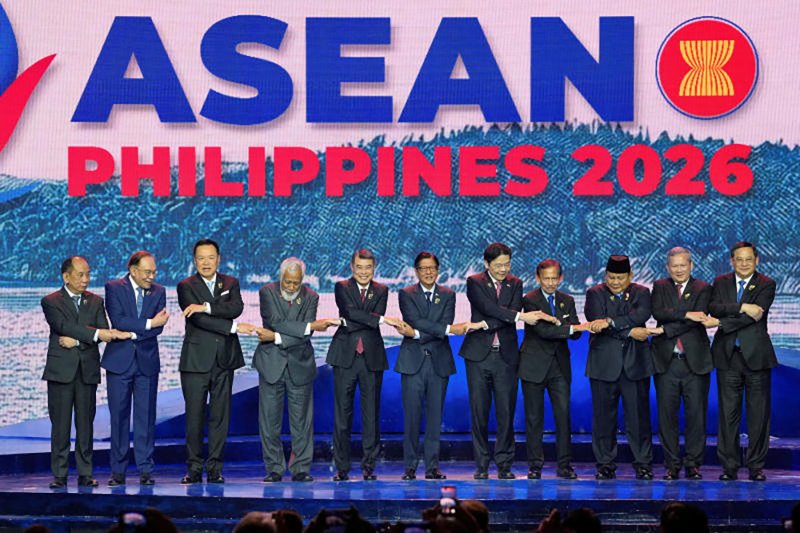
Prime Minister Anutin Charnvirakul has called for stronger regional unity, resilience and global relevance within Asean as the region grapples with growing geopolitical volatility and economic uncertainty.
Mr Anutin underscored that global conditions were shifting rapidly, with crises such as the conflict in the Middle East reflecting a broader and increasingly unpredictable international order, according to PM’s Office spokeswoman Rachada Dhnadirek, briefing the media following the leaders’ retreat at the Asean Summit on the Philippine island of Cebu on Friday.
The prime minister noted that the multilateral system long relied upon by the international community was undergoing significant change and that “the world will not be the same again”, Ms Rachada said.
He warned that Asean could no longer assume that principles such as dialogue, restraint and peaceful dispute resolution would occur automatically, and must instead actively reinforce them.
The 11-country bloc, he said, needed to respond to emerging challenges with greater agility and strategic foresight rather than maintaining a reactive stance.
The prime minister outlined three key strategic priorities for Asean.
First, he said unity remained the bloc’s core strength but required sustained effort. Member states must look beyond narrow national positions and prioritise shared regional interests, with improved coordination and faster decision-making, particularly during times of crisis.
Second, Mr Anutin stressed the importance of resilience and maintaining “Asean centrality”, urging member states to place the bloc at the heart of their foreign policies. He also highlighted the need for stronger and more practical mechanisms to manage tensions and prevent them from escalating into crises.
Third, on relevance, he said Asean must continue to play a constructive role both within and beyond the region by remaining a credible and trusted partner. That means supporting a rules-based international order and ensuring that regional cooperation delivers tangible benefits for people, including improved quality of life and economic opportunities.
Myanmar a test
Mr Anutin also addresses the situation in Myanmar, describing it as a key test of Asean’s unity, resilience and relevance.
He pointed to recent developments — including the amnesty granted to ex-president Win Myint and the relocation of deposed former leader Aung San Suu Kyi to a residence — as potentially positive signals that could create space for dialogue and reconciliation, despite existing limitations.
These developments, he said, could allow Asean to pursue more concrete engagement with Myanmar in a gradual and appropriate manner, in line with the bloc’s five-point consensus.
Philippine President Ferdinand Marcos Jr, in his capacity as chair of the event, acknowledged frustration among member states over the lack of progress in implementing Asean’s Five-Point Consensus aimed at restoring peace and dialogue in Myanmar.
“There was a tacit agreement that we need to do more,” he said, describing Myanmar as “part of the Asean family”.
Energy crisis spurs regional coordination
Regional leaders also underscored the urgency of coordinated action to address the economic fallout from the Middle East crisis, particularly its impact on energy supply and prices.
They placed energy security, food resilience and the protection of nationals abroad at the centre of attention.
Mr Marcos said leaders agreed the three priorities were closely interconnected and required urgent collective action.
They called for a harmonised approach to safeguard energy, with Mr Marcos warning that the conflict had triggered a “domino effect” disrupting the global economy and exposing the region’s vulnerability to external shocks.
Leaders agreed to accelerate implementation of the Asean Power Grid project, aimed at linking electricity networks across all 11 member states to support cross-border energy trading and improve long-term supply stability.
They also pushed for faster ratification of the Asean Petroleum Security Agreement, which would allow member states to support one another during fuel shortages and emergencies.
They also highlighted the need for concrete, collective measures and longer-term planning, with Indonesian President Prabowo Subianto cautioning that supply pressures could persist and urging the bloc to prepare for prolonged disruption.
Efforts under discussion include diversifying energy sources, strengthening crisis coordination and advancing a regional fuel-sharing framework, although implementation remains a challenge.
Mr Marcos acknowledged the urgency of the issue, saying leaders believed the region needed stronger energy mechanisms “yesterday, if not sooner”.
