
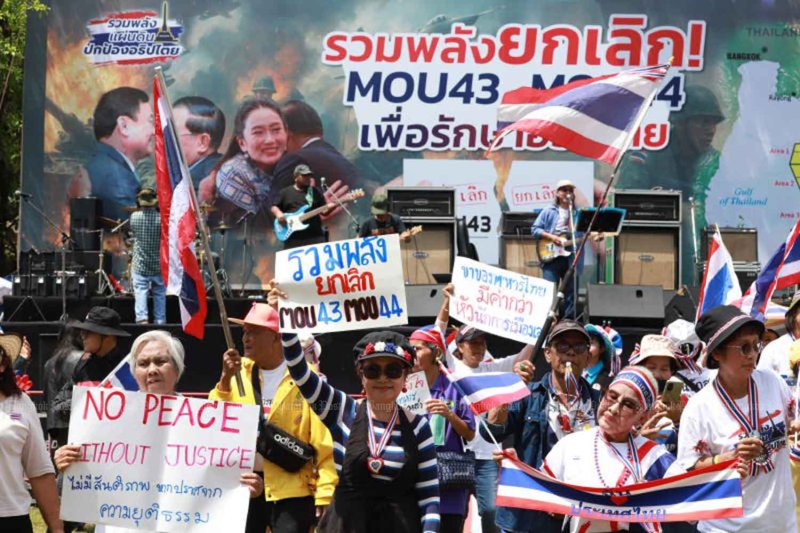
A Senate ad-hoc committee has recommended that the government scrap the 2000 agreement on land border demarcation with Cambodia, known as Memorandum of Understanding (MoU) 43, citing constitutional and legal concerns.
Senator Noppadon Inna, chair of the committee, said MoU 43 may violate constitutional procedures because the cabinet in 2000 acknowledged the agreement but did not formally approve it.
He said the signing process also failed to comply with required procedures -- including cabinet authorisation and parliamentary approval -- for cases involving potential territorial implications.
Mr Noppadon said acceptance of a 1:200,000-scale map under the agreement could affect Thailand's territory or jurisdiction, yet the MoU was never submitted to parliament for approval.
He added that border demarcation under MoU 43 had made little progress, remaining at the first of five stages despite nearly 26 years having passed.
"The Thai side can unilaterally terminate MoU 43, provided Cambodia is notified at least three months in advance," he said, adding that negotiations to amend the agreement could still take place before cancellation takes effect.
The report drew mixed reactions from senators, with some supporting the recommendations while others questioned the panel's reasoning and warned of possible hidden agendas.
Senator Pornchai Witthayalertphan argued that scrapping the agreement would remove an important bilateral mechanism and could lead Thailand into compulsory dispute settlement involving foreign arbitrators, weakening its leverage in negotiations over shared maritime resources.
He cautioned against allowing nationalist sentiment to overshadow the country's long-term interests.
The government has already resolved to terminate MoU 44 on overlapping maritime claims with Cambodia, saying maritime boundary issues would instead be governed by the United Nations Convention on the Law of the Sea (UNCLOS), to which both countries are parties.
Senator Thewarit Maneechai said cancelling MoU 44 could undermine Thailand's credibility in international agreements and argued that constitutional concerns were largely a domestic legal matter that did not automatically invalidate the pact.
He said the issue should not be viewed in black-and-white terms, but addressed through negotiations.
Amid energy concerns, he urged Thailand and Cambodia to pursue joint petroleum development.
The Senate will forward the report and accompanying observations to the government for consideration.