


The Ministry of Digital Economy and Society has strongly defended the controversial TH-AI Passport project, rejecting allegations of procurement irregularities, bid-rigging and political favouritism.
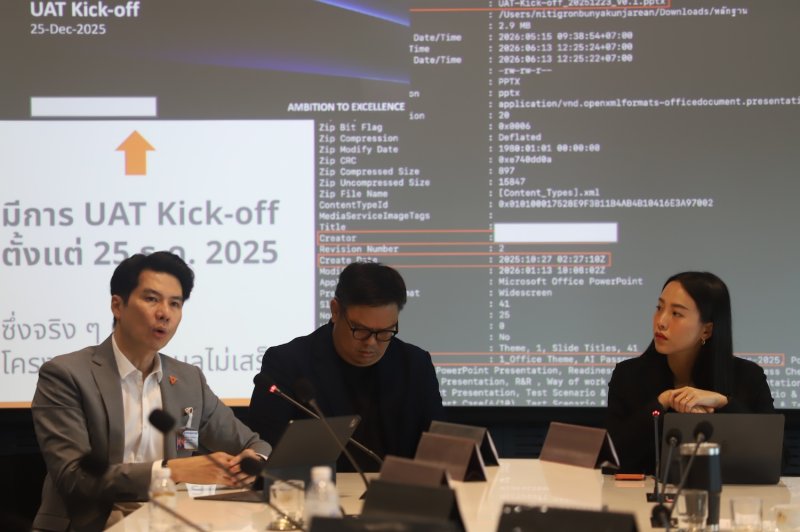
Patchara Anantasilp, the ministry’s permanent secretary, on Thursday presented a detailed timeline of the project’s development, denying it had been rushed, as lawmakers intensified scrutiny of the 1.6-billion-baht initiative.
The hearing brought together MPs from two House committees: Budget Planning and Monitoring; and Legal Affairs, Justice and Human Rights. They asked questions about the project’s accelerated implementation timeline, procurement process, and potential links between the winning consortium and politically connected business interests.
Under the first phase of the project, the government plans to spend around 1.6 billion baht to procure professional and premium generative artificial intelligence models for 5 million Thais to use for free for one year.
The winning bidder was TH Consortium, which consists of Turnkey Communication Services Plc, a Thai ICT engineering solutions specialist, and Human Intelligence Co Ltd, a joint venture between Thai and Hong Kong investors building digital education infrastructure in Thailand.
Long-term AI strategy
Mr Patchara told the lawmakers that the policy objective underpinning TH-AI Passport — expanding public awareness and adoption of artificial intelligence technologies — dated back to May 2022 under the administration of former prime minister Prayut Chan-o-cha.
The initiative originated from the National Artificial Intelligence Action Plan and was subsequently incorporated into multiple national digital development frameworks, he said.
In May 2025, under the administration of former prime minister Srettha Thavisin, the national AI steering committee established an ambitious target of reaching 20 million AI users or AI-aware citizens by 2027.
Mr Patchara said the objective remained unchanged even after subsequent political transitions and the establishment of a permanent national AI committee under newly enacted legislation in 2026.
“The target of enabling 20 million people to access and understand AI was not created overnight,” he said. “It has been part of Thailand’s national AI roadmap for several years.”
AI adoption and digital skills development has become one of five urgent policy pillars of the current government, with authorities instructed to accelerate implementation during the first phase, he said.
DE Fund usage
A key point of contention involves the funding source for the project. Critics have said that financing the project through extra-budgetary funds circumvented normal parliamentary budget scrutiny.
Mr Patchara rejected those claims, explaining that when the current administration assumed office on Oct 1, available allocations under the ministry’s annual budget had largely been committed.
As a result, officials turned to the Digital Economy and Society Development Fund (DE Fund), which had about 2 billion baht in available resources.
He stressed that obtaining approval from the fund was not a simple administrative exercise but required extensive review by an independent committee comprising representatives from central government agencies and external experts in information technology and digital policy.
“The approval process involves multiple layers of scrutiny. The committee responsible for reviewing projects is not made up solely of DE Ministry officials,” Mr Patchara said.
The committee reviewed the project proposal, examined pricing assumptions and oversaw the preparation of the terms of reference before the procurement process proceeded in accordance with government regulations.
Procurement timeline
Responding to allegations that the contract for the project had been awarded just 34 days after bids were called, Mr Patchara said the development process stretched across several stages, beginning in 2025.
The steps included policy development, feasibility assessments, market testing, budget planning, drafting of terms and procurement procedures before the contract was signed on April 14, 2026.
“The entire process took nearly a year. The narrative that everything was completed in 34 days is inaccurate and creates a misleading impression of how the project was actually developed,” he said.
Terms of reference
Opposition representatives focused much of their questioning on amendments made to the project’s terms of reference.
Theerachart Kotrakul, an adviser to the opposition leader, asked whether ministry executives were aware of changes made after the project was presented to the cabinet’s economic committee.
They included the reduction of the implementation period from 90 days to 30 days, and the addition of required digital advertising screens located in convenience stores.
One requirement set out in the terms was for the winning bidder to promote the project on digital screens in at least 1,500 convenience stores in Bangkok and the provinces, totalling 6,000 screens.
Mr Patchara responded that the cabinet had approved only the policy framework and overall project objectives, not the detailed terms.
He compared the process to infrastructure development, arguing that implementation schedules are often adjusted when agencies determine that objectives can be achieved more quickly.
Regarding the addition of convenience-store media screens, he said the aim was to maximise citizen participation and public awareness.
“The project’s success depends not only on the AI platform itself but also on public engagement. If people do not participate, the initiative cannot achieve its intended outcomes,” Mr Patchara said.
- Commentary: Government presses ahead with fraught AI plan
