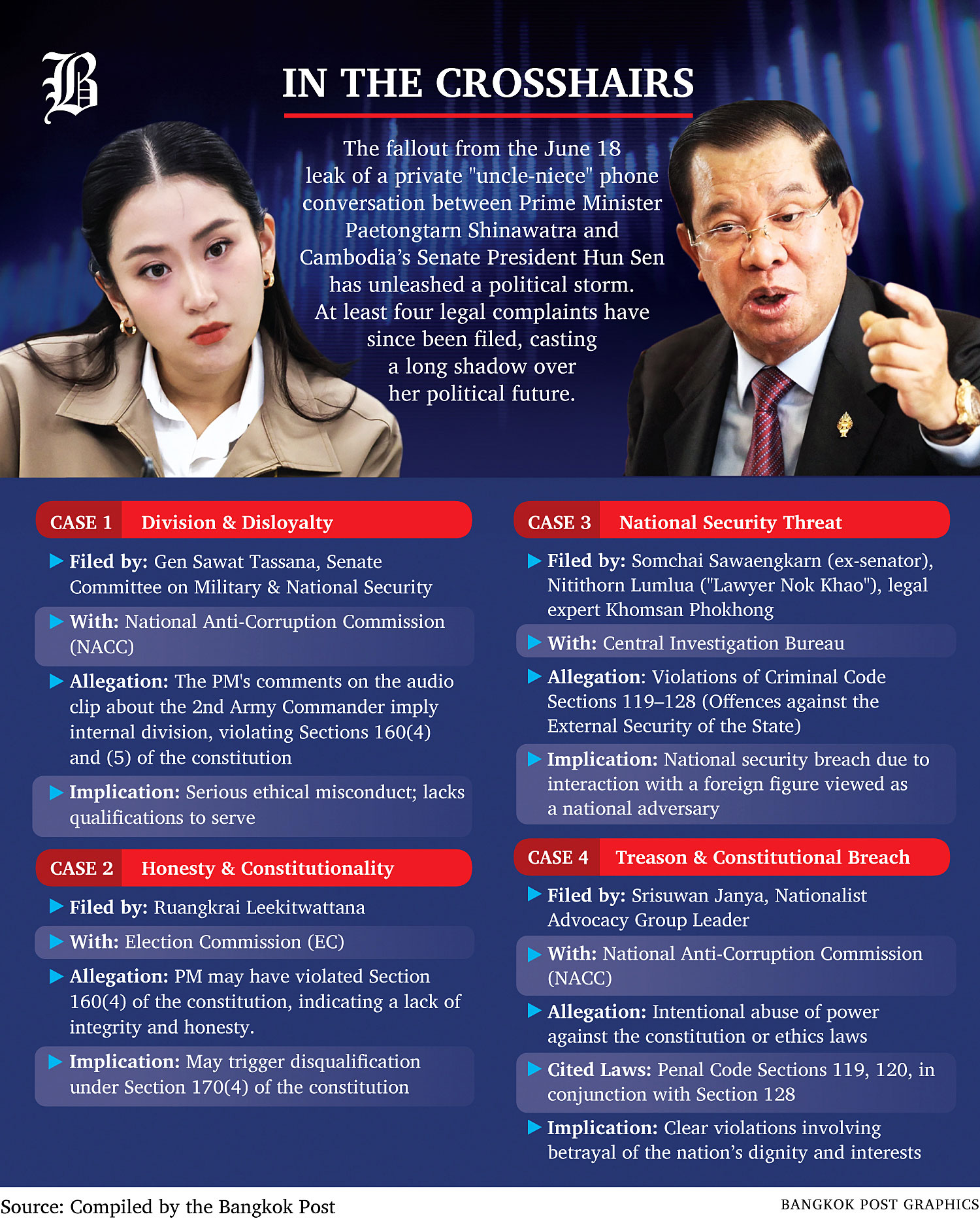
The fate of Prime Minister Paetongtarn Shinawatra hangs in the balance as the Constitutional Court will consider on July 1 whether to accept a petition calling for her suspension over a leaked audio clip featuring her conversation with Hun Sen, the president of the Cambodian Senate.

The petition, submitted by 36 senators, requests the court to investigate the leaked audio clip allegedly implicating the prime minister in conduct that breaches the constitution, lacks integrity, and violates serious ethical standards. The senators are also seeking her suspension pending the court's ruling.
The controversy stems from a formal complaint filed on June 19, in which the senators sought the removal of Ms Paetongtarn from office.
They cited a lack of qualifications and the presence of prohibited characteristics under Sections 160 (4) and (5) of the constitution. The complaint also accuses the prime minister of a lack of honesty and of engaging in conduct that constitutes a grave breach of ethical standards.
According to the senators, Ms Paetongtarn's alleged actions have tarnished the dignity of the premiership. They claim she abused her power by conflating personal interests with those of the state, thereby violating the principles of public interest and good governance.
The political ramifications could be significant. Should the Constitutional Court accept the petition and order the prime minister to cease performing her duties, it would send a powerful political signal and could have adverse implications for the future of the Pheu Thai-led government.
The repercussions of the leaked audio controversy have extended beyond the Constitutional Court and now involve independent oversight bodies. The National Anti-Corruption Commission (NACC) has already begun preparations to address the matter.
On Monday, the NACC unanimously resolved to accept a petition concerning the audio clip for preliminary investigation. The petition alleges that the content may constitute a serious breach of ethical standards, particularly in relation to remarks about tensions along the Thai-Cambodian border.
The NACC has prioritised the investigation and ordered an expedited review. This includes a full transcription of the audio recording, accurate translation from Khmer, witness examinations, and a legal analysis referencing relevant precedents.
Among these is the Constitutional Court's previous ruling disqualifying former prime minister Srettha Thavisin over the appointment of Phichit Chuenban as a cabinet minister.
Phichai Ratnatilaka Na Bhuket, a political science lecturer at the National Institute of Development Administration (Nida), told the Bangkok Post that the legal challenges facing Ms Paetongtarn are likely to intensify, particularly the petition filed by senators with the Constitutional Court seeking a ruling to terminate her premiership over the controversial leaked audio.
Mr Phichai said that, of all the potential legal threats, this particular case may present the most serious consequences for the prime minister. He explained that because the petition was submitted by senators, it will likely carry more weight with the court than if it had been filed by private citizens.
While the outcome remains difficult to predict, Mr Phichai expressed confidence that the court will accept the petition for consideration. Whether the court decides to suspend the prime minister from her duties during the review is uncertain, but he noted that both possibilities are plausible.
Mr Phichai further noted that, should the court accept the petition, the deliberation process would likely take approximately two months. During this period, the court would gather relevant evidence and information before delivering its ruling.
Legal scholar Jade Donavanik told the Bangkok Post that, should the court vote to accept the case on July 1, it will also deliberate on whether the prime minister must be suspended from her duties during the investigation.
"The judges will assess whether [her] continued occupancy of the premiership, even for a day or two, could pose a credible risk. If there is reasonable suspicion that such a risk exists, then remaining in office would be untenable," he added.
He further said that even if the court orders a suspension from duty, it must also determine whether the prime minister is, in fact, disqualified from holding office due to a serious breach of ethical standards.