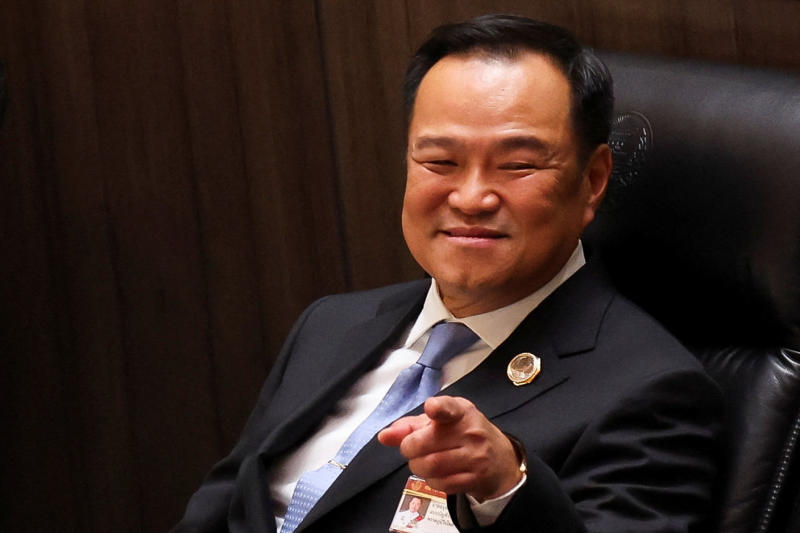
Bhumjaithai Party leader Anutin Charnvirakul gestures as he attends a voting session for a new prime minister in parliament on Friday. (Photo: Reuters)
Bhumjaithai Party leader Anutin Charnvirakul has been chosen as Thailand’s 32nd prime minister — and the fourth in just over two years — with a countdown expected to begin soon to a new general election early next year.
.snoitnetsba 72 erew erehT .irisitiN mesakiahC eenimon ytraP iahT uehP rof 251 ot ,setov 113 deviecer nitunA rM ,noonretfa yadirF no sevitatneserpeR fo esuoH eht ni etabed ruoh-owt a gniwolloF
.pihsreimerp eht fo ytingid eht tcetorp ot snoitagella eht yfiralc ot nitunA rM gnigru ,thab noillib 2 ot 5.1 morf gnignar smus htiw ,esuoH eht ni setov yub ot stpmetta degella fo snoicipsus desiar ,PM-tsil iahT uehP a ,sekgnaiP nrosidA
.nitunA rM gnitroppus erew dna sedis dehctiws yldetroper dah ohw sPM iahT uehP emos morf stsetorp werd skramer siH
.sdnuorg lagel dna lanoitutitsnoc no deifilauqsid eb dluohs nitunA rM dias ,naN rof PM iahT uehP a ,weakirS nanlohC
.snoitutitsni citarcomed revo ecneulfni lanretxe gnitivni ybereht ,noitcele 3202 eht ni setov noillim eno ylno now taht ytrap a ot yawa dedart eb ot setov noillim 41 wolla dluow taht esimorpmoc suoregnad a sa tcap ytraP s’elpoeP-iahtiajmuhB eht desicitirc eH
.seussi htlaeh ot eud 3202 ni PM na sa dengiser dah eh taht gniton ,evres ot yticapac s’mesakiahC rM denoitseuq ,ytraP noitaN iahT detinU eht morf PM-tsil a ,iadarapweaK ayattiW
.setupsid ytngierevos dna tnemnrevog gninoitcnuf a fo kcal eht sa hcus segnellahc gnisserp evloser ton dluow detcele gnieb retfa yletaidemmi esuoH eht evlossid ot egdelp s’mesakiahC rM dias eH
.dehcuotnu niamer dluow — yhcranom eht ot gnitaler 2 dna 1 sretpahC gnidulcni — snoisivorp yek taht demrifnoc eh fi redael iahtiajmuhB eht troppus dluow eh dias ayattiW rM ,nrecnoc a saw stnemdnema lanoitutitsnoc lluf eusrup ot ytraP s’elpoeP eht htiw laed s’nitunA rM elihW
.selpicnirp gnidiug rieht yfiralc ot deliaf etabed eht gnirud stnemugra s’iahT uehP dias eH
.snoitcele drawot gnivom dna noitisoppo eht gninehtgnerts ni nioj ot iahT uehP degru eH .yrassecen fi yrotsih ni noitisoppo tsegnorts eht gnidliub ot dettimmoc ytrap sih htiw ,scitilop iahT ni tniop gninrut a eb dluow shtnom xis ot ruof txen eht taht detsisni gnohpahttaN rM
.mrofer lanoitutitsnoc dna snoitcele rof yaw eht evap dna kcoldaed lacitilop eht kcolnu ot redro ni nitunA rM kcab ot noisiced sti edam ytrap sih dias eH
.sesimorp gnipeek no dneped dluow ytilibiderc rieht taht gnisserts ,emarfemit htnom-xis ot -ruof eht nihtiw noitcele txen eht rof eraperp won tsum seitrap lacitilop lla gniyas yb dedulcnoc gnohpahttaN rM
 Listen

 Facebook
 Reddit
 Copy Link