


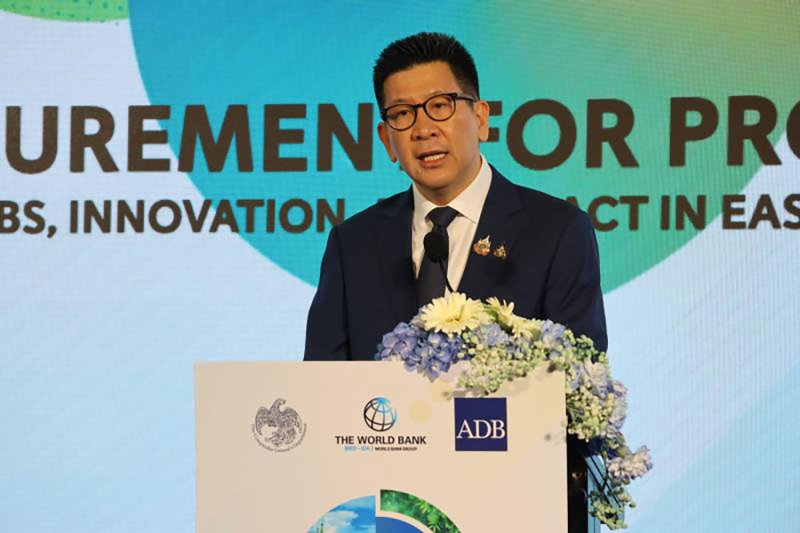
The government has played down the Democrat Party’s plan to ask the Constitutional Court to rule on the legality of its 400-billion-baht emergency borrowing decree, insisting the measure is both urgent and necessary to cushion households and businesses from the global energy shock.
Finance Minister Ekniti Nitithanprapas said on Wednesday the government had explored other funding channels, including reallocating delayed or inefficient spending in the 2026 fiscal budget, but said the amount that could be freed up would fall far short of what is needed.
He added that the 2027 budget will not take effect until Oct 1, leaving a gap of about five months as the government scrambles to roll out relief measures.
Mr Ekniti said he was not worried about the Democrats’ move to petition the court. He noted that the Democrat-led administration also issued a borrowing decree of the same size in 2009 under the Thai Khem Khaeng stimulus scheme to address the financial crisis of the day, and that the measure faced legal scrutiny at the time.
He said Section 172 of the constitution allows the issuance of an emergency decree only when there is urgent necessity and no viable alternative, and argued that the current situation meets those conditions as Thailand faces successive waves of global and energy-related shocks.
The cabinet on Tuesday approved an emergency decree authorising the Ministry of Finance to borrow 400 billion baht to ease cost-of-living pressures and support measures to reduce energy costs.
Under the plan, the funds will be used to provide immediate relief from rising energy costs to vulnerable groups and support a shift to renewable energy. The money will be sourced domestically, with disbursement from June to September to aid over 20 million low-income people.
Responding to the Democrats’ challenge, Prime Minister Anutin Charnvirakul said on Wednesday that different sides were simply doing their jobs, while the government’s duty was to help the public.
He also said checks would be in place at every step, including digital monitoring systems, and that all sides would have opportunities to take part.
Democrats: decree fails ‘urgent necessity’ test
Deputy Democrat leader Korn Chatikavanij said on Tuesday the party had agreed the decree may not meet the conditions set out under Section 172 and would petition the Constitutional Court to examine whether the government’s use of emergency powers is lawful.
Mr Korn argued that the government already has the ability to borrow to cover budget deficits under existing public debt laws, with ceilings designed to preserve fiscal discipline, and that emergency borrowing outside the budget should be reserved for genuine crises such as the 1997 financial crisis, the 2009 global financial crisis and Covid-19.
“In the current situation, although people are struggling with the cost of living and high oil prices, Thailand’s economy has not reached the level of a macroeconomic crisis,” he said.
“Last year it grew 2.6%, and this year it is still expected to grow 1.5% — not contract like in past crises. More importantly, the government still has other options it can do immediately, without borrowing more and creating a burden in the future,” he added.
He said the Democrats would propose moving unspent or non-urgent budget items — which he estimated could free up 50–100 billion baht — and using remaining space under the borrowing ceiling in the current fiscal year, including through a mid-year budget bill.
The party also proposed cutting the excise tax on oil by 7 baht per litre to quickly lower transport and production costs and ease the burden on households.
Lavaron Sangsnit, permanent secretary for finance, argued the emergency borrowing is needed because existing funding sources are insufficient for both immediate relief and structural economic adjustments linked to the energy crisis.
He also criticised a proposed oil tax cut, saying it could reduce excise revenue by about 200 billion baht and risk turning an economic crisis into a fiscal one that could undermine investor confidence.
Meanwhile, Sirikanya Tansakun, deputy leader of the People’s Party, said her party was discussing internally whether it would also seek a Constitutional Court ruling, after the Democrats approached it for support in filing a petition.
