


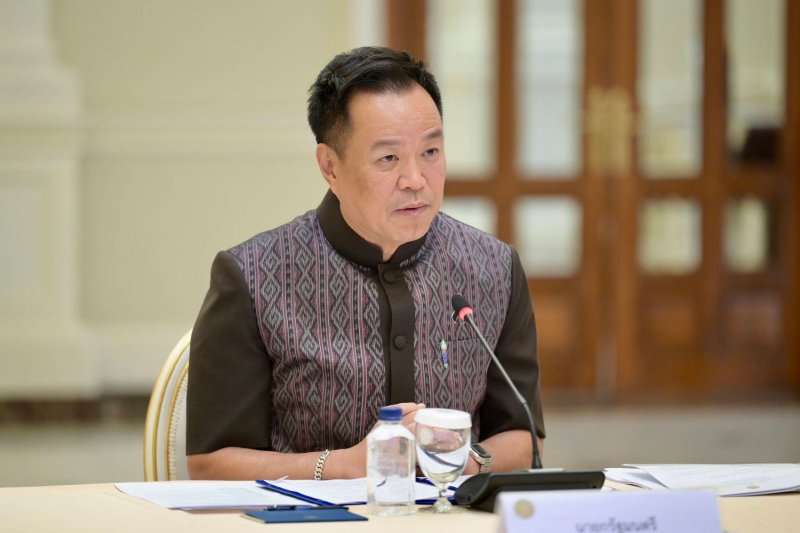
Prime Minister Anutin Charnvirakul has ordered all state agencies to fully disclose public information and eliminate unnecessary secrecy as part of a nationwide anti-corruption campaign launched in cooperation with the private sector.
Speaking at Government House on Wednesday after chairing the first integrated public-private meeting on corruption prevention and suppression, Mr Anutin said transparency and accountability were essential to restoring public trust and strengthening Thailand’s international credibility.
The meeting brought together senior ministers, anti-corruption campaigners, the Thai Chamber of Commerce, the Federation of Thai Industries and the Joint Standing Committee on Commerce, Industry and Banking (JSCCIB), alongside delegates from 35 state agencies.
Mr Anutin said the government had convened the meeting after receiving feedback from the private sector regarding concerns over transparency and corruption in public administration.
He instructed all ministries and departments to review their operations to ensure transparency, legal compliance and full auditability. Agencies were also directed to adopt modern technology and innovation to minimise corruption risks and improve access to information for the public.
“I used to be on the side requesting information,” Mr Anutin said. “Whenever data was requested, there were always exceptions — some information could not be disclosed, while some was released only partially.
“I have instructed officials to disclose everything. If legal barriers exist, then the laws should be amended. We can’t solve corruption if agencies continue choosing what they want the public to see and hiding the rest.”
Any evidence of corruption involving civil servants, ministers or even a prime minister must be submitted to investigative agencies, including the National Anti-Corruption Commission, the Public Sector Anti-Corruption Commission and anti-money laundering authorities, he said.
“A thief always leaves traces,” he said, saying corruption cases could ultimately be proven through documentary evidence and systematic investigation.
Simultaneously, Mr Anutin criticised the methodology behind Thailand’s Corruption Perceptions Index (CPI), arguing the ranking relied too heavily on public sentiment and perception rather than verified legal findings.
Business leaders welcomed the government’s response. Poj Aramwattananont, chairman of the Thai Chamber of Commerce, praised the administration for acting quickly after concerns were raised in private sector surveys. He said the intention was not to target individuals but to identify structural problems and encourage reform.
Ministry of Natural Resources and Environment permanent secretary Raweewan Phuridej said every department under the ministry had been ordered to identify operations vulnerable to corruption, particularly in procurement and licensing systems.
In a separate development, the Department of Provincial Administration ordered the temporary transfer of five Phuket officials following complaints from nightspots along Patong Beach alleging extortion and bribery demands. The transfers were intended to prevent interference during the investigation.
- Editorial: Corruption exposures come as a shock
