


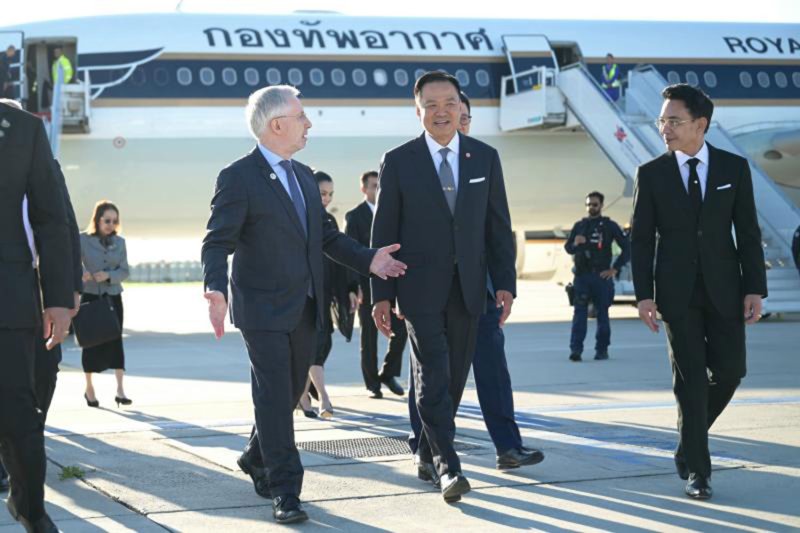
Prime Minister Anutin Charnvirakul began his official visit to France on Friday with a series of high-level meetings focused on energy security, cultural diplomacy and economic cooperation.
The visit comes as Bangkok seeks to strengthen strategic ties with Paris and enhance Thailand’s profile on the global stage through closer cooperation in trade, investment, technology and international affairs.
Mr Anutin was scheduled to hold talks on Friday with the International Energy Agency (IEA) on global energy challenges and Thailand’s long-term energy security strategy. Discussions focused on rising energy costs and geopolitical tensions, including concerns surrounding the Strait of Hormuz, which could have significant implications for global energy markets and investment confidence.
Government spokeswoman Rachada Dhnadirek said the prime minister regards affordable and stable energy supplies as central to Thailand’s competitiveness, particularly in attracting foreign investment.
Finance Minister Ekniti Nitithanprapas said the visit would also prioritise discussions on clean energy, digital transformation and artificial intelligence. He said the team would also meet with leading French investors and technology firms.
France has made significant advances in clean energy and digital innovation, making it a valuable partner for Thailand’s economic modernisation agenda, he said.
Alongside energy talks, the premier on Friday also met the director-general of Unesco to expand cultural cooperation and promote Thailand’s role in international cultural affairs. The discussions were built on recent exchanges between Thailand and the United Nations agency, with Bangkok positioning itself as a potential regional hub for international organisations.
On Monday evening, Mr Anutin will attend a state dinner hosted by French President Emmanuel Macron at the Palais de l’Elysée, where both leaders are expected to discuss trade, investment and strategic cooperation.
Nikorndej Balankura, the Thai ambassador to France, said the visit reflects growing momentum in Thai-French relations as both countries mark 340 years of friendship and 170 years of diplomatic ties.
He described Thailand as a trusted partner for France, particularly given Bangkok’s balanced relations with both China and the United States during a period of global geopolitical uncertainty.
Mr Nikorndej said Thailand and France could deepen relations through food diplomacy and luxury goods. He noted that Thailand is recognised globally for food security and agricultural production, while France remains synonymous with culinary excellence.
“When these two countries engage in this area, we do not need to rely on others for food security and production. This cooperation is built on one key word: trust,” he said.
He added that while bilateral investment ties have developed steadily, cooperation in the luxury goods sector remains largely untapped. France is a world leader in premium and luxury brands, driven increasingly by middle-class consumers across Asia, and Thailand could serve as a strategic regional distribution hub.
“I see strong potential for Thailand to serve as a hub for distributing French luxury goods across Asia,” he said.
Mr Anutin will also meet Thai business leaders and members of the Thai community in France, where around 25,000 Thai nationals reside, Mr Nikorndej said.
The ambassador said many Thai entrepreneurs operate restaurants and businesses in France, while Thai students are increasingly pursuing studies in advanced sectors there.
