

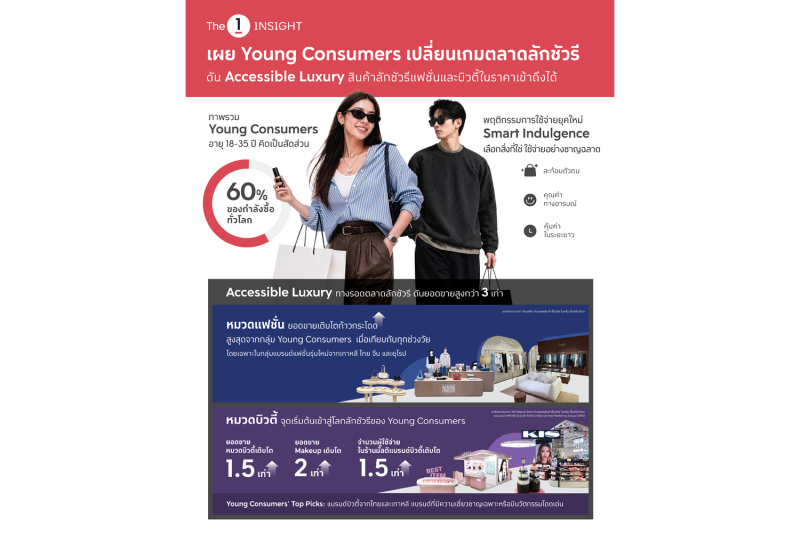
The 1 Insight has revealed that young consumers aged 18–35, comprising Millennials and Gen Z, are emerging as the key driving force behind the growing Accessible Luxury market. Spending in this segment is now more than three times higher than in traditional luxury categories, helping sustain the overall luxury market while redefining what “luxury” means for today’s consumers.
According to The 1 Insight, younger consumers no longer define luxury solely through high prices or heritage brand names. Instead, they prioritize emotional value, self-expression, and long-term product quality, giving rise to a “Smart Indulgence” mindset — a more intentional approach to spending on products that align with both personal identity and perceived value.
This shift has created significant opportunities for emerging brands from Korea, Thailand, China, and Europe that offer a balance between quality, design, and accessible pricing. Many of these brands have experienced rapid sales growth and global popularity through strong brand storytelling on social media, attracting widespread consumer demand, long queues outside stores, and fast-selling collections.
Recent data shows that consumers aged 18–35 now account for approximately 60% of global purchasing power, making them the dominant force shaping economic activity, retail trends, and consumer spending worldwide. At the same time, the Accessible Luxury segment — spanning both fashion and beauty — has become the largest category within the luxury market today.
In the fashion category, the Smart Indulgence phenomenon is especially evident in Accessible Luxury products, which continue to see strong growth across all age groups and even stronger momentum among younger consumers. The three most popular categories among young consumers are footwear, apparel, and watches.
Within the beauty segment, Accessible Luxury products are increasingly viewed as a “Luxury Entry Point” for younger consumers due to their more attainable pricing compared to fashion products. Sales of Accessible Luxury beauty products among young consumers have grown by 1.5 times, with makeup products recording the strongest growth at two times higher than previous levels.
Multi-brand beauty retailers featuring products from various countries have also gained significant traction, particularly those focused on Accessible Luxury offerings tailored to young consumers. Spending through these channels has increased by 1.5 times as demand continues to accelerate.
The study also found that purchasing behavior within Accessible Luxury beauty categories varies by product segment. In makeup, Korean brands and niche brands with innovative concepts are experiencing rapid growth, driven by demand for fun, trend-driven products that reflect individual style. In contrast, within skincare — where brand heritage and credibility remain highly influential — established global luxury brands continue to dominate consumer preference and remain top-selling names in the category.
The 1 Insight believes that the rise of Accessible Luxury reflects more than increasing purchasing power among younger consumers. It signals a fundamental redefinition of luxury itself — one centered on identity, emotional value, and accessibility. As a result, young consumers are becoming the key force shaping the future direction of the global luxury market.
