

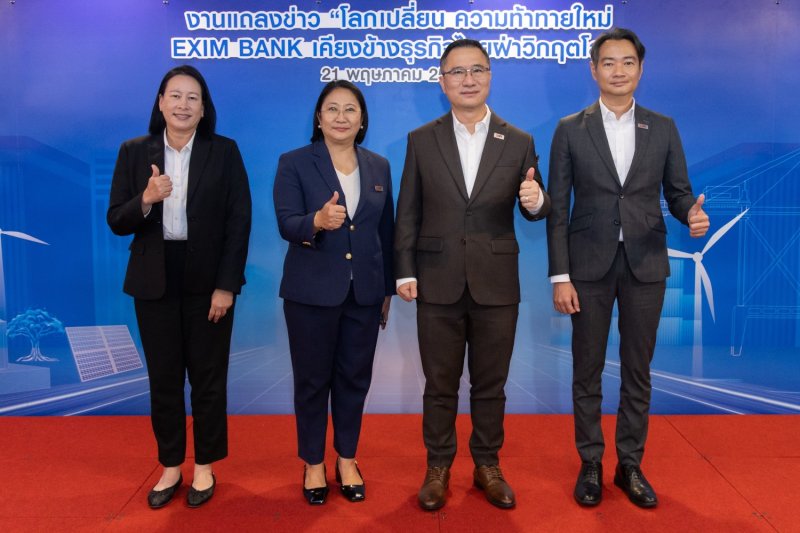
Charat Rattanaboonniti, president of Export-Import Bank of Thailand (EXIM Thailand), said during a recent press briefing entitled “A Changing World, New Challenges: EXIM Thailand Standing by Thai Businesses Through Global Crises” that the global economy is currently facing unprecedented challenges from crises characterised by “severity, volatility, and variability” across three key dimensions. These developments are directly affecting economic stability, trade, and investment worldwide, including Thailand’s export sector, which must urgently adapt to increasingly complex uncertainties. The three key challenges are as follows:
Firstly, severe conflicts, both in the form of prolonged geopolitical conflicts and intensifying trade wars. In particular, escalating tensions in the Middle East have disrupted traffic through the Strait of Hormuz, one of the world’s most critical shipping routes for oil, natural gas, and chemical fertilisers, thereby threatening energy and food security in many countries. At the same time, ongoing uncertainty surrounding protectionist trade measures by major economies, especially US tariff policies, continues to affect global trade dynamics and international supply chains.
Secondly, volatility in global commodity and financial markets, driven by rapidly rising energy and commodity prices, increasing logistics costs and war risk surcharges, as well as fluctuations in exchange rates and gold prices. These factors are directly impacting the costs and liquidity of Thai businesses.
Thirdly, environmental variability, resulting from global warming and extreme weather conditions that may affect agricultural productivity and production costs. In addition, global environmental regulations, including the Carbon Border Adjustment Mechanism (CBAM), the European Union Deforestation Regulation (EUDR), the Corporate Sustainability Reporting Directive (CSRD), and the Packaging and Packaging Waste Regulation (PPWR), are becoming critical conditions requiring Thai entrepreneurs to accelerate their adaptation in order to maintain competitiveness in global markets.
Mr Charat said that these developments are expected to weigh on GDP growth at both the global and domestic levels. According to the International Monetary Fund, global GDP growth in 2026 is projected to slow to 3.1%, the lowest level in six years, down from 3.4% in the previous year. Meanwhile, global trade growth is expected to moderate to 2.8%, the lowest in three years, compared with 5.1% in 2025. This contrasts with inflation, which is projected to accelerate to 4.4%, the highest level in two years, up from 4.1% previously.
For Thailand, EXIM Thailand estimates that exports will grow by roughly 7% this year, supported mainly by the electronics sector, as well as agricultural and food products, which are benefiting from the expansion of artificial intelligence (AI) technologies and rising global demand for food security. Nevertheless, Thai entrepreneurs continue to face mounting pressures from higher transportation and insurance costs, economic slowdowns in key trading partners, and US tariff measures, all of which remain significant risk factors requiring close monitoring.
At the same time, Thai businesses are confronting the three challenges, namely: high costs, driven by rising raw material prices, logistics expenses, labour costs, financial costs, and risk management expenditures; high compliance requirements, resulting from increasingly stringent international standards, environmental and ESG regulations, personal data protection laws, and tighter accounting standards; and high competition, stemming from intensified competition from low-cost imports, particularly from China, rapid technological change, and continuously evolving consumer behaviour. These factors necessitate urgent efforts by entrepreneurs to enhance competitiveness, adjust business models, and strengthen operational resilience.
Mr Charat added that amid a rapidly changing and increasingly challenging global economic landscape, EXIM Thailand, as a specialised financial institution, stands ready to serve as an ‘export co-pilot', supporting customers through its “5T” framework aligned with government policy. This framework consists of: “Target”, mitigating impacts and reducing risks for customers, particularly SMEs, through on-site customer revisits to offer tailored financial products, alongside debt restructuring, interest rate reduction, liquidity enhancement, and employment support as appropriate; “Transition”, supporting the transition toward a green economy through sustainable finance products, with a target for loans and contingents related to sustainability investment and transition to account for 50% of total exposure, while also expanding ESG-related services such as sustainability reporting for EXIM Thailand’s clients seeking to align with global environmental standards; “Transform”, promoting business upgrading through technology and risk diversification via expansion into new markets through advisory services, business matching, and product packages in collaboration with partners, aiming to increase the proportion of exports to markets beyond the United States, the European Union, and Japan to 75%. All these operations are carried out under the principles of “Transparency”, supporting transparent export transactions in accordance with international standards while professionally caring for customers, and “Together”, integrating cooperation within EXIM One Team and with both public and private sector partners to build a comprehensive export ecosystem that fosters the sustainable growth of Thai entrepreneurs.
“EXIM Thailand’s measures and support will help Thai entrepreneurs strengthen both their readiness and adaptability in addressing challenges across all dimensions. EXIM Thailand is committed to serving as an export co-pilot, standing alongside Thai businesses in every situation, empowering them not only to survive global crises but to emerge stronger and achieve sustainable growth on the international trade arena,” Mr Charat said.
May 21, 2026
Corporate Branding and Communication Department
