

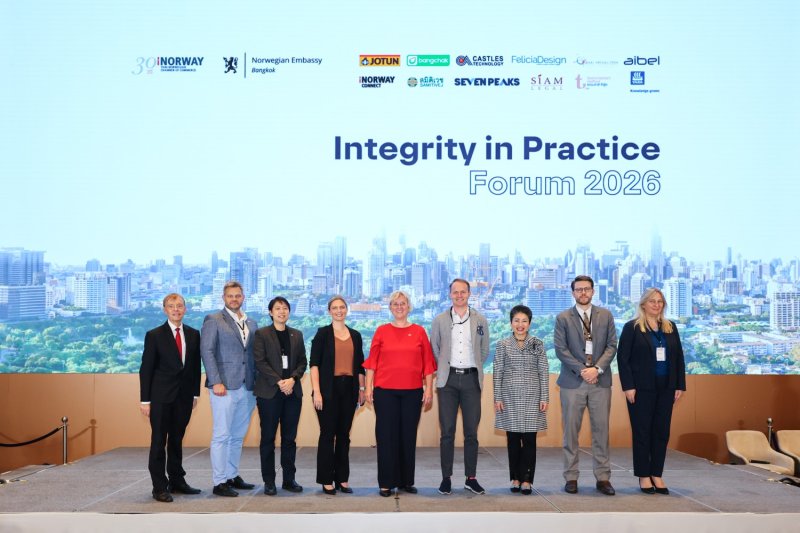
BANGKOK, THAILAND — The Thai-Norwegian Chamber of Commerce (TNCC), in collaboration with the Royal Norwegian Embassy in Bangkok, hosted the “Integrity in Practice Forum: Shaping the Future through Responsible Governance” at Hotel Nikko Bangkok. The high-level forum brought together over 100 participants, reflecting a shared commitment to advancing transparency, integrity, and responsible business practices in Thailand through Thai–Norwegian collaboration.
As Thailand continues to align its economic landscape with global standards, the forum served as a critical bridge between the public sector, private industry, and academia. The event explored the integration of anti-corruption principles into corporate culture and academic curricula, drawing direct links to the World Bank Business Ready (B-READY) framework and the OECD’s Anti-Corruption and Integrity Framework.
Norway is recognised for its relatively low levels of corruption, supported by established institutions, transparent governance practices, and an emphasis on accountability in public administration. This forum shares these proven approaches to foster a more resilient and inclusive business environment in Thailand.
H.E. Mrs. Astrid Emilie Helle, the Norwegian Ambassador to Thailand, who delivered the welcoming remarks, emphasised the importance of cross-border collaboration in governance:
"The partnership between Norway and Thailand continues to flourish, founded on trust and a shared commitment to transparency and sustainability. By aligning with international standards, we can pave the way for future growth and mutual benefits that support long-term economic development and attract high-quality investment."
The forum featured two powerhouse panel discussions. The first, "From Vision to Practice: Transparency Roadmap," included experts from the Thailand Development Research Institute (TDRI), the Anti-Corruption Organization of Thailand (ACT), Thai Private Sector Collective Action Against Corruption (CAC) and leading private sector voices. During the discussion, Mr. Tippatrai Saelawong, Senior Researcher at TDRI, highlighted corruption risks facing Thai SMEs and emphasised the need for institutional transparency, long-term anti-corruption reforms especially public procurement system as Thailand works toward aligning with OECD standards. Meanwhile, Mr. Kittidej Chantangkul, Executive Director of ACT, underscored the need for stronger accountability systems, effective whistleblowing mechanisms, and civic participation to reduce corruption risks. The session also emphasised that integrity must be embedded within organisational culture through consistent enforcement, strong leadership, and a fair business environment.
Mrs. Gloyta Nathalang, Senior Executive Vice President, Sustainability Management and Corporate Communications of Bangchak Corporation PCL, a key panelist representing Thai industry leadership, noted:
"ESG is part of our DNA and guides how we make decisions every day — not simply how we report our performance. Good governance is built on clear boundaries, consistency, and transparency. Integrity in practice also means looking beyond what is legally acceptable and acting early when we see warning signs or ethical risks. Leadership also matters. Leaders must walk the talk and help create a culture where employees feel comfortable speaking up, raising concerns, and making decisions based on integrity — not only compliance. These principles are essential for building trust, attracting investment, and ensuring long-term business resilience.”
Mr. Andreas Stavnes Hallan, Vice President Engineering Asia of Aibel (Thailand) Ltd., a key panelist representing Norwegian industry leadership, highlighted that “Transparency is no longer just an ethical duty; it is a fundamental driver of our performance. Integrating these principles into the heart of corporate strategy is essential for any business looking to remain competitive in the modern global economy. To us, it is a license to operate and deliver out of Thailand."
The second panel, "Future of Integrity," shifted the focus toward education and evolving societal expectations, featuring representatives from Yara Thailand, Jotun Thailand, and Bangkok Patana School
During the session, Ms. Kristine Anvik Leach, Managing Director at Jotun Thailand Ltd., shared perspectives on navigating business integrity and anti-corruption expectations, the importance of leadership and compliance training, and how organisations can build a strong ethical mindset when facing complex grey areas in business. Ms. Nantiya Pitakwongdeengam, Managing Director at Yara (Thailand) Co., Ltd., spoke about how Yara is strengthening integrity in its business operations and preparing future leaders to make ethical decisions amid today’s business challenges. Representing the education sector, Mr. Jamie Owen, Business Director at Bangkok Patana School, highlighted how international schools can promote integrity and leadership values across generations.
The afternoon concluded with the Integrity in Practice Workshop led by Ms. Pinn Siraprapasiri, Senior Manager of the CAC, transforming global integrity standards into practical business action. Through immersive real-world scenarios involving political pressure, conflicts of interest, whistleblowing, and high-risk clients. The interactive workshop sparked meaningful discussions and demonstrated how integrity and anti-corruption practices directly impact business performance, reputation, and long-term sustainability.
The event concluded with a networking session to encourage joint initiatives and long-term collaborations between the Norwegian and Thai business communities.
For more information and updates on the programme, please visit www.norcham.com
About the Thai-Norwegian Chamber of Commerce (TNCC): Celebrating its 30th year, the TNCC promotes trade and investment between Norway and Thailand, providing a forum for Norwegian companies and individuals to network and engage with the Thai business community.
