

 Facebook
 Reddit
 Copy Link


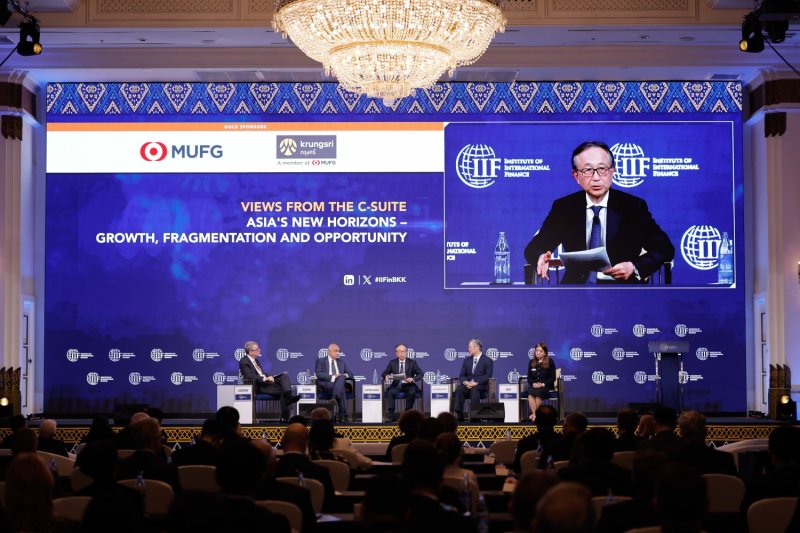
Mitsubishi UFJ Financial Group (MUFG) considers Asia its “second mother market”, with vision of further expansion in the coming years, group chairman Hironori Kamezawa said during a panel discussion at the Institute of International Finance (IIF) Annual Membership Meeting in Bangkok.
The event was recently held concurrent with the IMF-World Bank Annual Meeting taking place in Bangkok.
“Asia accounts for nearly twenty per cent of our profit portfolio,” Kamezawa said, adding, “Our loan volume in Asia is nearly US$200 billion, making us one of the largest lenders in Asia [outside China].”
While underlining the group’s moves to expand in Asia, he said that some parts of the region still lack access to banking services, adding, “We expect see further progress in financial inclusion through digital services.”
Recognising the growing importance of Southeast Asia, MUFG set roots in the region over a decade ago, investing billions of dollars through major strategic bank acquisitions and tech partnerships. Since 2013, MUFG has carved out a presence in Thailand, the Philippines, Indonesia, and Vietnam through acquiring stakes with local partners.
Kamezawa said MUFG was now making inroads into Asia’s third largest economy, India. In April 2026, MUFG acquired a 20 percent stake in India’s Shriram Finance for $4.4 billion and is exploring other opportunities for expansion.
MUFG had also made efforts in recent years to explore the digital payments space, investing in Ascend Money in Thailand as well as GCash, the popular e-wallet platform in the Philippines. “At the moment, we have 72 million people connected to our platform in Southeast Asia. Our goal is to reach 100 million,” he said.
Asked about Asia’s importance to Japan, he stressed that the region holds strong growth potential driven by decarbonisation, digitalisation and industrial upgrading. He highlighted the importance of teamwork and co-creation, particularly in areas such as energy, digitalisation and infrastructure.
“Japan and Asia could help each other’s growth”, said Kamezawa, who took over as chairman of MUFG board in April this year. “Japan can help create new industries and businesses by providing long-term capital and expertise in technological capabilities, while Asia has talent, innovation and dynamic markets, creating complementary strengths.”
Speaking about the strategic changes that artificial intelligence (AI) would bring for the finance industry, Kamezawa said AI could serve as both a partner and an equalizer, particularly in Japan, who is facing labor supply constraints. It also has the potential to become a driver, enhancing capabilities of individuals and organisations.
“AI provides insights, humans make judgements. AI learns from the decisions and experiments and thus the cycle continues,” he explained. “As human and AI learn together, that’s what an AI-Native bank looks like.”
But he also spoke of the need for effective rules on how AI and humans should work together. He also laid out three concerns related to AI: over-reliance on AI, cybersecurity threats and uncontrollable AI behavior.
He then stressed the importance of establishing a robust governance framework.
“While AI is a great partner, we need to make a great governance player to ensure safeguards,” he said.
