 Listen


 Facebook
 Reddit
 Copy Link


Despite the opposition People’s Party voting to support Bhumjaithai's candidate for prime minister, Anutin Charnvirakul, the Pheu Thai Party declared it would proceed with its move for a House dissolution.
Sorawong Thienthong, secretary-general of the ruling Pheu Thai Party, said on Wednesday: “Regarding the responsibilities of Mr Phumtham [Wechayachai], he has already carried out the process.”
Many people argue that Mr Phumtham, as only caretaker prime minister, does not have the authority to dissolve the House. However, Pheu Thai has insisted that he does and confirmed that a request for a dissolution has already been submitted for royal approval. (continues below)
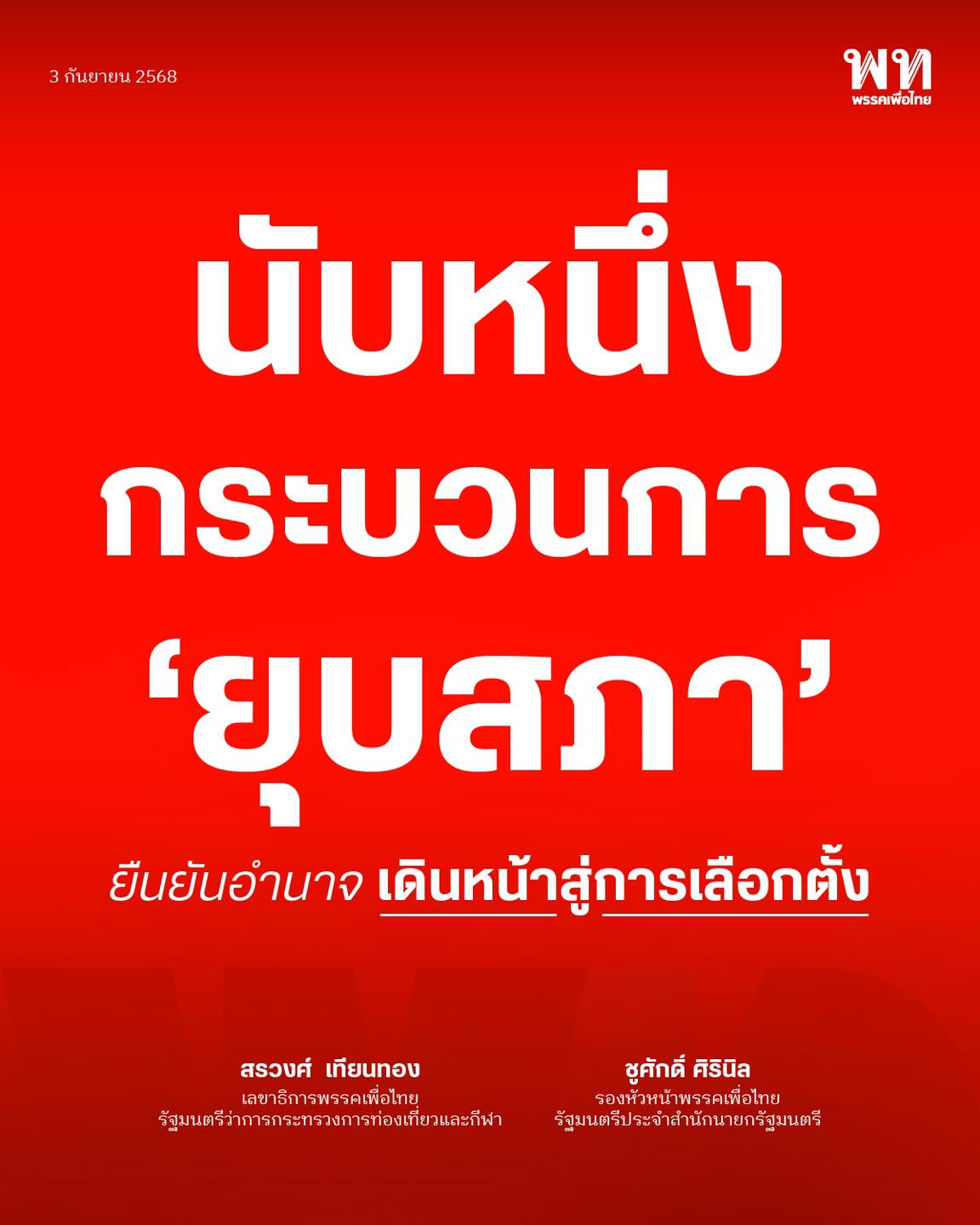
A post announcing the move for a dissolution of the House on the Pheu Thai Party’s Facebook Page.
Opinions in political circles are now clearly split in two camps: those who believe the dissolution move is legal, and those who do not.
1. Dissolution is possible, not unconstitutional, subject to royal discretion
Chusak Sirinil, deputy leader of Pheu Thai and now caretaker Prime Minister's Office minister, reaffirmed in the party’s latest statement his opinion that Mr Phumtham, as acting premier, has full authority and can dissolve the House, in line with established procedure.
Mr Phumtham has also expressed confidence that he is empowered to request a dissolution, and confirmed that he has already taken that step.
Worachet Pakeerut, a law lecturer at Thammasat University, said Mr Phumtham, in his acting capacity, has full authority as there is no constitutional clause prohibiting a dissolution.
Borwornsak Uwanno, former chairman of the 2017 Constitution Drafting Committee, also said that a caretaker government is legally permitted to dissolve the House, as no constitutional provision forbids it. However, he stressed that the final decision rests with the King’s royal prerogative.
2. Dissolution is not possible — only the prime minister has the power
Pakorn Nilprapunt, secretary-general of the Council of State, the government's legal adviser, said on Aug 30 that, “In my personal opinion, it cannot be done — this is what the textbooks state.”
Charan Phakdeethanakul, a former Constitutional Court judge, echoed this view, stating that dissolution is strictly within the prime minister’s authority. The 2017 constitution clearly stipulates that only the prime minister can seek royal approval for a House dissolution.
From these two perspectives, one side argues that, since there is no constitutional prohibition, a caretaker or acting prime minister can request a dissolution, subject to the King’s discretion. The other side maintains that a caretaker or acting prime minister lacks such authority, as he is not a full prime minister.
The future government hinges on how this move for a House dissolution is ultimately adjudicated.


