


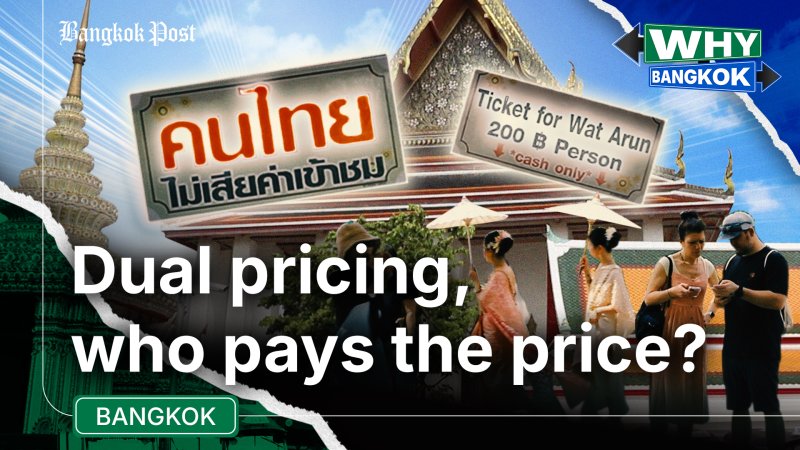
Thailand welcomed 32.9 million foreign visitors in 2025, a 7.23% decline from the year before. In the second episode of Bangkok Post’s Why Bangkok, the series turns its lens on one of tourism’s most persistent grievances: dual pricing.
While no single factor explains the drop in visitor numbers, the question of whether tourists feel fairly treated is one the industry cannot afford to ignore, and it is a debate that cuts deeper than the price gap alone.
The Price of Entry
Dual pricing is not unique to Thailand. The Taj Mahal in India and Petra in Jordan both charge foreign tourists more than local visitors, typically framed as a maintenance fee. In Thailand, public attractions like temples and national museums operate under ministerial regulations, while private operators are overseen by the Department of Internal Trade, though the latter are considerably harder to regulate.
For many visitors, the pricing itself is not the main issue.
Caroline Purcell, a tourist from the United States, said she found the entrance fees at Wat Arun reasonable. “There’s a ton of people that visit. Obviously, people don’t think it’s unaffordable or unattainable,” she said. “I’m not totally opposed to native Thai people getting into these attractions for free considering this is your country.”
The Expat Exception
But the system becomes more complicated when it affects long-term residents. Pawarin Ramanwong, a travel agency director, pointed out that expats who have lived, worked and paid taxes in Thailand for years are still charged foreigner rates based on appearance alone.
“Expats put money into the economy just like locals do,” she said. “If we make them feel like locals when it comes to pricing, they’ll be more comfortable spending money here.”
Her broader concern, however, is not the pricing itself but the lack of transparency around it. “The core issue is communication, being upfront and clear from the start about what a place costs and who pays what,” she said. “If visitors can see where their money goes — clean restrooms, proper information signs — they’ll feel it’s worth it.”
Scams, Tuk Tuks and the Grab Effect
Beyond formal admission fees, informal scams targeting tourists have long been a fixture of the Bangkok experience, particularly in transport. Taxis and tuk tuks operating outside fixed-rate systems have historically been the most common source of complaints, and regulating individual drivers remains difficult.
What has changed, according to both Ms Pawarin and local vendor Duengnapa Jarijitpaiboon, is the rise of ride-hailing apps. “Tourists used to get confused,” Duengnapa said. “But now they’ve shifted away from taxis and tuk tuks, they just use Grab or Bolt. The price is fixed and transparent, so that’s where they go.”
The government has taken some steps in this direction. The Department of Land Transport has initiated a project to install QR codes in taxis, allowing passengers to identify drivers, verify fares and file reports directly.
A Reputation Worth Protecting
Thailand’s tourism industry accounts for a significant share of national income, and those within it are aware that the margin for complacency is shrinking.
Competing destinations in Southeast Asia are increasingly attractive to budget-conscious travellers. “There are other Southeast Asian countries that are a bit cheaper, and the service is equal, or maybe better sometimes,” said a Belgian tourist we spoke to.
Ms Pawarin put it plainly: “Tourism is one of the country’s biggest sources of income, if we’re not careful, if we just let things slide and don’t take it seriously, one day it could all disappear.”
