


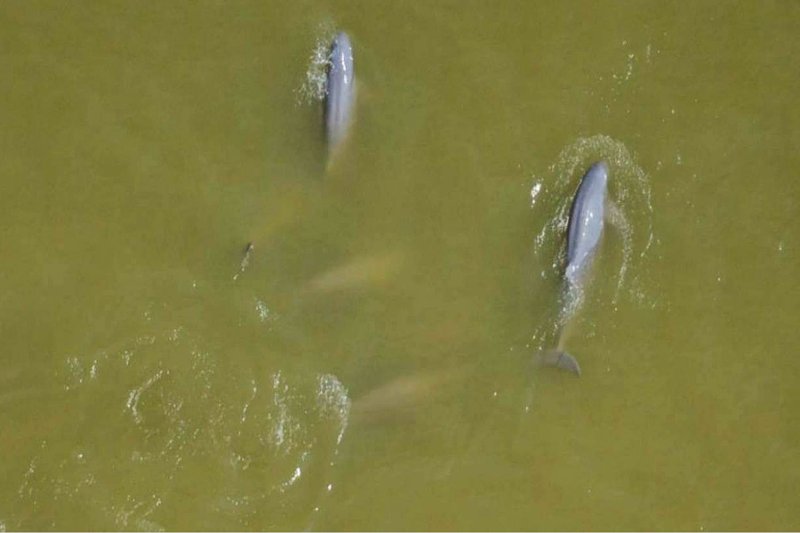
Efforts are being stepped up to protect the critically endangered Irrawaddy dolphins in Songkhla Lake, where the local population has dwindled to just 14.
The initiative follows the cabinet's approval of a five‑year conservation plan for the Irrawaddy dolphin in Songkhla Lake (2024–2028), with a budget of 402 million baht.
The funding will come primarily from foreign aid and the Science, Research, and Innovation Promotion Fund under the Thailand Science Research and Innovation (TSRI) agency. Additional financial support will be provided by the World Bank's PROBLUE Fund.
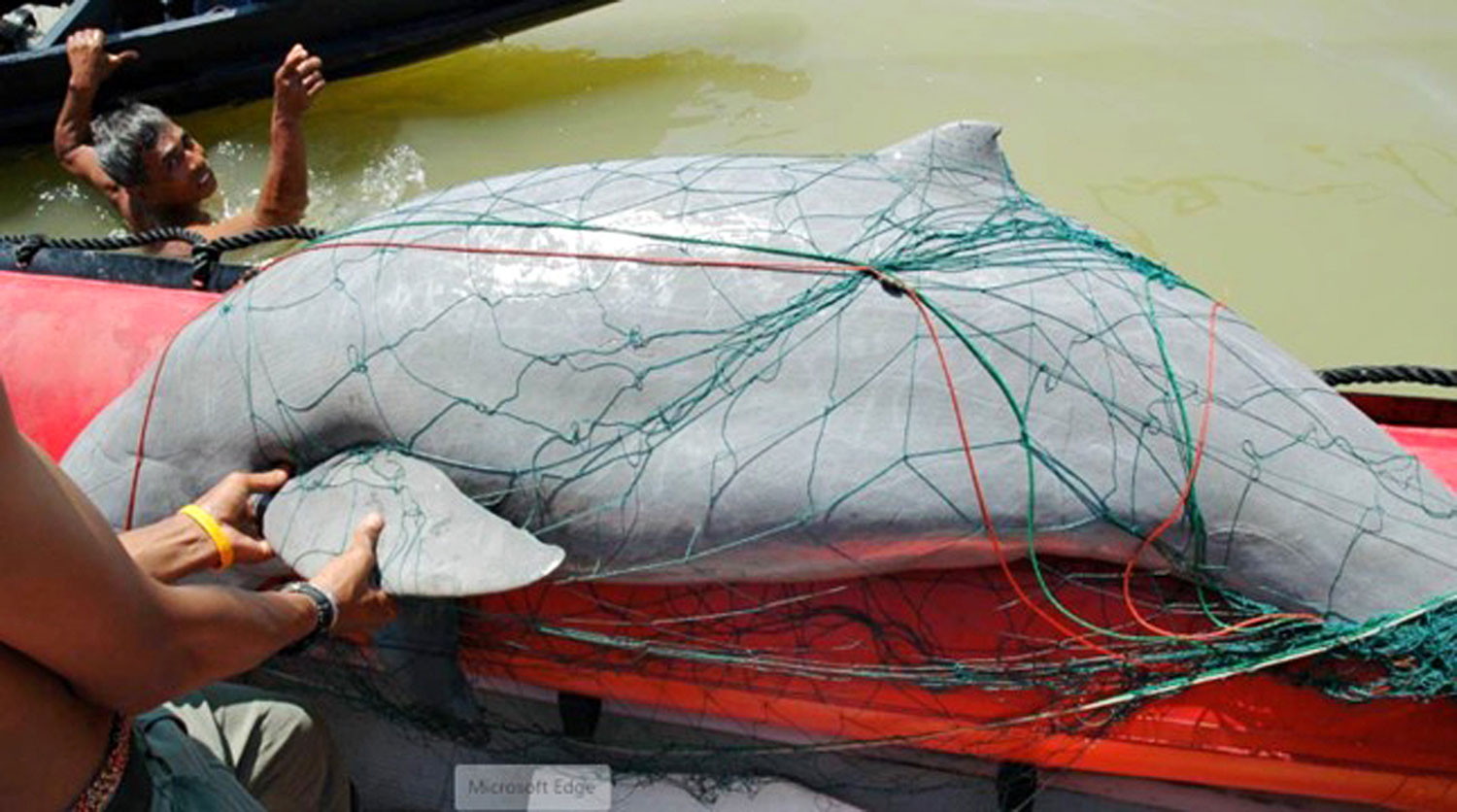
An Irrawaddy dolphin was found several years trapped in a fishing net for giant catfish in Songkhla Lake. Officials were unable to save its life. (Photo courtesy of Department of Marine and Coastal Resources)
Together, these resources will help halt the decline of the dolphin population, restore the Songkhla Lake ecosystem and promote balanced and sustainable economic and social development for surrounding communities, according to Chakkaphan Sutthirat, deputy director of TSRI.
Early this week, Mr Chakkaphan attended an orientation programme for the Irrawaddy Dolphin conservation plan in the Songkhla Lake Basin.
There, he introduced the programme to about 200 participants, including local villagers, representatives of the World Bank, the Department of Fisheries, Department of Marine and Coastal Resources and the Department of National Parks, Wildlife and Plants and environmentalists, researchers and members of civil society networks.
The programme focuses on restoring the ecosystem in Songkhla Lake, its watershed, breeding and population recovery of Irrawaddy dolphins and engaging the community to align conservation with sustainable economic growth.
The Songkhla Lake Basin is one of the most important ecosystems on Earth. It encompasses the Small Sea in Phatthalung province, the Large Sea in Phatthalung and Songkhla provinces and Songkhla Lake itself.
This area is rich in biodiversity and serves as a critical habitat for the Irrawaddy dolphin, which is currently classified as Critically Endangered by the International Union for Conservation of Nature.
Songkhla Lake is one of the few remaining places in the world where this species still survives.
Challenges and Responses
In recent years, the population of Irrawaddy dolphins in the basin has been declining due to multiple factors: fishing gear, shallow and degraded lake conditions, declining water quality and pollution.

Santi Nilawat
The government is well aware of this problem and recognises the importance of conserving the species, Mr Chakkaphan said.
Sompong Klaynongsruang, director of TSRI, said the Irrawaddy dolphin is critically endangered. The current population in the basin is no more than 14 individuals, she added.
"Currently, they are under observa- tion, though researchers have yet to determine their gender balance," Ms Sompong said.
Experts estimate that, under favourable environmental conditions, the population could produce three new calves within three years.
"Irrawaddy dolphins typically give birth to one calf after a 12-month pregnancy. With proper support, we hope to see at least one calf within two years, and three by the end of the project within the next three years," Ms Sompong said.
While the possibility of twins exists, researchers caution that environmental challenges -- such as food availability, water salinity and pollution -- make multiple births unlikely. However, if conditions improve, the number of newborn dolphins can exceed expectations, they say.
The project aims to share findings with government agencies and conservation groups throughout its duration to strengthen long-term efforts to protect Thailand's rare freshwater dolphins.
According to Ms Sompong, TSRI has supported research aimed at conserving the Irrawaddy dolphin, restoring the Songkhla Lake Basin ecosystem and promoting economic and social development in surrounding communities.
TSRI also supports studies on the conservation and restoration of Irrawaddy dolphins and the Songkhla Lake ecosystem in a sustainable way, she said.
She said the plan sets a three‑year minimum timeline.
The first step is to bring the dolphins back to health and enable reproduction, she said, adding that economic collaboration will be the next stage.
Conservation begins with the use of sonic systems or sensors to survey how many dolphins remain, their health status and their locations, she noted.
In areas identified as dolphin habitats, alternative livelihood opportunities will be developed to generate income for communities, she said.
This approach aims to improve the local quality of life while protecting the environment, she said.
This research will not negatively affect existing livelihoods, but will instead support sustainable income generation in harmony with conservation goals, she said.
Ecological Significance
Dolphin numbers have dropped sharply in recent years, with calf mortality linked to the death of mothers.
"From eight dolphins, we are now down to four in some areas because when a mother dies, the calf often cannot survive," said Santi Nilawat, director of the Lower Andaman Sea Marine and Coastal Resources Research Center of the Department of Marine and Coastal Resources.
Mr Santi, who oversees an Irrawaddy dolphin conservation project in Songkhla Lake, said that traditional monitoring methods, such as boat surveys and aerial observation, have proven costly and inconsistent.
Therefore, scientists are now deploying hydrophones to track dolphin movements year-round, enabling dynamic protection zones, he said.
These zones allow fishing in most parts of the lake but restrict activity in areas where dolphins are detected, balancing conservation with community livelihoods, he said.
"Collaboration with local communities is essential. Fishing practices that threaten dolphins, such as [the use of] certain types of nets, are being phased out, while alternative livelihoods are being promoted," he said.
He emphasised that the presence of dolphins is a key indicator of the lake's ecological health.
"If dolphins disappear, it signals that the ecosystem is in serious trouble," he said, adding the decline could open the way for more destructive fishing practices, further destabilising the food chain in the area.
He said that climate change and pollution also pose risks. Rising water temperatures and shifting currents affect the lake's ecosystem, while agricultural runoff from rice fields introduces pesticides, he said.
However, recent studies show that heavy metal levels in fish consumed by dolphins remain within safe limits, he noted.
"Our goal is simple. Dolphins must continue to breathe in Songkhla Lake. Their survival means the lake itself is alive," Mr Santi said.
