


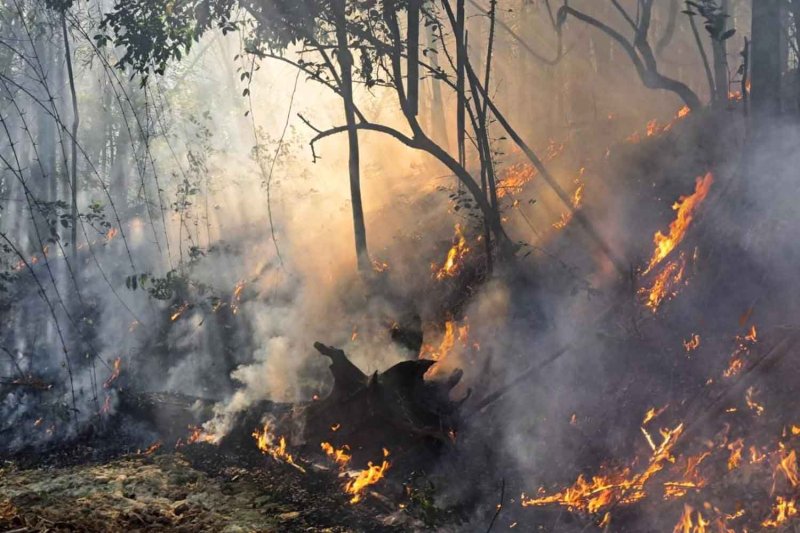
Hotspots were detected across northern Thailand during the last week of April as forest fires raged despite intensified efforts by authorities to bring them under control. Most fires were found in forest zones.
The Ministry of Natural Resources and Environment has come under criticism for its handling of the situation, placing Minister Suchart Chomklin under pressure.
The fires, which have taken months to subside, are polluting the air with fine particulate matter, putting millions at risk.
Mr Suchart said the main cause of the fires was human activity, including locals burning forest areas to forage for mushrooms and other wild plants.
Communities have rejected the claim.
Daecho Chaitup, president of the Sustainable Development Foundation, said only a small number of locals set fires in forests to gather food.
He said the ministry's ban on forest burning has created difficulties for villagers in managing their farmland, as boundaries between forest zones and agricultural land remain unclear.
"When there is no permit for fire use, hotspots increase in forest zones. The fire-ban policy paints locals as the culprits, when there should be a broader understanding that controlled burning may be necessary in some cases," he said.
Clearer demarcation between forest and farmland would allow communities to help monitor fires and establish local rules to prevent illegal encroachment and poaching.
He added communities could appoint their own guards to control fires within their areas.
Residents living in forest zones could also play a key role in reducing hotspots and should be encouraged to maintain good practices, he said.
A study by the Faculty of Forestry at Kasetsart University found that hotspots in 2023 were largely concentrated in forest zones, with 10% in conservation areas, 20% in community-use forest areas, and 40% in zones designated for future national park status.
Researcher Kobsak Wanthongchai said the findings highlight the need for improved forest fire management, including training, equipment and financial support for local communities.
Thailand has about 102 million rai of forest, half of which is deciduous forest, consisting of broad-leaved trees that shed their leaves during the dry season.
Forest fires are part of the natural ecosystem and can enhance soil fertility and provide food for wildlife, he said.
However, frequent or annual fires can damage forest systems, as young trees are destroyed, disrupting ecological balance.
"We can't stop forest fires, but we need to maintain balance. Right now, forest fires are out of control and too frequent, doing more harm than good," he said.
"A method of wildland fuel management should be seriously considered to limit the impacts of forest fires."
He added that public reaction to PM2.5 pollution caused by forest fires reflects growing frustration, sending a message to the government that people are running out of patience living in a toxic environment.
Experts say forest fires in the North have intensified due to unusually dry conditions linked to El Niño, combined with human activity such as poaching.
Vegetation burned in previous years has also fuelled further fires, contributing to their rapid spread.
Attapon Charoenchansa, chief of the Department of National Parks, Wildlife and Plant Conservation, said controlling illegal forest encroachment remains a major challenge. A ban on entry into forest areas may be imposed, he said.
"Those who set fires show no regard for the rules or the damage caused to the economy, public health and the environment. They should not be protected," he said.
He said these individuals are linked to forest fires they deliberately set for personal gain, particularly for collecting forest products and hunting wildlife.
Without strict law enforcement, the problem cannot be resolved and will continue unchecked.
Forest fires have become a major cause of annual forest loss, with illegal burning causing far more severe damage than fires associated with plantation farming, which are generally easier to control.
The department is responsible for fire prevention across 90.8 million rai of forest land.
This year, it received a budget of 858 million baht for the programme, of which 457 million baht has been allocated to hiring local communities to support fire prevention efforts.
