


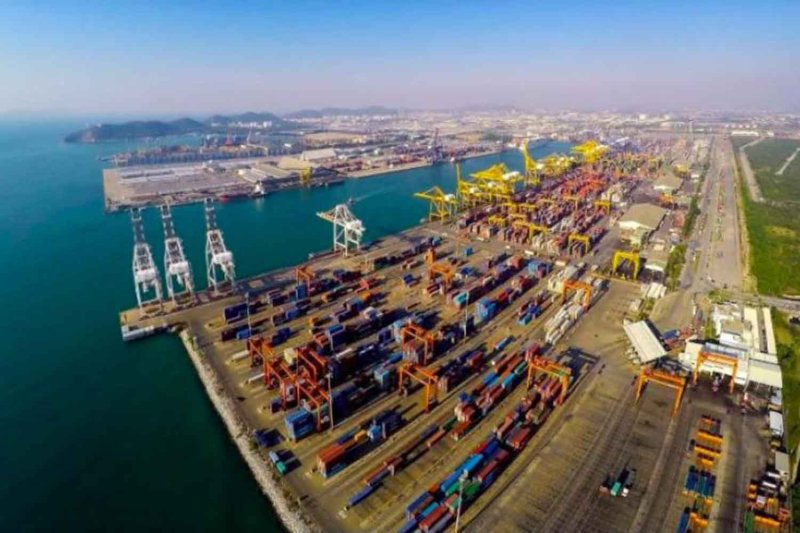
The proposed Land Bridge project has returned to the centre of national debate, with supporters hailing it as a potential economic game-changer and critics warning it could become one of Thailand's costliest and most environmentally damaging gambles.
The government has launched a fresh round of studies into the 1-trillion-baht scheme, which would create a transport corridor linking the Andaman Sea with the Gulf of Thailand.
Proponents say the project could reduce reliance on the congested Strait of Malacca and transform Thailand into a regional logistics hub, while opponents question its economic viability, environmental impact and political motivations.
Earlier this month, the government appointed a committee chaired by Deputy Prime Minister and Finance Minister Ekniti Nitithanprapas to conduct a review, with findings expected within 90 days.
Officials say the renewed process will improve transparency and allow broader public scrutiny. Yet despite official optimism, the project remains deeply divisive.
Government push
Deputy Transport Minister Siripong Angkasakulkiat said authorities were reviewing all aspects of the project, including environmental concerns, local livelihoods, land concessions and investment models.
One contentious issue has been the proposed lease period for private investors. Initial proposals for 99-year concessions drew criticism, prompting the government to revise the framework to an initial 50-year term with a possible 49-year extension.
Mr Siripong said renewals would depend on performance.
"If investors operate successfully for 50 years and everything performs well, naturally they should have the right to negotiate an extension," he said.
He said the state would not shoulder most construction costs, as the project would rely primarily on private investment through public-private partnerships.
The main state expense at this stage would likely be land expropriation, estimated at around 10 billion baht.
Before construction could begin, parliament would need to pass the Southern Economic Corridor (SEC) law, establishing the legal framework for investment incentives and land-use planning, he said.
Mr Siripong also floated the idea of local referendums rather than a nationwide vote, arguing residents directly affected by the project should carry the greatest influence over the decision.
Supporters believe the Land Bridge could open a major export route by allowing cargo to move directly between Thailand's western and eastern coasts, reducing shipping times and strengthening the kingdom's role in global trade networks.

Siripong: 'Authorities will review all aspects'
Economic doubts
Critics, however, remain unconvinced. Senator Norasate Prachyakorn, one of the project's most vocal opponents, said existing research raises serious doubts over whether the scheme can deliver meaningful economic returns.
He pointed to sharply differing assessments by two major studies. Research commissioned by the Office of Transport and Traffic Policy and Planning (OTP) forecast strong gains in GDP, employment and logistics competitiveness.
However, a separate study conducted by the National Economic and Social Development Council (NESDC) with Chulalongkorn University painted a far less optimistic picture.
According to OTP estimates, the project's economic internal rate of return (EIRR) could reach 17.43%.
By contrast, the Chulalongkorn study calculated an EIRR of just 1.24% -- far below the roughly 12% threshold generally expected for large infrastructure projects.
The university study also estimated a benefit-cost ratio of only 0.22, suggesting returns of just 22 baht for every 100 baht invested.
"That effectively means the project loses money," Mr Norasate said.
Critics have also questioned whether shipping firms would abandon established routes through Singapore and the Strait of Malacca in favour of unloading cargo on one side of Thailand and transporting containers overland to another port.
"The entire model depends on the assumption that shipping lines will choose to use the Land Bridge," Mr Norasate said. "But there is little hard evidence proving they actually will."
Rather than building entirely new deep-sea ports, the NESDC has suggested upgrading existing infrastructure, including Rayong port, which critics argue would provide stronger returns with lower financial and environmental risks.

Norasate: 'There are doubts about viability'
Environmental concerns
Environmental risks have emerged as another major fault line.
The project would affect an estimated 300,000 rai across southern Thailand, including large-scale coastal reclamation in Ranong and Chumphon, while transport corridors would cut through agricultural land, mangrove forests and sensitive marine ecosystems.
Thon Thamrongnawasawat, a marine expert, warned that sediment disruption from deep-sea port construction could spread beyond projected impact zones and threaten coral reefs and seagrass habitats.
"In Ranong, there are 2,924 rai of seagrass containing 11 species," he said, warning that Koh Payam could be particularly vulnerable.
Critics also fear the proposed SEC legislation could weaken oversight and allow excessive foreign control over land and resources, drawing comparisons with controversies surrounding the Eastern Economic Corridor.
"Local communities may lose their fishing grounds, natural resources and livelihoods permanently," Mr Norasate warned.
He also questioned whether the latest review process would be genuinely impartial, arguing key environmental assessments remain incomplete.
A national choice
As debate intensifies, calls are growing for broader public participation.
Mr Norasate has proposed a two-tier referendum involving both local communities and a nationwide vote, arguing the country's natural resources belong to all Thais rather than any single administration.
"This is not simply the property of the government," he said. "It belongs to the Thai people."

Thon: Warns of 'sediment disruption'


