


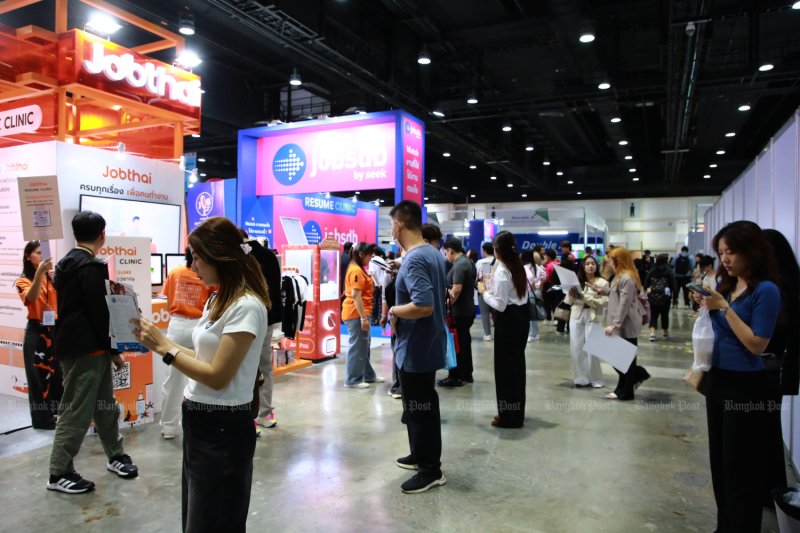
Since the widespread adoption of AI tools began in 2022, employment among workers aged 22 to 25 has decreased by 13%, according to a Stanford University study of younger generations of workers.
There are two groups of AI users. On one side are those who use it simply as a tool to complement their own abilities. On the other side are those who rely entirely on AI-generated output to complete tasks.
The Bangkok Post spoke with next-generation first‑jobbers across different fields of study and work in Thailand. Most said they use AI as a tool, not as a substitute for their entire work. While AI has capability and potential, they say it still cannot fully capture human experience or generate work that resonates emotionally.
“I mostly use it as a tool, usually within design apps. I don’t use AI to generate entire artworks. In this field, everyone still wants art to be human‑made,” said Junjaras Na Ranong, a 21‑year‑old graphic designer.
Nichapha Aittidetdumrong, 21, a portrait painter, said she never uses AI in her work, relying instead on traditional methods and references from various sources.
Chananan Karnjanaaree, 21, an international relations student, shared her perspective on her future career and how AI might fit in. “I use it as a tool for point evaluation, which is quite similar to the real scoring,” she said.
“But the overall AI‑generated task still doesn’t serve political logic, because politics requires reasoning and criticism in specific ways. So, replacing human labour with AI does not fit the political field yet.”
Employment implications
Many interviewees expressed concern about AI literacy and the risks of misuse. They agreed that even when used carefully, AI can still harm society in some ways, while acknowledging that companies are rapidly expanding adoption and replacing human labour in certain areas.
With some already entering professional careers and others soon to be first‑jobbers, how do they think AI will affect job opportunities?
“No matter how advanced AI becomes, humans are still better at emotion and feeling,” said Ms Chananan.
“A diplomatic job requires observing people. AI can’t detect actions or predict which country will benefit most from negotiations,” she added.
“Human analysis is still superior in real situations. Sharing a meal or negotiating with a country’s leader must still be done by humans.”
Nursing student Chonticha Khunkrai, 22, is not worried about her employment prospects. “There is no AI displacement effect in this field because we must care for patients’ bodies, minds and emotions,” she said.
A report from Markets and Markets noted that leading medical organisations worldwide are introducing AI into healthcare. However, it is concerning that AI could increase nurses’ workloads, as they would need to manage AI assistants while still delivering patient care.
Ms Chonticha added that medical practice requires constant learning, such as adapting treatment methods. “If hospitals use AI, I hope salaries will remain stable or even increase,” she said.
In the language field, students interviewed said AI still lacks qualities needed for translation and teaching.
“The translated results from AI might trigger sensitive or historical issues. Humans are still better translators because they bring emotion and real‑world knowledge,” said Sakunkan Yodpaka, 21, a Chinese language student.
Suphasin Khwansathaphonkun, 21, who hopes to become an English teacher, said: “I want to be a teacher to improve students’ lives — mentally, educationally and personally.
“I recently spoke with a student with autism about their struggles, and I believe AI cannot truly understand mental disorders, backgrounds or human feelings.”
Engineering insight
“We cannot deny that AI use has become normalised, and companies definitely want to hire humans who can use AI,” said Kankavee Buama, 21, an industrial physics student.
He said that industries, however, still need human engineers and scientists because AI cannot yet handle entire operations, especially with policies and regulations that change weekly and require rapid enforcement.
At an international AI exhibition held in Thailand on June 9, Dhanawat Suthumpun, managing director of Microsoft for Thailand and developing markets, said that Thailand is adopting AI at the fastest rate, with a white‑collar worker adoption rate of 32% — double the global average of 16%.
There is undoubtedly a threat to first‑jobbers as AI grows rapidly and encroaches on human work fields.
One plausible way first‑jobbers say can help them survive in the new AI world is by upskilling and keeping a human signature in their work. To avoid being outperformed by artificial intelligence, they should be intelligent humans themselves — developing skills just as human developers refine AI.
“To gain opportunities as a first‑jobber, you must also maintain the human touch in your work,” said Ms Nichapha.
