

The delicate art of balance
Chantsuda Thananitayaudom
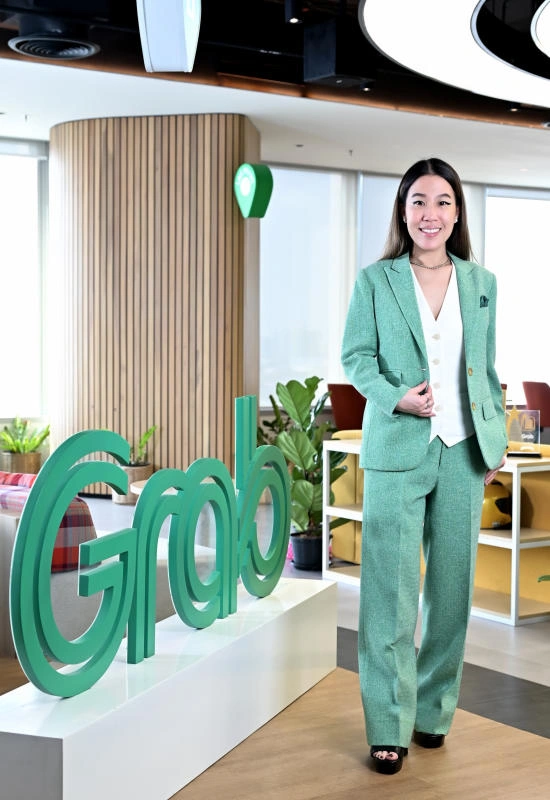
In the high-stakes arena of Thailand’s on-demand economy, leadership is often measured in market share decimals. But for Chantsuda Thananitayaudom, country head of Grab Thailand, the true metric of success is far more profound: the delicate art of "balance".

Since taking the helm on April 1, 2025, Ms Chantsuda has navigated the company through a highly competitive landscape where rivals never stopped attempting to surpass the incumbent, and maintaining the top spot is harder than reaching it.
According to data from Singapore-based research firm Momentum Works, the Thai food delivery market surged from US$4.2 billion in 2024 to $5.1 billion in 2025.
Within this expanding pie, Grab secured a commanding 47% market share, while its closest competitor, Line Man, followed at 41% — both players managing to increase their share by one percentage point year-on-year.
Having joined Grab in 2018 as country marketing head, she was the strategic architect behind the brand’s local identity.
BARBELL STRATEGY
"In an increasingly competitive on-demand market, our strategy is anchored in continuous innovation," Ms Chantsuda said.
She said consumer lifestyles are evolving rapidly, and expectations are higher than ever.
"We invest heavily in technology and data utilisation to understand behavioural shifts, anticipate emerging needs, and solve obstacles," said Ms Chantsuda.
"As an industry leader, Grab Thailand focuses not only on launching new solutions but also on consistently improving service reliability, affordability, and user experience to maintain trust in our platform. We also apply what we call a barbell strategy — maintaining balance across key priorities," she said.
First, the company balances affordability and quality. In today’s softer economic environment, consumers are more price-conscious, but reliability and service standards cannot be compromised.
Second, the company balances business-to-customer and business-to-business growth.
The company is also expanding enterprise solutions to ensure diversified and sustainable revenue streams, Ms Chantsuda said.
Third, the company focuses on ecosystem balance. She said long-term leadership is not about short-term gains; it is about ensuring that users, drivers, merchant-partners and the platform grow together in a sustainable and mutually beneficial way.

LEADER'S MINDSET
Despite the pressure of steering a tech titan, Ms Chantsuda remains grounded, crediting her resilience to a disciplined mindset of gratitude and reflection.
"In a highly competitive and fast-changing environment, pressure is inevitable. I have learned to focus on what I can influence, execute well and make a small win each day, rather than being distracted by factors beyond my control," said Ms Chantsuda.
She said every experience — whether a success or a setback — offers valuable lessons. When things do not go as planned, she sees them as opportunities to learn, improve and return stronger.
"At Grab, we view competition positively. Healthy competition drives innovation, expands the industry and ultimately benefits consumers."
She said on a personal level, maintaining resilience starts with mindset.
"I begin each day with gratitude — appreciating the people around me and the experiences that shape my journey. I also make time for reflection, reviewing what I have learned and how I can grow further."
"Spending time in nature, whether by the sea or in the mountains, helps me recharge, gain clarity and maintain balance. Those moments allow me to pause, refocus and return with renewed energy," Ms Chantsuda said.
While food delivery and mobility remain the bedrock of the business, Ms Chantsuda sees a horizon that stretches far beyond the next meal.
With food delivery penetration in Thailand at nearly 20% compared to the near-universal reach of household goods, she sees a massive "convenience gap" waiting to be filled.
"The market is far from mature," she said.

While reports like e-Conomy SEA 2025 forecast the online transport and food delivery sector to grow 15% year-on-year, Ms Chantsuda views these figures as conservative.
She said Grab sees strong growth momentum in related services such as groceries, quick commerce, financial services and enterprise solutions.
"Diversifying and strengthening these verticals ensures we maintain a healthy and balanced portfolio, while capturing long-term growth opportunities across the broader digital economy."
Over the past 12 years, Grab has become part of everyday life in Thailand. According to a recent study by the Thailand Development Research Institute, Grab’s operations in Thailand generate both direct and indirect economic contributions of 179 billion baht — equivalent to around 1% of GDP.
"In 3-5 years, we aim to significantly expand our economic contribution to Thailand — not only in scale, but also in quality," Ms Chantsuda said.
Grab will do this by leveraging technology, including AI, to strengthen its operations and growing core services while expanding adjacent offerings that respond to evolving user needs.
It will also empower small businesses and create more sustainable earning opportunities across the country, alongside initiatives that support upskilling and reskilling, she added.