


Myanmar’s junta leader Min Aung Hlaing moved closer to the presidency after a lower house nomination on Tuesday, paving the way for the military to extend its rule following elections criticised by the United Nations and others as a sham.
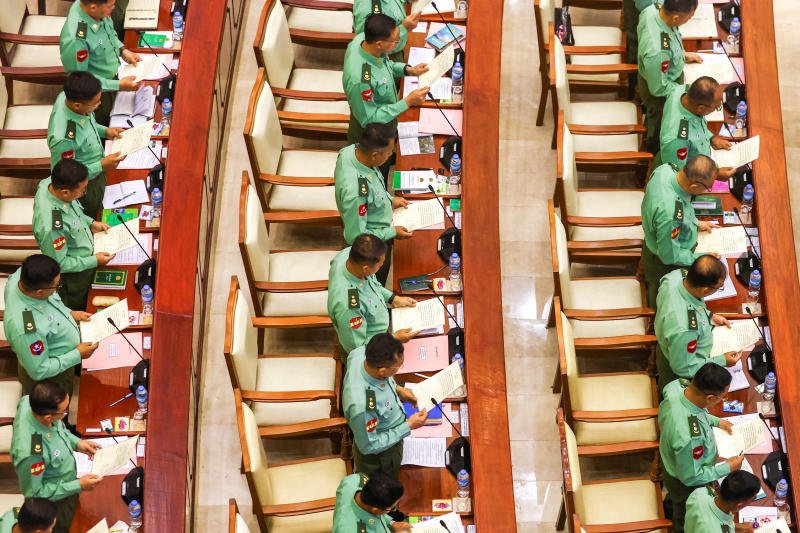
The 69-year-old junta leader secured the lower house nomination for vice president in a chamber dominated by the military-backed Union Solidarity and Development Party that won an overwhelming majority in the elections concluded in January. He stepped down as commander-in-chief on Monday, according to state-run media, ahead of a presidential vote because the 2008 constitution bars the president from holding a military post.
Gen Min Aung Hlaing won 247 out of 260 eligible votes, while his rival, Kyaw Swe of the National Unity Party, received 10 votes, according to a live broadcast.
Myanmar has been in turmoil since Gen Min Aung Hlaing led a military coup in 2021 that ousted Aung San Suu Kyi’s civilian government, with conflict spreading across much of the country and nearly half the population now living below the poverty line. Loyalists and former generals dominate both chambers of parliament, where the military holds a quarter of the seats, giving Min Aung Hlaing a clear path to the presidency.
The next step is for parliament to vote among nominees from the lower house, upper house and the military to elect the president and two vice presidents for the new term starting in April. A president is expected to be named by Friday, with the incoming government set to take office before the water festival holidays begin on April 11, according to lawmakers.
The election, held in phases in military-controlled areas, has been widely criticized by Western governments despite praise from China. There were no polls in parts of the country controlled by rebels, while Suu Kyi’s National League for Democracy, which had landslide victories in 2015 and 2020 elections, was banned.
Ethnic parties had little choice but to align with the military and its allies, said Sai Tun Lin, a lower house lawmaker who is also a joint general secretary of the Shan and Nationalities Democratic Party.
“If he takes the presidency in contrast to his pledge to transfer power after the election, the international community won’t change its perspective on Myanmar,” he said, referring to the junta chief.
