 Listen


 Facebook
 Reddit
 Copy Link


ANTALYA, Turkey — As world leaders begin addressing the United Nations (UN) climate summit Wednesday in Antalya, Turkey, 197 nations will be represented. From Albania to Zimbabwe, heads of state and governments and top ministers will commit to the global goal of a liveable planet.
But not the United States.
For the second year in a row, the most powerful country on Earth and the largest contributor of planet-warming emissions in history has refused to participate in the global effort to slow climate change.
US President Donald Trump, who called global warming the “greatest con job ever perpetrated on the world,” withdrew the United States from the 2015 Paris climate agreement and stopped sending American delegations to the annual negotiations, known this year as COP31.
The United States is no longer trying to reduce its greenhouse gas emissions, has cut support for scientific research into global warming and halted funding to help vulnerable countries cope with the impacts of climate change.
That has left the rest of the world scrambling to fill the vacuum.
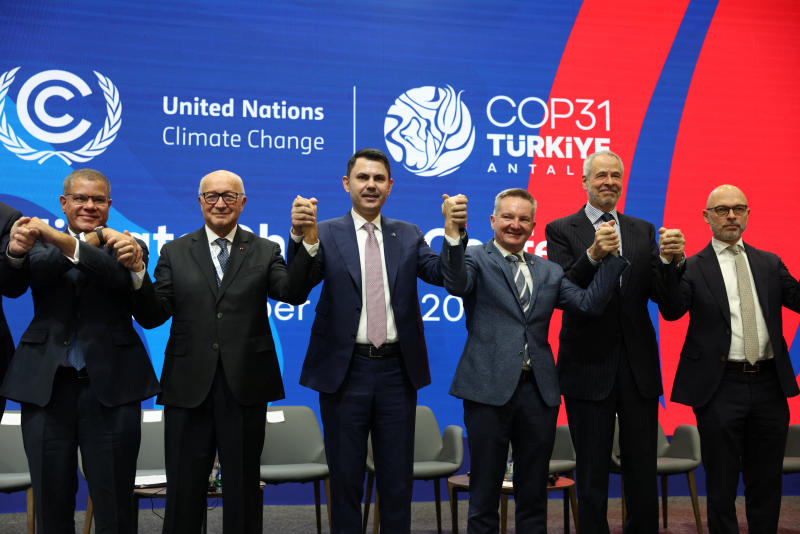
COP31 President Murat Kurum poses with former COP presidents Alok Sharma of COP26, Laurent Fabius of COP21, Andre Aranha Correa do Lago of COP30 and Michal Kurtyka of COP24, and COP31 President of Negotiations Chris Bowen, at the UN Climate Change Conference (COP31) in Antalya, Turkey, Nov 10, 2026. (Photo: Reuters)
“Look, whenever the mic was on, and it was the turn of the US to speak, we all listened,” said Yaw Bediako Osafo, a negotiator from Ghana who is leading a group of African countries in the talks. “Now the world’s superpower is pulling out and saying, ‘Well, we’re not going to be involved.’”
The political climate in the United States changed abruptly last week, as Democrats dominated the midterms. The new Congress controlled by Democrats will have limited power to enact climate policies with Trump still in office. But Democrats said they intend to rein in the Trump administration, which has promoted fossil fuels and waged attacks on the clean energy industry.
“There does seem to be some positive messages coming out of the US recently,” said Tina Stege, the lead negotiator for the Marshall Islands, whose low-lying atoll country is threatened by rising sea levels.
Some are already looking ahead to the possibility that, if a Democrat were elected president in 2028, the United States might return to the UN climate negotiations.
“If what was manifested in this election continues, we’re going to elect someone who really wants to get something serious done on climate,” said John Kerry, who served as the US climate envoy in the Biden administration.
Kerry said he believed other countries would welcome the return of the United States, as long as “there’s no arrogance and there’s a readiness to work.”
Taylor Rogers, a White House spokesperson, said: “The United States is focused on common sense, not climate nonsense. The Trump Administration will continue to work with our allies around the world to restore energy abundance and unleash affordable, reliable, secure energy sources.”
While China, the world’s largest present-day emitter, leads the world in the manufacturing and export of renewable energy technologies, Beijing has not stepped forward to fill the space vacated by the United States.
Some countries such as Britain and Japan have pushed forward with plans to drive down greenhouse gases.
But others have backtracked. The European Union (EU) has softened its targets for phasing out gasoline-powered vehicles, proposed slowing some of its emissions reductions and weakened some methane rules. New Zealand last year sharply lowered its reduction target for methane, a powerful planet warming gas. Brazil has moved to expand offshore oil drilling.
And under Prime Minister Mark Carney, Canada has scaled back some of its ambitious climate initiatives over the past year. The country abandoned a federal consumer carbon fuel charge and cancelled plans to put a cap on greenhouse gas emissions from the oil and gas sector.
“I don’t see a real clear leader,” said Ilana Seid, Palau’s ambassador to the UN. “Countries are distracted from what used to be kind of a north star for all of us.”
Several people said when the world’s largest polluter is doubling down on fossil fuels, it makes it easier for other polluting countries to downplay climate change.
“When the US stands up and stands tall and assumes that moral leadership, many things follow,” said Swarnim Waglé, Nepal’s finance minister. “With perceived withdrawal, other countries also retreat.”
Yet some said they were glad the United States was absent. At previous climate summits, the Trump administration had been an impediment to progress, they said. During Trump’s first term, his administration promoted coal at the climate talks.
“Under this administration it’s better that they’re not here,” said Rachel Cleetus, director of the climate programme at the Union of Concerned Scientists. “We’ve been such an unreliable partner in this space.”
Still, many Americans are participating at events at COP31, including foundations and nonprofit groups based in the United States as well as current and former Democratic politicians and policymakers.
California Governor Gavin Newsom, a possible 2028 presidential candidate, is arriving on Thursday, along with Minnesota Governor Tim Walz, according to several US officials. Al Gore, the former vice president, is speaking at events on the sidelines.
Gina McCarthy, the White House climate adviser during the Joe Biden administration, is leading a contingent of 120 US officials including mayors, governors and business leaders. About 19 House Democrats also are traveling to Antalya, led by Representative Sean Casten of Illinois.
McCarthy said her group wanted to send the message that most Americans still care about climate change. She said that message got a little easier to deliver after the midterm election.
“Hopefully, the rest of the world will feel less anxious about whether the US can pull itself out of this administration and get back to the level of work that we all expect,” she said.
Senator Sheldon Whitehouse, a Democrat from Rhode Island, planned to attend and said it was important to show up.
“America gets enormous advantages from having a primary and respected role in the international community,” he said. “When we choose not to engage on an important matter like this, we just squander all of those opportunities.”
This article originally appeared in The New York Times.
