 Listen


 Facebook
 Reddit
 Copy Link


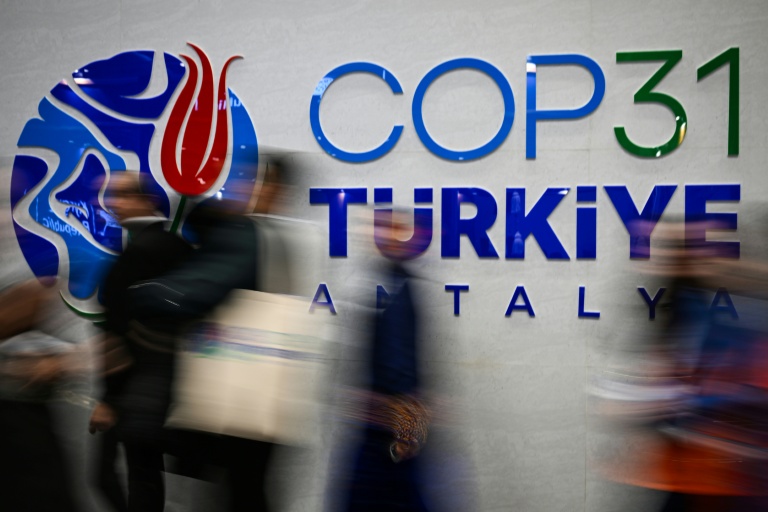
ANTALYA (TURKEY) - From traffic chaos to Venezuela defending oil and the return of activist Greta Thunberg, take a look at what happened Thursday at the COP31 summit.
The UN's annual climate conference, which started on Monday, runs until November 20 in the Turkish Mediterranean resort city of Antalya.
- Disruption -
The conference has been plagued by transport problems, with events forced to be cancelled due to delayed arrivals and missing delegates.
The disruption continued on the second and final day of the leaders' speeches on Thursday, with attendees stranded due to a lack of available transport.
"This is not just civil society. It's also affected delegates, the negotiators," Tasneem Essop, executive director of the Climate Action Network civil society alliance, told AFP.
"You can imagine people sitting on buses for five hours is just unimaginable. It's had a huge impact on the work inside, especially when delegates are supposed to be in meetings, in negotiations."
- Climate security -
Britain already has a climate minister, Katie White, but Prime Minister Andy Burnham told fellow world leaders that he had appointed a special envoy focused on climate security.
"Climate is a national security issue," said Burnham.
"As evidence of that," the prime minister said, he appointed Madeleine Alessandri, the former head of the UK's Joint Intelligence Committee -- the body that briefs ministers on security threats -- to the post.
While countries often have climate envoys whose roles include climate security, Britain is the first to establish a separate job focused on the issue, said Cosima Cassel, an expert at climate think-tank E3G.
"This appointment elevates that issue to the level it deserves, and other governments should consider a similar model," Cassel told AFP.
- Venezuelan oil -
While Brazil has been promoting a global roadmap for countries to transition away from fossil fuels at COP31, Venezuela's interim president, Delcy Rodriguez, defended her country's "sovereign right" to develop its oil industry.
"We believe there is no inevitable contradiction between energy development and environmental protection, because a just transition does not shut down economies -- it transforms them," Rodriguez said in her speech.
Rodriguez was appointed acting president after US President Donald Trump sent troops into Caracas to capture the country's leader, Nicolas Maduro, in January.
In September, Venezuela signed a massive oil deal with Washington, giving it access to more than 65 billion barrels of oil -- almost 20 percent of Venezuela's proven reserves.
- Blowing past 1.5C -
COP31 was given a fresh warning that global temperatures were likely to blow past the world's target of limiting global warming to 1.5C above preindustrial levels.
The planet is heading towards an "irrecoverable overshoot" of 1.5C unless governments rapidly cut emissions and abandon their support for the fossil fuel industry, according to Climate Action Tracker, an independent scientific monitoring group.
Nations agreed at the 2015 UN climate talks in Paris to keep global warming "well below" 2C above pre-industrial levels, while pursuing efforts to limit it to 1.5C.
But the United Nations declared in September that the long-term 1.5C target would be missed in a matter of years.
- Thunberg back -
Greta Thunberg, who had not attended a UN climate summit in years, warned that the climate crisis was "already a matter of life and death".
"The planet is not dying, it is being killed," the Swedish activist told reporters, a day after calling the annual gathering a "greenwashed circus".
Few major breakthroughs are expected at COP31 as countries face an energy crisis and geopolitical tensions in the wake of wars in Iran and Ukraine.
Thunberg also used her appearance to urge COP31 host Turkey to impose an "energy embargo" on Israel as the transfer of oil from its territory was "directly fuelling the genocide of Palestine".
For years, Azerbaijani crude oil has been transported through a pipeline to the Turkish Mediterranean port of Ceyhan, where it is loaded onto tankers, including those bound for Israel.
Turkey has suspended trade with Israel over the war in Gaza, but NGOs and the opposition say oil is still transiting to Israel.
Turkish authorities deny that any oil destined for Israel passes through its ports.
